After Pompeii, we mostly roamed around Naples, wandering into churches, eating in various restaurants, and browsing through the streets.
Just a short walk from where we stayed on Via Duomo was Cattedrale di San Gennaro, which was one of the churches we wandered through while it poured down rain, giving us a break from the wet. Cattedrale di San Gennaro is a Roman Catholic cathedral and the seat of the Archbishop of Naples. It was finished in the 14th century. The artwork on the ceiling, dome, and altar are stunning.
We walked down toward the waterfront one day to find a gluten free restaurant we’d found online. We all loved this one street that was just very picturesque in the middle of such a large city
Picturesque street
Laundry hanging as decor in a restaurant
One of my fun finds. I love Bialettis, and this one is huge! Not to mention great for Christmas 🙂
We also took the Naples Underground tour, which is fascinating. You descend into the first tunnels and your guide takes you through discussing the history from WWII to the Romans, even the Roman theatre that is mostly buried beneath the houses that now stand in this part of central Naples. In the picture below, they were studying various plants and how they grow underground. The guys above ground while you wait for your tour are rather rude, but stick it out. It was very entertaining.
Overall, we really enjoyed Naples, though Herculaneum and Pompeii were the best parts of the holiday. We did enjoy some aspects of the city, but it made me sad how much trash was around the city, big piles surrounding dumpsters. It really detracts from how lovely it is.
Ever since I took a class on the Bronze Age in the Aegean, I’ve wanted to go to Pompeii and Herculaneum. Of course, that usually means a trip to Naples. Having been to both Rome and Venice, I thought I knew what traveling to Italy would entail: good food, friendly people, and a lot of walking. I was right on some of it.
Before traveling to Naples, I researched the different ways of going to where we would stay to find the least expensive. In the end, we opted to use a service called the Alibus, which takes you to the Central train station for 5 euros/person. There are five of us, so it was definitely more cost effective than hiring a car, which was a minimum of fifty. From the Central station, the walk wasn’t too bad, so that was our plan.
First, it took us a bit to find the Alibus stop. If you don’t like crowded buses, then be prepared, because it is. You pay for your passage on the bus, which was very convenient. The drive into Naples didn’t take long and we were let off just near Central Station. Of course, Google Maps took us this roundabout route, and during the walk, we learned quickly you have to be very careful of drivers in Naples! In Rome, the traffic is insane, but the cars are pretty conscientious of pedestrians, not so much in Naples! When we reached the flat where we were staying, the woman who worked for the agency giggled and giggled and said we were crazy. We still hadn’t quite comprehended how bad it was until we walked a bit more. We understood her giggles completely by the time we returned home. Especially after a driver decided to skim close to my seventeen-year-old daughter and hit her with his wing mirror while they attempted to cross the street.
Once we were settled, we decided to grab a quick bite at a coffee shop a few doors down before we attempted to catch the train to see Herculaneum before the end of the day. Admission to Herculaneum stops at five p.m., so we thought we had plenty of time.
We purchased our train tickets on the Circumvesnia to Ercolano and found the platform easily. Then, we sat and sat. According to the internet, the train was on a certain schedule. If that was supposed to be the schedule, then the train was really late. That wasn’t the only time, however. We learned that you could never go by the online train schedule around Naples. The trains ran on their own schedule.
We made it to Ercolano with five minutes to spare. Unfortunately, we didn’t make the walk downhill in time, so we just missed the last admission. We took a few pictures from the walkway above and took the train back to Naples to hunt for dinner.
The next morning, we ate breakfast, had a quick coffee at the same cafe as the night before, and caught an earlier train out to Herculaneum. This time, we were one of the first admitted inside and didn’t have a big crowd while we took in the ruins, the artwork, and just the overall scope of the place. Most people want to see Pompeii, but there are several great reasons to go to Herculaneum as well.
Less of a crowd!
Herculaneum was unearthed after Pompeii and is better preserved.
While touring, you’ll see people working to restore and preserve what is there.
Herculaneum street
Original wood in a wine shop
Neptune and Amphitrite
A Thermopolium where it is believed food was sold
Herculaneum with Pompeii in the background
We spent several hours walking around Herculaneum, which is situated between Ercolano and about a mile or so of coastline before the sea, and were awed at the mosaics preserved within structures such as the bath house and another home where crews were actively restoring the mosaics as well as the frescoes. They even made us wear paper covers on our shoes so we didn’t damage their careful work.
Mosaic in the female bath house
Squid
Octopus
What has been unearthed is amazing, but it’s even crazier when you realize how much of Herculaneum is still buried under the town of Ercolano. The unearthed section is quite small when you consider this was a city of 4-5,000 people. Seeing the original wood still intact in some of the structures and the mosaics is well worth the time—even in the rain! We spent several showers in certain structures before we could walk around again and enjoy the site.
Restoration in progress
Bootied feet!
Like a welcome mat
Another great mosaic floor
Horses in relief
Skeletons in the boat houses
When we left Herculaneum, we walked back up the hill to the train station. Restaurants in some European cities will have someone outside whose sole job is to get people inside to eat. When you stop in Ercolano, the restaurant just outside the train station is terrible about it! The man whistled at my underage daughter trying to get our attention. He didn’t seem to care that I was furious, only that he had my attention. Needless to say, we didn’t stop to eat and boarded the train in the direction of Pompeii.
Next up … Pompeii and the rest of our trip to Naples!
I’ve always wanted to spend countless time wandering the art museums of Paris. I didn’t get into all of them, but I did make the Louvre!
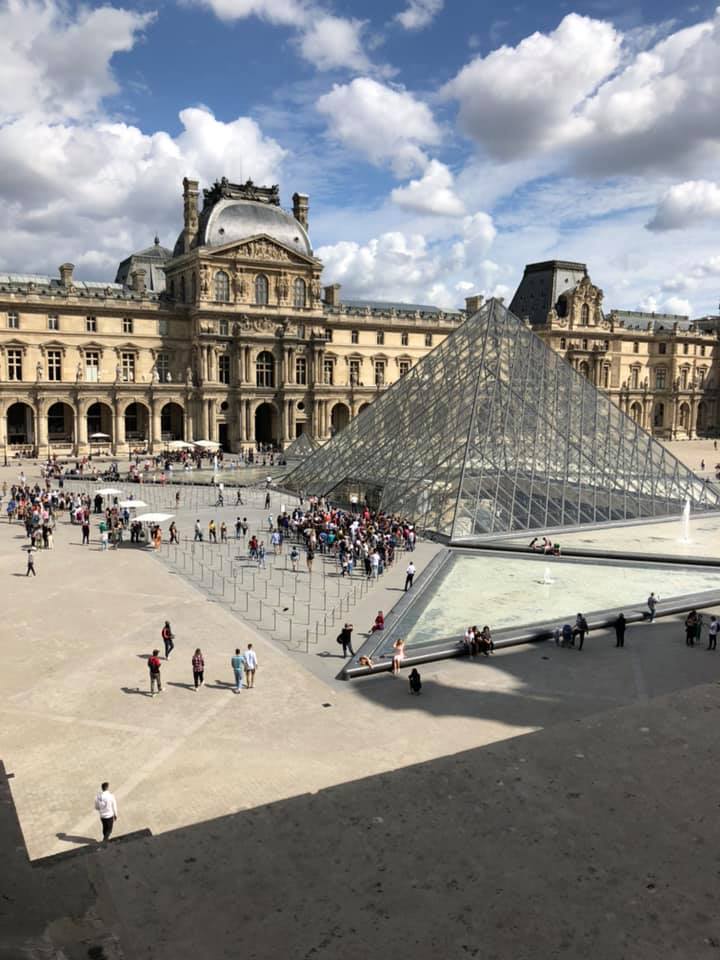
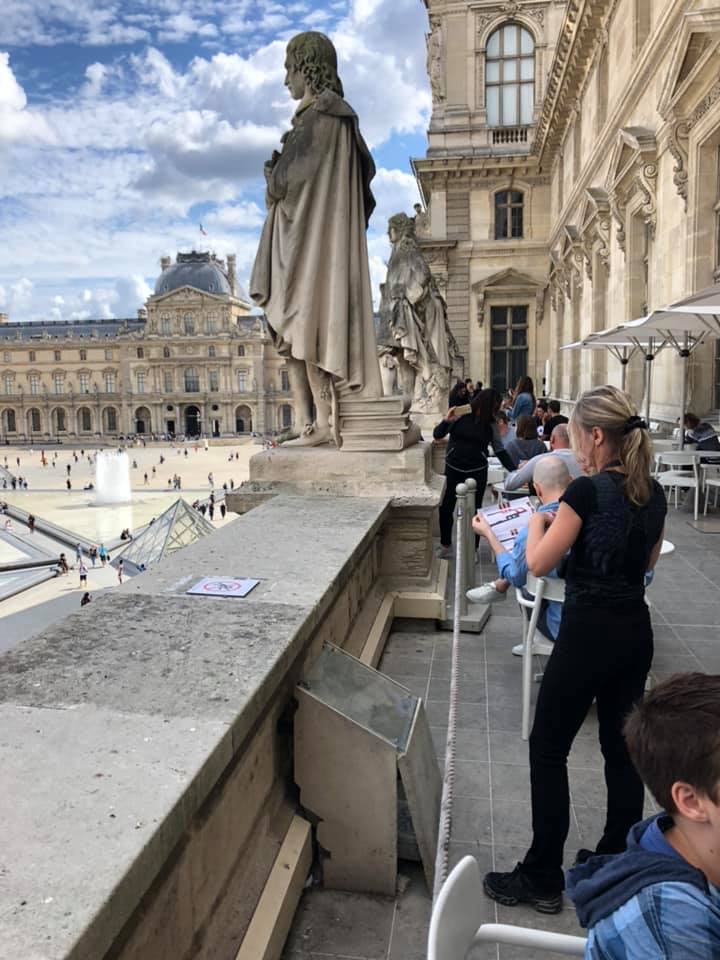
The largest art museum in the world, the Louvre is situated on the Right Bank of the Seine and was very close to where we stayed while we were in Paris. The Louvre was once a Palace until Louis XIV moved to Versailles in 1686.
Now, the Louvre holds an amazing amount of artwork as well as being it’s own work of architecture when you take the time to look at the outside.
We purchased our tickets in advance. I’ve heard enough stories of people planning to go on the one day of the week the Louvre is closed, not to mention the crazy lines to get in, so we made a point of showing up with ours in hand. Happily, the Louvre does not charge for children, so only my husband and I had to pay admission.
After the usual security checks, we were shunted inside and up a huge escalator to the top floor of the Denon wing where you stand in line until you find yourself in front of the Mona Lisa, set up from the rest of the artwork, and the guides repeating over and over again, “One photo and you go.” Rarely does anyone adhere to that rule before they are shooed into the rest of the Louvre by the guides.
When you leave the Mona Lisa, you walk through a door into the remainder of the top floor (Sully and Richelieu wings). Be aware that you cannot access the Denon wing again unless you return to the ground floor. My advice is to see what you want in the Denon wing on your way up to the Mona Lisa, then work your way through and down the Sully and Richelieu wings. That way, you don’t have to figure out how to return like I did to see Vermeer’s Lacemaker.
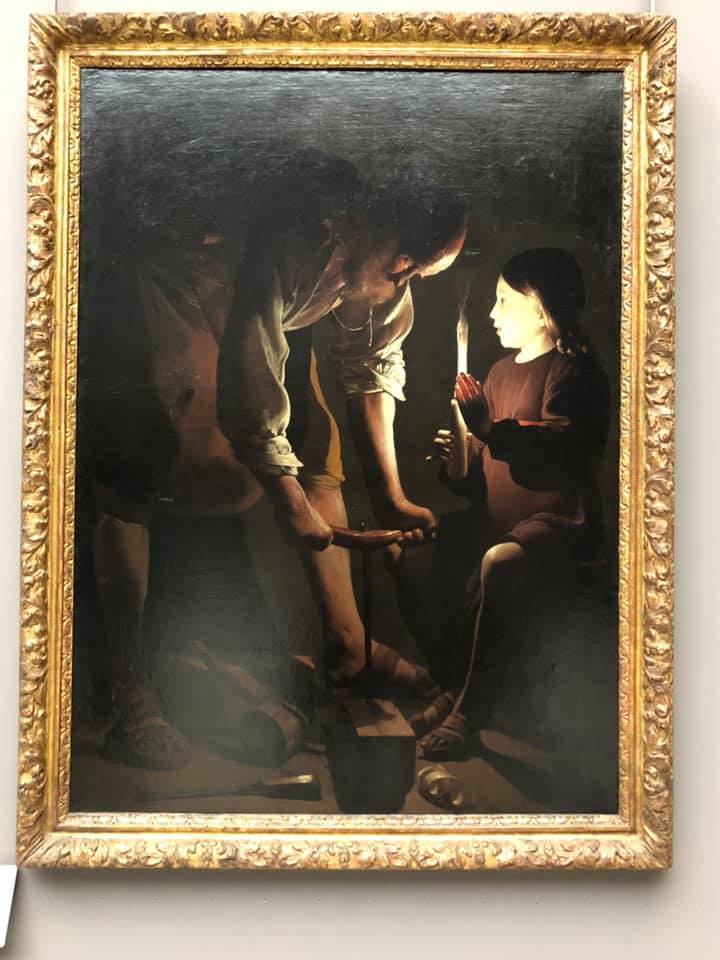
I love how you can see the light through Jesus’ fingers!
That advice given, the Louvre is enormous and unless you have several days to take your time, you almost have to walk through taking glimpses for works you know or works that catch your eye. The staff will let you know where works are if they know them, and most of the major works the Louvre has are indicated on the map. It’s a maze of wonderful things to see and I enjoyed the entire experience—even when my children were done by lunch and wanted to leave.
The Louvre has something that will speak to your soul if you take the time to search for it. I never know what I’m searching for when I go to an art museum. I definitely have certain works I want to see, but I’m always caught by some work that either by beauty or something technical draws me in. The Louvre was no different, just be prepared to be tired and have sore feet at the end of the day!
From Strasbourg, we made the short trek to Reims, our last stop on our Christmas market tour. Upon learning that the Reims area is famous for Champagne and the Champagne houses, we decided to see what all the fuss was about before we checked into our accommodations and set off for the Christmas market.
After researching the local Champagne houses, we decided on Tattinger. I’d read some wonderful reviews of their tour so I went to their website and booked everything there, which was super simple and quick.
We were a bit early for our 1:00pm tour so we found food and snacked before we checked in for the tour. We didn’t wait long before our tour guide appeared to usher us into the first room where we watched a brief video on the history of Tattinger champagne before he led us out and down into the tunnels under the Champagne house.
Reims was once a huge chalk mining town so underneath the city is approximately 200-250 km of tunnels that are now used as wine cellars for Champagne. These tunnels were also used as refuges for the citizens of Reims during the world wars, giving them a place to hide from bombing raids. In WWI alone, nearly 80% of Reims was destroyed by bombs. During the tour, it’s easy to spot graffiti left behind during the wars.
Remains of the Abbey
Staircase from the Abbey
The tour was extremely thorough, teaching the exact process of how Champagne is made and taking us through the different cellars all the way down to the lowest cellars which were chalk mines dating back to the 4th century. These caverns are 60 feet below the surface and are incredible to see. It’s no wonder the caves are a UNESCO World Heritage Site since they’re steeped in so much history.
4th Century Chalk mine
ceiling of 4th century chalk mine
Tattinger Champagne House is also built on the ruins of the St. Nicaise Abbey which originated in the 13th century and still has old staircases and embellishments from that original structure. The monks who lived there also made wine so the site is steeped in history when it comes to the tradition of making wine.
When the tour ended, we enjoyed our glasses of Champagne before we found the flat where we were staying the night. Once we settled in, we walked a mile or so to the town centre for the Christmas market.
Unlike Strasbourg and the German markets, the Reims market wasn’t spread around town but was isolated around the amazing cathedral. After clearing the security checkpoints, we wandered all through and toured the cathedral while we were there. It’s a beautiful Christmas market with lots of wares and great food to sample. The location really made it magical but all of the Christmas markets we visited had their own charm.
We roamed until we were tired and walked back to the flat. The next day we drove to the Eurotunnel and left France behind so we could spend Christmas Eve and Christmas day at home. It was a long trip but worth it to see the mixture of European Christmas markets. I want to do it again but maybe not so many in one go! It made for a long trip.
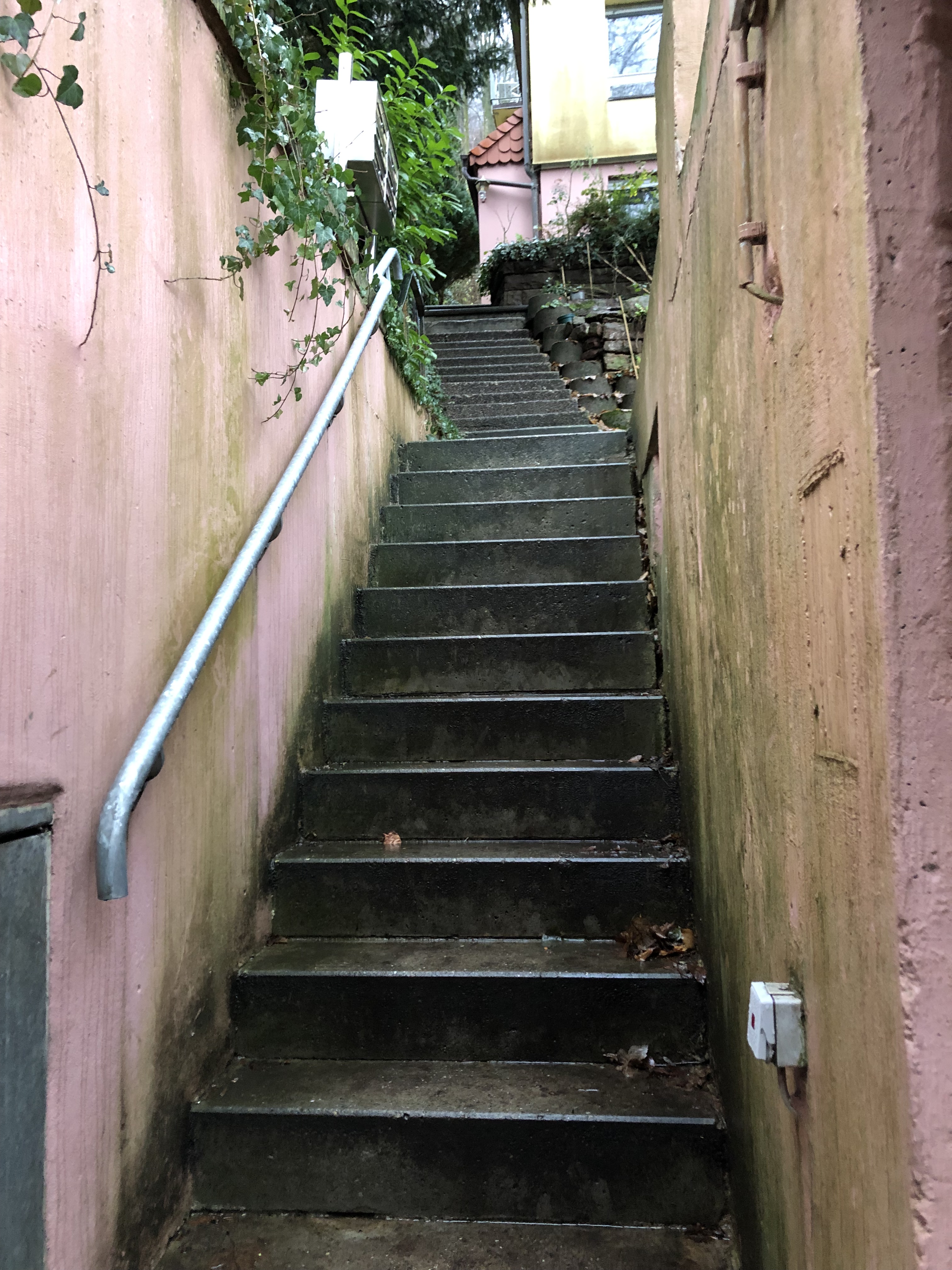
From Cologne, we drove a short way to Heidelberg. Because of the morning we spent in Cologne, we arrived in Heidelberg close to dinner time and checked in to the small cottage where we would be staying. When searching for accommodations, I found a small Airbnb just up the hill from the town center, which had a forest in the cabin feel and a great view. As much as I loved the space, the climb up the stairs was a workout! You definitely didn’t need the gym when you stayed there! (There are more steps going up that you can’t see in the picture!)
Heidelberg is a town in western Germany and home to one of Germany’s oldest universities, Heidelberg University (founded in 1386). Located in the Rhine Rift Valley, Heidelberg is surrounded by the Königsstuhl and Gaisberg mountains. Heidelberg is divided into six sections of town, with the Christmas market being located in the Altstadt, or the old town center.
We headed down the hill before it got dark, quickly finding the first section of Christmas market, which was nearly a straight line from where we were staying. Heidelberg is a With the mountains surrounding us and the castle seemingly watching over from the hill across the river, it makes for a scenic and amazing backdrop to the festivities.
We browsed the stalls, drank Gluwhein, and even looked around a comic book store while moving from one square to another. My children wanted to ice skate, but unfortunately, the weather was warmer in Heidelberg than it was in Gothenburg so the ice was slushy so they didn’t enjoy it nearly as much. Kind of a waste of money for the skates since they used them probably 15 minutes and decided they were done.
Heidelberg’s Christmas market is smaller than Cologne, but no less special. Honestly, I preferred it with the smaller crowds and the scenic atmosphere. It had its own magical quality and is not to be missed.
The drive to Denmark had been rainy and sometimes had a little snow but we made it in the early evening to our hostel. This hostel was a good bit different from the first. The rooms were considerably smaller and my children described our beds as eggs. It wasn’t uncomfortable, but I did like having the extra room of the first hostel but we were only there one night.
The hostel staff informed us that there were three Christmas markets within walking distance. We found the closest, which like Gothenberg, appeared to be in another amusement park, and also charged an admission. Unfortunately, the entry was once again rather costly and didn’t include any rides.
The Santas I’d so loved in Sweden changed in Denmark, having more of their faces showing than Sweden. I wasn’t as big of a fan of them as the ones in Sweden, but I did love some of the Christmas ornaments I found along the way and purchased a few of those instead of Santas. The toadstools were a common ornament we found and I thought they were really cute. My husband wasn’t too sure, but I bought them anyway 😉
We walked the stalls and enjoyed Gluhwein and Grog, which was still lovely, though contained alcohol since we were no longer in Sweden. The atmosphere was beautiful with the flocked trees and Christmas lights. I think we walked the entire market just to see everything. The only drawback was somehow one of my daughters got flocking all in her coat. When we returned to the hostel, it ended up all over the floor and my bed since she had the bunk over mine.
We did go to bed a bit early since our longest drive of the trip was the next day and we needed to get an early start. Nine hours and one ferry ride between Denmark and Germany would get us to Cologne and an entirely different Christmas Market Experience.
From Rock of Cashel, we continued driving west to County Kerry where we toured for two days. We stayed in a great Airbnb home near Kenmare and drove out from there. The location turned out to be perfect since we were situated right at the beginning of the Ring of Kerry, which is what we did on the first full day.
If you’re wondering what the Ring of Kerry is, it’s a drive actually. If you’ve ever driven down Highway 1 in California, it reminded me a little of that except it curves down through the town of Killarney as well as Killarney National Park. It’s a 3-4 hour drive (approx. 110 miles) of quaint Irish villages, forests, rocky coastlines, and a few sandy beaches along the way—and a castle or two of course. We really didn’t stop for any of the castles. We stopped more for scenic vistas than anything else.
Driving out from Kenmare, we set off mostly through the forest, though you could see the bay peeking through the trees. Not all of the drive was directly along the coast, which made for some amazing views with the pastoral landscape in the foreground.
From the beginning of the drive
Amazing views
As we curved south toward Killarney, we stopped at the Gap of Dunloe, a rather narrow pass between MacGillycuddy Reeks and Purple Mountain. This amazing place was formed by glacial flows and where the Loe river now flows. We followed the GPS/SatNav until we reached a small cafe. We briefly stopped thinking we could drive no further. The weather had been rainy all day and it was still a bit drizzly when we arrived. There is a horse and cart for hire than can take you out along the small winding road into the Gap, but we didn’t take one. I will say that when we mentioned driving, the cart drivers told us not to even though we saw a lot of cars driving out from the road.
Looking back at Wishing Bridge
Wishing Bridge
Gap of Dunloe
Since the weather seemed to be clearing a bit, we decided to chance it and drove down to a small lay-by on the other side of the “Wishing Bridge.” It’s said that wishes made on the bridge come true. I wish I’d known that at the time. We then walked around the bridge and took pictures before walking back to the car and driving a little further. Worried we might not find a better place to turn around, we turned back before the end and headed back along the Ring of Kerry towards Killarney.
Killarney is a neat town and we stopped in for a late lunch and to grab a few groceries for breakfast the next morning before we drove back through Killarney National Park, finishing the Ring.
The road through Killarney National Park is much more windy and a little more narrow than the road along the rest of the Ring of Kerry. That said, there are lay-bys where you can get out and take pictures of the more picturesque views. Killarney National Park is a mountainous area where you can see the highest mountain range in Ireland as well as the Killarney lakes.
Killarney National Park
The park is a total of 25,425 acres and became a national park in 1932 when Muckross House was donated to the country. It is now a UNESCO Biosphere Reserve and a Special Area of Conservation as it contains the only Red deer herd remaining in Ireland as well as Sika deer which were introduced for hunting by the owners of Muckross house in the 1860s. We had one a Sika deer cross the road in front of us during one of our drives through the park. Thank goodness I wasn’t driving very fast!
The Ring of Kerry and Killarney National Park are definite must-sees for this part of Ireland. I wish we’d had more time to see a lot of the little bits and pieces we missed along the way.
One thing we didn’t get to do the last time we were in Venice was take a water taxi out to Murano and Burano. When you walk through Venice, the stops for the water taxis are scattered all over, but we just never thought to take one since you could see so much by foot.
Down the Grand Canal
A canal in Murano
A square in Murano
Murano is a cluster of islands located in the lagoon near Venice. A series of bridges link these small islands and allow for you to walk around Murano much like you would Venice. This part of Venice was originally settled in the sixth century and thrived as a fishing colony until the glass makers moved to this area to keep fires from breaking out in Venice. Since then, Murano has been all about glass. When you tour Venice, there are stores boasting of Murano glass and when you exit the water taxi, there are stores immediately off the boat selling everything from water glasses and hand blown animals to the ornate.
We paid for a day pass on the water taxis and started at Ferrovia, which is the stop just outside of the train station and travelled down the Grand Canal until we exited into the lagoon. We skirted along the Cimetero San Michele, an old island cemetery I’d love to walk through if I had the time and chance, until we reached Murano at the Colonna taxi stop.
We perused several shops and even bought a few small pieces of Murano glass (hopefully we didn’t get suckered into Chinese rip-offs!) and eventually walked to the Faro taxi stop where we boarded another boat headed to Burano.
As you approach Burano, the first thing you notice is how different it is to Murano as well as Venice because of the brightly coloured homes visible from the boat. Burano, however, is famous for its colourful homes as well as lace and seafood. We arrived in Burano late afternoon and our first stop was for food. We found a nice little restaurant, but little did we know what would come of this little adventure.
Approach to Burano by water taxi
Burano at night
A number of restaurants around Venice have a seating charge, so they charge so much per person as soon as you are seated. This one not only had the seating charge, but each meal was actually more a meal for two or three people and the charge in the menu was per person. It added up quickly. That said, the food was incredible and the Prosecco, made homemade there was amazing, the bill left something to be desired at the end.
(The day had turned a little misty by the time we made it to Burano, so my photos weren’t great, but I found this one below to give an idea of how colourful the houses really are.)
By the time we finished our meal, it was getting dark, and everything in Burano was closing since it was a Sunday. We waited for a water taxi and boarded the first one even though it went to Treporti and then doubled back. We just wanted to sit. We took the boat to San Marco at the Piazza San Marco and then found a boat that took us back to Ferrovia so we could take the train back to Marcon.
If you go to Venice, Burano and Murano are not to be missed!
For those who haven’t been, Bruges is lovely–and I’ve only seen a portion of it! Bruges is a combination of lovely old cobbled streets, well-preserved buildings, and waterways. The city centre is even enough to be made a UNESCO World Heritage Site and sometimes called “The Venice of the North.”
Historically, Bruges is first heard of in the 9th century and was probably first a coastal settlement, though by the 19th century it was a destination for well-to-do French and British tourists.
Crossing the first bridge into Bruge
Lovely street corner
We left Mons with the intention of stopping in Brussels, but leave it to us to pick the one day of the year Brussels is closed to cars!!! Bruges was only an hour away, so we detoured in that direction since it wasn’t too far from the Calais. We found inexpensive parking at the train station and then with the help of a friendly local, we passed through the train station and in the direction of the city centre.
Bruges, in some ways a lot like the Netherlands, has bike paths, so make sure you don’t stand in them when looking to cross the street or you will have some rather angry locals and you might just get run over! 😉 My husband tried that before we ever crossed the first road.
From the train station, it was merely a matter of following the crowd, which led us into the centre, which is lined with quaint shops for tourists, selling chocolate, souvenirs, and beer, as well as restaurants. We passed several canals, but unfortunately, not all of my pictures were what I hoped they would be.
Mainly, we walked around the different streets and browsed in shops until we headed to the Church of our Lady for a tour. Now, if you are interested in touring this well-known church, you have to first go across the street to purchase tickets in the Old St. John Hospital.
Michelangelo’s Madonna
Altar
Stained glass
When you first enter, Michelangelo’s Madonna (1504) is in a small chapel just to the side. There are pews and such to a certain point, but barricades to keep onlookers back and a glass barrier around her to protect her (Can’t be too careful after the attack on the Pieta in 1972). If you aren’t familiar with this sculpture, it’s the one they focussed on in the film Monument’s Men.
Personally, I’m fascinated by Michelangelo’s sculptures. The serene, delicate expression on the face of this Madonna as well as Mary in the Pieta are beautiful. I had pushed for us to tour the church just to see her–not that she’s the only art treasure they have, but she’s the one I wanted to see the most!
Fresco
Crypts
Definitely walk all around the church, though! Don’t just stop at the Madonna. There are a lot of little lovely things about it. I particularly loved the remains of a fresco in one wall and how they had the crypts under the altar area open and covered for everyone to see the artwork detail in them. Definitely not to be missed.
After the church, we took a break for a late lunch, but ended up heading back to the Chunnel early and regretted our decision since it was booked solid. We ended up finding a beach in Calais so the children weren’t bored to tears waiting until we could enter the Eurotunnel station.
The first signs of people in Mons date back to the Neolithic period, but wasn’t made a town until the 12th century. Though in its early days, it was a mining town, it has changed dramatically. Since that time, this city near the French border has also grown, though still not the size of Brussels.
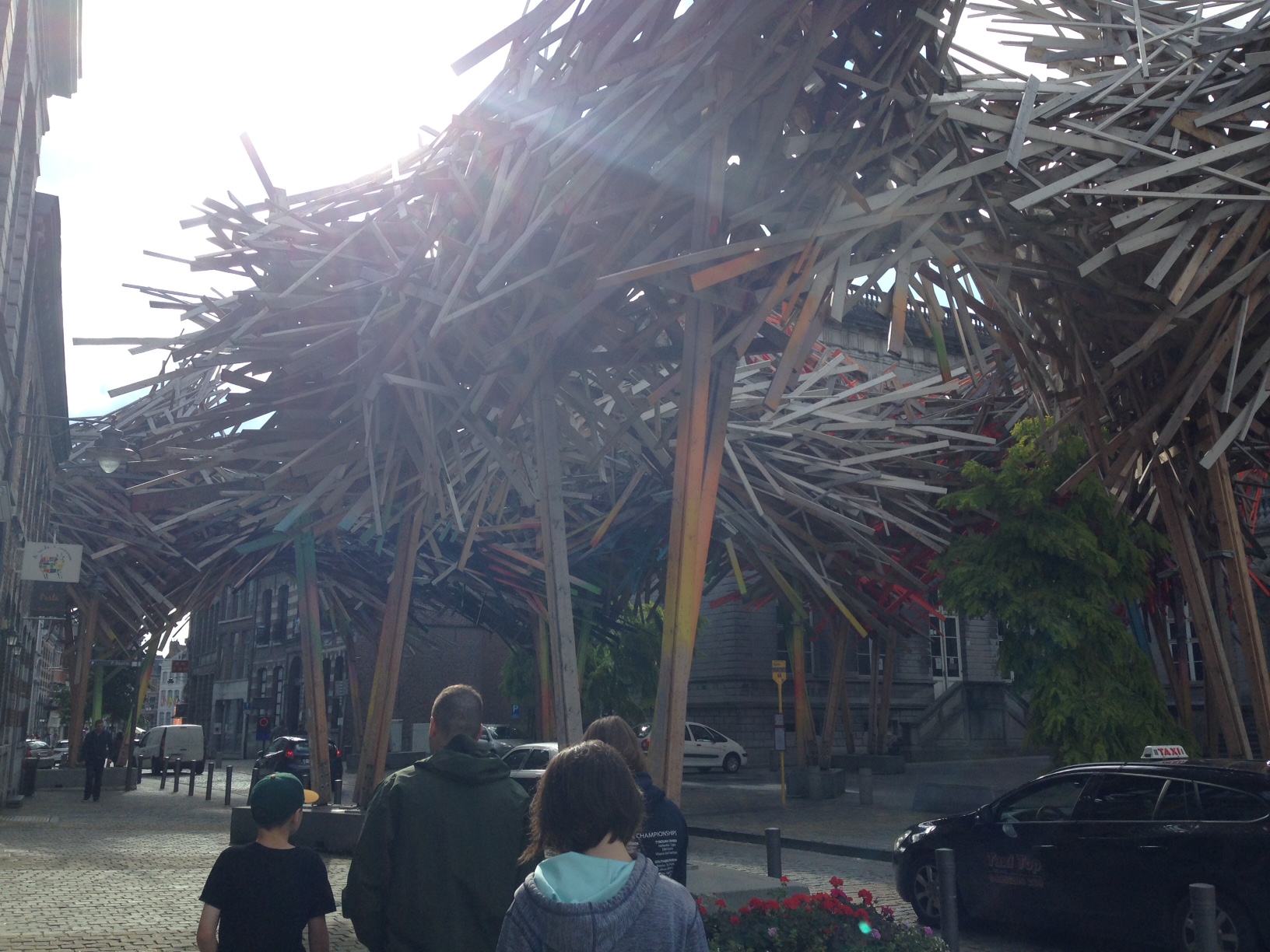
We had a few hours one afternoon while visiting a nearby village and decided to go into Mons and see what was there. Our first views were typical of many towns or cities in Northern Europe until we turned a corner to find a sculpture shadowing the road. On rue de Nimy, an enormous arrangements of sticks was designed by artist Arne Quinze. You drive through on the street below.
We found parking on a side street. When we paid, we thought we put in money for 3 hours, but it turned out that we covered our parking until the next morning. After shrugging it off and putting the ticket in our window, we walked until we happened upon a church. I always love to look around the churches here, so we stepped inside.
Sainte Elisabeth has had several churches since people first began worshipping there, but the latest Baroque structure was built in the 18th century. It was a lovely church and definitely worth the walk through with the 16th, 17th, and 18th century artwork inside as well as the architecture.
When we departed Sainte Elisabeth, we continued down rue de Nimy until we reached Grand Place. Most towns in this region have a Grand Place as it was their market centre and most still remain with quaint restaurants with outdoor tables and great architecture. In this case, it was no different.
We continued on until we hit the end of the pedestrian only roads and then doubled back. My son was aching for a waffle, so we stopped at a small stand to indulge his whim. They aren’t quite the same as in Brussels, where they are a waffle smothered in fruit, whipped cream, chocolate, and all other forms of the decadent, but a simple glazed sort of waffle you held in a piece of paper and if you wished, they shoved long strips of chocolate into the thicker parts.
We couldn’t resist but to duck into a store with the sign Fromagerie. If you don’t like the smell of aged cheese, you won’t care for the smell of this store. They had an amazing selection, though, and we ended up buying some beer cheese for my husband and apple cheese for the rest of us that I apparently ate way too much of, much to the dismay of my daughter.
Of course, we couldn’t have cheese without bread and a bakery next door had baguettes as well as an amazing seeded gluten free loaf I couldn’t resist trying. We stopped at a local grocery store for some more gluten free goodies and a bottle of wine (to go with the cheese and bread of course!!!) before heading back to the quaint farmhouse where we were staying.
Our friends in Belgium 😉
Because we overpaid for parking, we passed on our parking voucher to someone else, who was incredibly grateful 🙂
I wish I could say that I practiced more of my French, but the minute I spoke in most places, they reverted straight to English whether I spoke in French or not. 😦