Afte Herculaneum, we hopped back on the train and traveled to Pompeii, the more popular of the two archeological sites. When they handed me the map at the entrance, it was overwhelming how huge it is. As a result, we all discussed what we wanted to see most, and I steered us out to one far corner for the part I wanted to see most, Villa of the Mysteries (Villa dei Misteri).
Dionysus and Ariadne
Villa of the Mysteries is named for the hall of the mysteries in the portion of the house that faces the sea. This too, located in the residential portion of the building, has a fresco covering three walls that is absolutely incredible. It is one of the most preserved ancient buildings, depicting a scene of Dionysus, who is on the middle wall, joined by Ariadne, his wife. Other scenes involve rituals as well as architectural details common in the art of Pompeii and Herculaneum. The building dates back to 200 BCE while the frescos are closer to 70 to 80 BCE.
After, the children wanted to see the amphitheatre, so we zig-zagged through the maze of buildings, marvelling at the ruts from carriages visible in the roads and the strategically placed stones allowing people to cross the streets, which were a good one to two feet below the sidewalks.
Wounded Bear
We passed some lovely mosaics in former front doors as well as the House of the Wounded Bear, which is mid-1st century AD. We also passed graffiti on the walls that remain from when Pompeii was in its hey day. The writing is political propaganda.
Mostly, we took photos of the amazing mosaics and frescos along the way.
We also passed the famous “Guard Dog” mosaic, called that for the words below it (“Cave Canem”) that say Beware of the Dog.
One of the last ruins we walked through was the House of the Venus in the Shell. We really enjoyed the garden in the rear.
We basically wandered through the ruins until we finally reached the amphitheatre, sitting in the middle and taking in everything until we were absolutely exhausted and ready to head back to the train and Naples.
While I much preferred Herculaneum, Pompeii is another do not miss if you have the opportunity.
Ever since I took a class on the Bronze Age in the Aegean, I’ve wanted to go to Pompeii and Herculaneum. Of course, that usually means a trip to Naples. Having been to both Rome and Venice, I thought I knew what traveling to Italy would entail: good food, friendly people, and a lot of walking. I was right on some of it.
Before traveling to Naples, I researched the different ways of going to where we would stay to find the least expensive. In the end, we opted to use a service called the Alibus, which takes you to the Central train station for 5 euros/person. There are five of us, so it was definitely more cost effective than hiring a car, which was a minimum of fifty. From the Central station, the walk wasn’t too bad, so that was our plan.
First, it took us a bit to find the Alibus stop. If you don’t like crowded buses, then be prepared, because it is. You pay for your passage on the bus, which was very convenient. The drive into Naples didn’t take long and we were let off just near Central Station. Of course, Google Maps took us this roundabout route, and during the walk, we learned quickly you have to be very careful of drivers in Naples! In Rome, the traffic is insane, but the cars are pretty conscientious of pedestrians, not so much in Naples! When we reached the flat where we were staying, the woman who worked for the agency giggled and giggled and said we were crazy. We still hadn’t quite comprehended how bad it was until we walked a bit more. We understood her giggles completely by the time we returned home. Especially after a driver decided to skim close to my seventeen-year-old daughter and hit her with his wing mirror while they attempted to cross the street.
Once we were settled, we decided to grab a quick bite at a coffee shop a few doors down before we attempted to catch the train to see Herculaneum before the end of the day. Admission to Herculaneum stops at five p.m., so we thought we had plenty of time.
We purchased our train tickets on the Circumvesnia to Ercolano and found the platform easily. Then, we sat and sat. According to the internet, the train was on a certain schedule. If that was supposed to be the schedule, then the train was really late. That wasn’t the only time, however. We learned that you could never go by the online train schedule around Naples. The trains ran on their own schedule.
We made it to Ercolano with five minutes to spare. Unfortunately, we didn’t make the walk downhill in time, so we just missed the last admission. We took a few pictures from the walkway above and took the train back to Naples to hunt for dinner.
The next morning, we ate breakfast, had a quick coffee at the same cafe as the night before, and caught an earlier train out to Herculaneum. This time, we were one of the first admitted inside and didn’t have a big crowd while we took in the ruins, the artwork, and just the overall scope of the place. Most people want to see Pompeii, but there are several great reasons to go to Herculaneum as well.
Less of a crowd!
Herculaneum was unearthed after Pompeii and is better preserved.
While touring, you’ll see people working to restore and preserve what is there.
Herculaneum street
Original wood in a wine shop
Neptune and Amphitrite
A Thermopolium where it is believed food was sold
Herculaneum with Pompeii in the background
We spent several hours walking around Herculaneum, which is situated between Ercolano and about a mile or so of coastline before the sea, and were awed at the mosaics preserved within structures such as the bath house and another home where crews were actively restoring the mosaics as well as the frescoes. They even made us wear paper covers on our shoes so we didn’t damage their careful work.
Mosaic in the female bath house
Squid
Octopus
What has been unearthed is amazing, but it’s even crazier when you realize how much of Herculaneum is still buried under the town of Ercolano. The unearthed section is quite small when you consider this was a city of 4-5,000 people. Seeing the original wood still intact in some of the structures and the mosaics is well worth the time—even in the rain! We spent several showers in certain structures before we could walk around again and enjoy the site.
Restoration in progress
Bootied feet!
Like a welcome mat
Another great mosaic floor
Horses in relief
Skeletons in the boat houses
When we left Herculaneum, we walked back up the hill to the train station. Restaurants in some European cities will have someone outside whose sole job is to get people inside to eat. When you stop in Ercolano, the restaurant just outside the train station is terrible about it! The man whistled at my underage daughter trying to get our attention. He didn’t seem to care that I was furious, only that he had my attention. Needless to say, we didn’t stop to eat and boarded the train in the direction of Pompeii.
Next up … Pompeii and the rest of our trip to Naples!
One thing we didn’t get to do the last time we were in Venice was take a water taxi out to Murano and Burano. When you walk through Venice, the stops for the water taxis are scattered all over, but we just never thought to take one since you could see so much by foot.
Down the Grand Canal
A canal in Murano
A square in Murano
Murano is a cluster of islands located in the lagoon near Venice. A series of bridges link these small islands and allow for you to walk around Murano much like you would Venice. This part of Venice was originally settled in the sixth century and thrived as a fishing colony until the glass makers moved to this area to keep fires from breaking out in Venice. Since then, Murano has been all about glass. When you tour Venice, there are stores boasting of Murano glass and when you exit the water taxi, there are stores immediately off the boat selling everything from water glasses and hand blown animals to the ornate.
We paid for a day pass on the water taxis and started at Ferrovia, which is the stop just outside of the train station and travelled down the Grand Canal until we exited into the lagoon. We skirted along the Cimetero San Michele, an old island cemetery I’d love to walk through if I had the time and chance, until we reached Murano at the Colonna taxi stop.
We perused several shops and even bought a few small pieces of Murano glass (hopefully we didn’t get suckered into Chinese rip-offs!) and eventually walked to the Faro taxi stop where we boarded another boat headed to Burano.
As you approach Burano, the first thing you notice is how different it is to Murano as well as Venice because of the brightly coloured homes visible from the boat. Burano, however, is famous for its colourful homes as well as lace and seafood. We arrived in Burano late afternoon and our first stop was for food. We found a nice little restaurant, but little did we know what would come of this little adventure.
Approach to Burano by water taxi
Burano at night
A number of restaurants around Venice have a seating charge, so they charge so much per person as soon as you are seated. This one not only had the seating charge, but each meal was actually more a meal for two or three people and the charge in the menu was per person. It added up quickly. That said, the food was incredible and the Prosecco, made homemade there was amazing, the bill left something to be desired at the end.
(The day had turned a little misty by the time we made it to Burano, so my photos weren’t great, but I found this one below to give an idea of how colourful the houses really are.)
By the time we finished our meal, it was getting dark, and everything in Burano was closing since it was a Sunday. We waited for a water taxi and boarded the first one even though it went to Treporti and then doubled back. We just wanted to sit. We took the boat to San Marco at the Piazza San Marco and then found a boat that took us back to Ferrovia so we could take the train back to Marcon.
If you go to Venice, Burano and Murano are not to be missed!
After the Colosseum and the Arch of Constantine, we checked out the lines for Palatine Hill. It was part of the admission for the Colosseum and we could see the ruins from outside and were definitely interested. We ended up having to go to lunch first. The lines were long before, but we hoped they might die down, which they did. By the time we were done eating, we had to simply show our ticket and walk through the gates.
Palatine Hill is the original site of Rome where mythology claims Romulus and Remus were found by the wolf Lupa and it is claimed Romulus built the sanctuary of the Curiae Veteres on one side of the city. This 131 foot plateau was the centre point of the Seven Hills of Rome and has a circumference of 5,700 feet. This site contains everything from prehistoric Roman ruins and later palaces and temples. It looks upon the Roman Forum on one side and Circus Maximus on the opposite and just a warning–bring your walking shoes!!
Evidence shows people have been living on Palatine Hill since the 10th century BC until the emperors made Palatine Hill their domain and built a series of palaces there. When the Roman Empire fell, Palatine Hill deteriorated until a stronghold was built in the Middle Ages. During the Renaissance, wealthy families built homes on Palatine Hill. Now, it’s an archeological site and still being excavated.
There’s just too much to Palatine Hill to go through it all and I know we didn’t even get to walk through all of it. It’s an entire day and maybe two if you are particularly thorough. The views from the top of the hill as well as the little bits that you find looking into some of the alcoves is worth every bit of it. It’s amazing to get a tiny glimpse of what existed here. Just by the ruins, you can see how amazing and fantastic much of it was.
Panorama of Palatine Hill from a higher vantage point
One of the major attractions of Rome is, of course, the Vatican. The Vatican is known for having a tremendous amount of artwork as well as the Sistine Chapel, so obviously a big thing to do and see when visiting Rome. We booked tickets for the Vatican Museums for our first day in Rome. Little did we know that even during October, this would be a packed and still crazy place to visit.
Ponte Sant’Angelo with Castle Sant’Angelo behind it.
Ponte Sant’Angelo
We crossed the Tiber river at Ponte Sant’Angelo, and turned left, heading towards the dome of St. Peter’s Basilica. What I didn’t expect as we turned from the bridge towards the Vatican was the immediate assault of tour guides who line the path to St. Peter’s Basilica and around to the Vatican Museums trying to sell tours. They are paced about every 10-15 steps, and all start with the same line “It’s a 2 hour wait to get into St. Peter’s! Skip the lines!” This continues as you walk to Via della Conciliazione all the way until St. Peter’s Square.
Walking down Via della Conciliazione
Bernini’s Colonnade
Now, a couple of things we learned from this. They have badges that say “official” but they don’t work for the Vatican or St. Peter’s Basilica. They are official to their company maybe, but they aren’t employed by the church. Most of them use the same line, but sometimes, you’ll get one tour guide who will try a different approach. With us, it was “You know you can’t go in there dressed like that!” As far as we knew, our shorts and tops were fine, but the tour companies also make a mint selling souvenir scarves for 5 to 10 euros each and try to sell you their tour in that they can provide them to you with the tour or you can purchase the scarves from their shop just to the side.
St. Peters and the Sistine Chapel do have dress codes, so if you go, simply where a top that covers your shoulders and shorts or capris that cover your knees, and you won’t require any sort of scarf. We rebelled against the tour guides and purchased them from a street vendor for the same price. I will say that even with the scarves, we didn’t put them on in the Sistine Chapel and no one said a word. They were more concerned with the photography than my shorts or my daughter’s exposed shoulders.
When the Vatican and St. Peter’s were first built, Via della Conciliazione weren’t there. Instead, a bunch of old homes and windy roads led to St. Peter’s Square and Bernini’s amazing colonnade. Mussolini was the one who tore down those old homes and paved the road creating an impressive avenue and linking Rome more indelibly to Vatican City.
Now, the Vatican Museums are almost around the back of St. Peter’s Basilica, so you have to turn right before you enter St. Peter’s Square and follow the annoying tour guides still posted regularly, around the back to the entrance. We pre-booked our tickets, so we didn’t have to wait in line except to check in for our tour time because they stagger it to keep things from becoming too packed. We showed an hour early, but we still were able to enter and begin the tour.
Painted Ceilings and Vaults
Mosaic tile floor
Hall of Maps
Lacoon and his sons
The Vatican Museums are basically a crazy winding path through various old papal apartments, rooms, and porticos all decked in amazing frescos, tapestries, and both religious and mythological statuary. It takes several hours to get all the way through and at times you have to fight crowds to see particular pieces like Laocoön and His Sons in one of the small porticos, but it’s definitely worth it.
The security and guides become more rude as you approach the Sistine Chapel. We were told to hurry through some portions until we were packed into the Sistine Chapel. It is certainly a chapel and not large–especially considering the number of people standing inside to get a look. People are supposed to remain quiet in a show of respect, so security and a recording will tell people to be quiet. Security is also calling out for people to put away their cameras and not to take photos.
The frescos and the entire atmosphere is overwhelming really. While it was beautiful, I found it a little disappointing. We all stood and looked at the ceiling for some time and then the walls before we exited and moved on to the last little bits before we exited the museums.
Unfortunately, the lines were still extremely long for St. Peter’s Basilica, so we ate a late lunch and walked around before calling it a day with the plan to be at St. Peter’s first thing when it opened. If I had to do it again, I would’ve had us get up early and be at St. Peter’s within a half hour of opening and then book the Vatican Museums a few hours later. You could put lunch between the two viewings or you could simply walk down the Tiber until your viewing time.
For first time travellers to Rome, we did a number of things correctly and a number of things caught us completely off-guard. Hopefully, after reading our experiences in the next several posts, you will know what to expect and won’t run across the same pitfalls we did! We still had an amazing time, so it wasn’t anything terrible, but definitely something that would’ve made things much easier if we’d known at the time.
Ponte Sant’Angelo
We had a rather late arrival, and after reading nightmare horror stories about taxis from Ciampino airport to the city centre (which is anywhere in the Aurelian Wall), we ended up hiring a car. Yes, it was more expensive since there is a law in Rome that dictates a flat rate charge from the airport (30 euros from Ciampino and 48 from Fiumicino) for a maximum of 4 people and their luggage for licensed Taxis. It’s even posted on the outside of every taxi, but for one, we number 5 people. I’ve also read horror stories of people being dropped off at the walls or taxi drivers claiming that to the walls is the flat rate and beyond is an extra charge. The practice is illegal, but how many tourists really understand the law or are in a position to enforce it with the police if there is a problem. If it had just been me and my husband, we probably would’ve just made the attempt to get the lower price, but with three children along for the ride and the evening arrival. We weren’t willing to try.
We stayed not far from the Tiber and had a really quick walk to the Ponte Sant’Angelo when we crossed to see the Vatican. We had decided when we booked our place that we would walk everywhere and as long as you’re planning on touring what’s within the Aurelian Wall, it’s completely achievable.
So, if you’re not familiar with Rome, you might be asking ‘What is the Aurelian Wall?’. Most old cities had some sort of original wall that surrounded the city for protection and some cities still have remnants of that fortification to this day. Bath has bits of the original walls still intact around the city, though because they’re partially buried, they don’t seem much like walls; however, Rome’s Aurelian Wall, which was built by the emperors Aurelian and Probus in the 4th century still stands tall to this day. When it was first built, the entire wall, that encircled the right bank of the Tiber, was 26 feet high, surrounded 12 square miles, had 383 towers, 18 main gates, and over 2,000 windows.
When you approach the walls, even at night, you can’t miss them. We passed through one of the gates, which is one lane, and once we were inside, the traffic became even crazier before. If you’ve never driven in Rome before, you’re in for a shock! As opposed to British drivers, who tend to be rather mannerly on the road and rarely use their horn, the Italians are the opposite. Everyone uses their horn, they cut each other off, and then squeezing through tight spaces–I thought we’d never make it in a couple of places.
Arriving at night was fascinating and beautiful, though. We passed by so many historical places that were illuminated and looked just amazing in the dark.
Once we were shown around where we were staying by the property owner (We had the same experience in Venice as well. They took us around the entire flat and showed us everything.), we needed to eat. With several of us requiring gluten-free, that can always be a struggle, but my daughter found a place with 4 stars on Google, so we headed in that direction.
Voglie di Pizza is not large and it’s not the fanciest place when you look at it. It’s not much more than a narrow strip of hallway inside with outdoor seating, but it was one of our favourite places to eat by the time we left. We even returned on our last night. For those who need gluten-free, there is a regular menu as well as a decent gluten-free menu. A lot of places will only have pizza or only have pasta, but they also had Melanzane Alla Parmigiana (Eggplant/Aubergine Parmesan) and a few other options as well. I also had Tiramisu, which is something I haven’t had in forever. The food was good, the prices were not as high as a lot of places, and the people who worked there were extremely friendly and helpful. Definitely a recommend if you’re in the area!
Street Corner
Chiesa
We ended our first evening in Rome with a leisurely walk back to the flat so we could start sight-seeing the next day. It’s amazing all the little things on random street corners whether it’s statues or paintings, and then the churches tucked up into little niches along narrow cobbled streets. It’s definitely worth seeing!
From the moment we crossed the first bridge, we followed the signs toward the Rialto Bridge and San Marco. Obviously, by my past posts, we did stop places along the way, shopping and sightseeing as we plodded along. Our main goal was to reach what everyone said we had to see.
View from the Rialto Bridge (sorry about my son’s head!)
The Rialto Bridge is one of four bridges that cross the Grand Canal, designed by Antonio da Ponte and completed in 1591. In all honesty, you can’t miss it since it’s rather large and in a rather busy and congested portion of Venice as you pass through the Rialto market to get to it. It also has shops, such as the Hard Rock Cafe, on the bridge itself, so you cannot see the Grand Canal from the interior of the bridge, you have to pass through an archway to an outer ramp to take pictures of the Grand Canal.
From the Rialto Bridge, the Piazza San Marco is not far and is one of the main sights of Venice, containing Saint Mark’s Basilica and Doges Palace as well as a few other sites. Our first stop was Saint Mark’s, an Italo-Byzantine church completed in 1092! We’d heard it was a must see and was free to enter, which was lovely. My complaint was it was dark. Not so dark you couldn’t see, but I really would have liked to see the mosaics (Not just regular mosaics either! The background is gold glass tesserae-gold leaf encased in layers of glass.), which cover the wall in more detail, and it was really impossible to see all I wanted. Given the windows in the ceiling, I am certain a bit of it was the poor weather and the time of day since we toured near 5 pm, but we had poor weather both days in Venice. No matter what, our experience would have likely been the same. My other complaint–we weren’t allowed photos.
Piazza San Marco
Saint Mark’s Basilica
Clock Tower
Doges Castle on the Piazetta
Now, one thing to note on Saint Mark’s! General admission to the building is free, and you can see most of the mosaic’s and the main portion of the church for nothing, but they do have certain artefacts and portions of the Basilica which require admission. For example, the Treasury has antiquities, even including a small animal mummy (My children found it and I don’t remember the animal. Sorry!) and some Greek/Roman pottery. The Presbytery is another part which requires admission.
Mosaics
Presbytery
Once we’d seen all of Saint Mark’s, we walked back out to take photos and then, walked down towards the water through the Piazetta and past Doges Castle. We took quite a few photos of the amazing view, though with the weather, though it was a bit foggy. From there, we turned left and walked down a ways before testing our skills and our sense of direction by taking whatever bridges we thought were in the correct direction to make it back to the tram. We ended up using the GPS/SatNav! Venice is a maze!
Our second day in Venice was rainy and more relaxed. We decided to play tourist shopper and walked through a lot of the gift shops and even boutiques (some felt no bigger than a walk-in closet!). I believe I warned everyone in the initial post to beware of the “Made in China” knock-off souvenirs. The handmade Carnivale masks are impressive and if you are looking for something small, not terribly expensive by comparison. There are also many shops touting, real Italian leather handbags. We found a distinct difference in the feel of the bag after shopping in one boutique rather than the touristy shop. Just be aware of what you are buying!
If you are celiac or gluten intolerant. Do not worry about finding food! Many restaurants offer either pizza or pasta, and sometimes both you can eat. We actually had a more difficult time finding bread and other “Sensa Glutine” items at the grocery store. Just beware the bakery windows! They look divine and I kept taking photos! I did enjoy the coffee and espresso drinks immensely, however, much to the chagrin of my nerves. 😉
If only!
Yum!!
We opted not to take a gondola ride as they were rather pricey for five people, though from what we discovered, you can haggle the price of the ride. 🙂
Photos St. Mark’s courtesy of:
tango7174 of St. Mark’s Basilica: https://commons.wikimedia.org/wiki/File:Veneto_Venezia2_tango7174.jpg
Dennis Jarvis of Pentecost at St. Mark’s https://commons.wikimedia.org/wiki/File:Venice_SMarco_Vault2.jpg
As you follow the signs to the Rialto Bridge and Saint Mark’s Basilica, you’ll definitely pass a small square with the Scuola Grande di San Rocco, the Chiesa (church) of San Rocco, and a da Vinci Museum. Now, I can’t comment on the da Vinci museum other than the understanding we had from the description was that it was a compilation of da Vinci’s inventions that were built and on display. I love da Vinci, but I would prefer to see his actual drawings and paintings, so we skipped the da Vinci museum. I was very intrigued, however, by the Chiesa di San Rocco and the Scuola Grande di San Rocco.
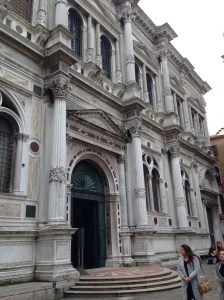
Chiesa di San Rocco
Scuola Grande di San Rocco
San Rocco (or Saint Roch) was the protector against plague, which had devastated Venice in the 15th century. In 1478, a group of wealthy Venice citizens founded the Scuola Grande di San Rocco.
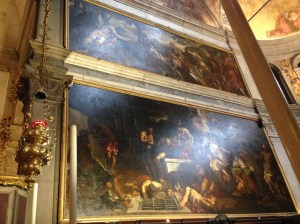
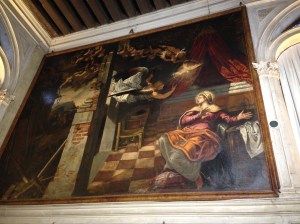
When I was studying for my art degree, I took a class that I loved called Women in Art and Culture, and one of the artists we studied was Marietta Robusti, also called Tintoretto. Both the Church of San Rocco and Scuola Grande di San Rocco have works from Jacopo Robusti or Tintoretto, her father, who was commissioned in 1564 to produce paintings for the interior. I was curious to see the work of the father as I’d never really studied him in depth, and I didn’t regret the visit!
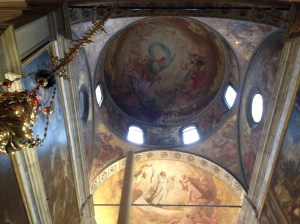
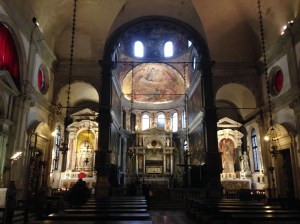
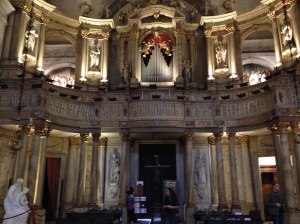
The church is small and has more artists featured than Tintoretto, but the works are all lovely and the church is by no means unadorned. It is beautiful in its paintings and detail, but doesn’t really hold a candle to the Scuola Grande di San Rocco.
Ceiling church
Altar
Tintoretto Paintings
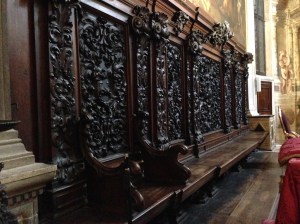
Detail on seating by altar
Altar from the rear
Back of the church
We exited the church and walked across the square. My husband was hesitant due to the admission, but we soon realised children were free, which is always welcomed with five of us–especially as my children aren’t always excited about art museums.
One of the paintings downstairs
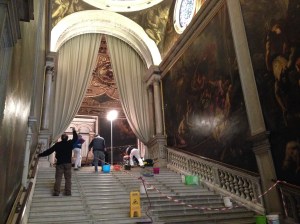
Cleaning the stairs
The Dome over the stairs
The downstairs (Salla Terra) is a columned room containing a nave and two aisles nothing but the works of Tintoretto adorning all of the walls, depicting scenes from Mary’s life. It’s a lovely room, but once you’ve looked at all of the paintings, which are gorgeous, you walk up a stone staircase with a domed roof to a room that will take your breath away. I find the downstairs deceptive when you first walk in and it makes the upstairs (Sala Superiore (“Upper Hall”)) all the more grand.
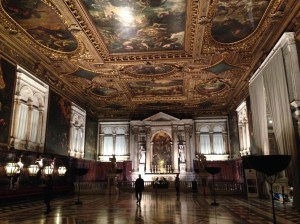
Upstairs
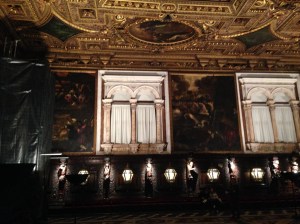
Walls with Sculptures
Tintoretto is on right
floor
Crucifixion
Walk to Cavalry
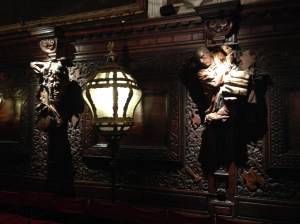
The ceiling and walls are covered by Tintoretto’s paintings trimmed in gold and with sculpture adorning the walls beneath it, including a wooden rendering of Tintoretto himself by Giuseppe Angeli and allegorical figures by Francesco Pianta. The ceiling in the Sala Superiore are from the Old Testament and the walls are depictions from the New Testament. There is also a room off to the side which has paintings depicting Christ appearing before Pilot to Calvary, which adorns an entire wall.
Scuola San Rocco was not something we planned, but was my favourite part of the trip. If you go to Venice, you shouldn’t miss it!
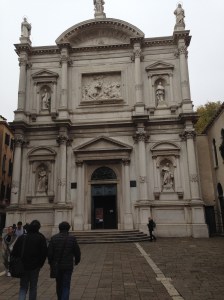
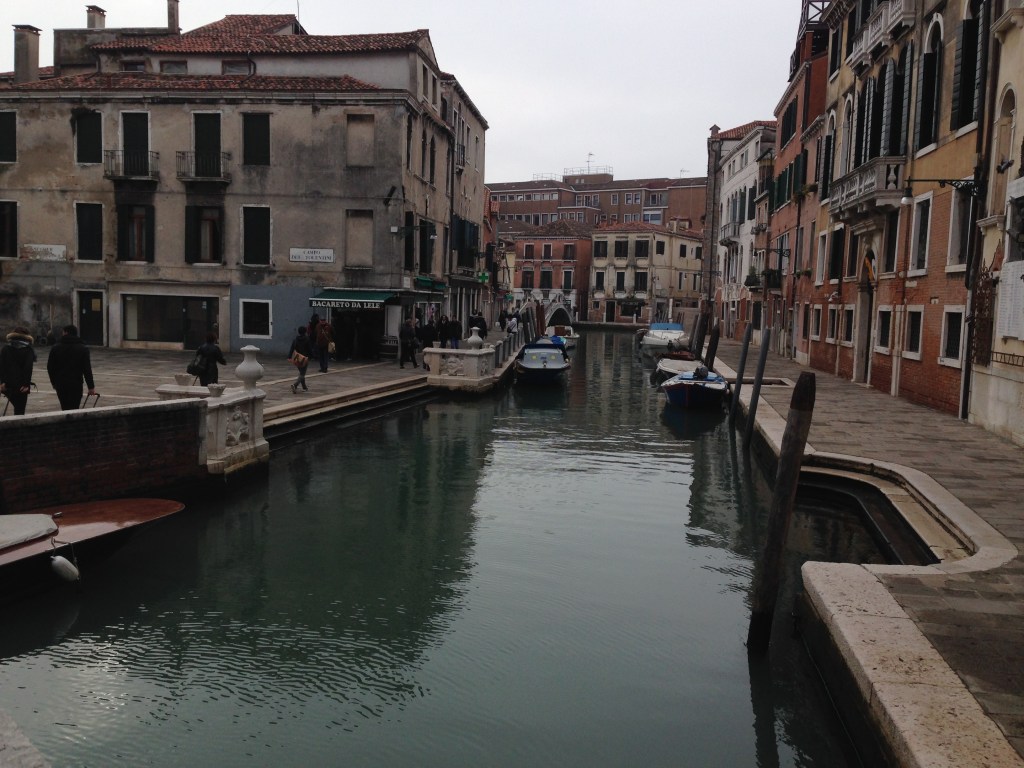
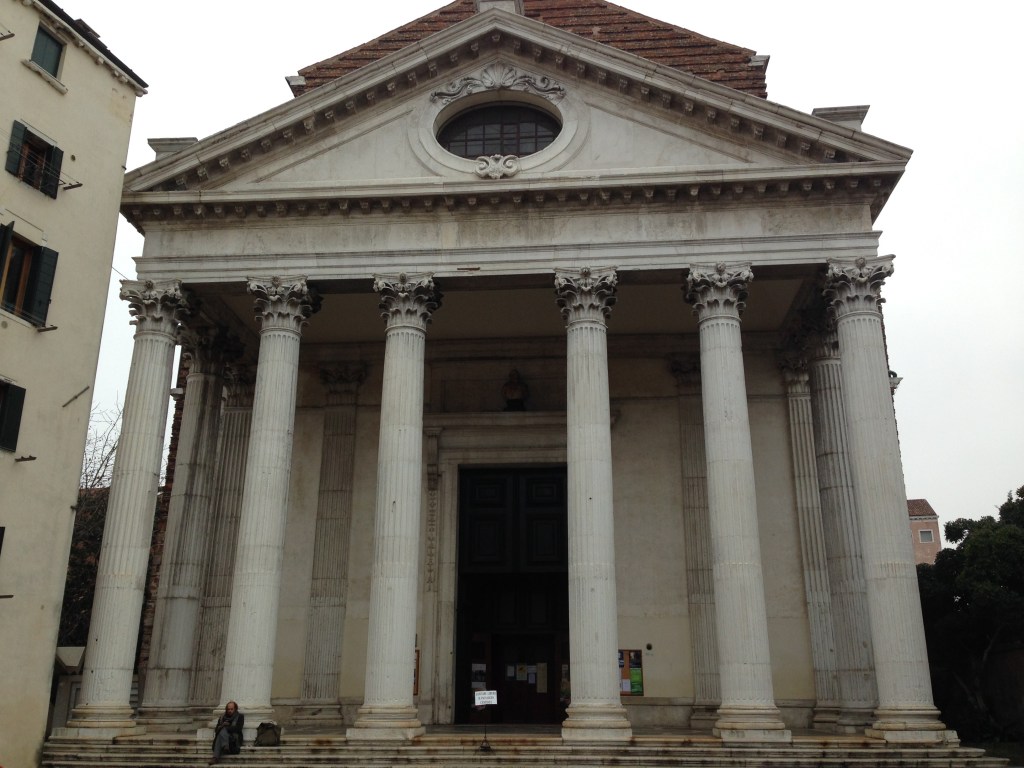
When you cross that first bridge in Venice, La chiesa di San Nicola da Tolentino is at the opposite side of a small square across from the German consulate. The temple facade caught our eye, so we decided to investigate and boy, am I glad we did!
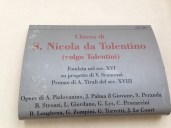
La chiesa di San Nicola da Tolentino translates to The church of St. Nicholas of Tolentino, and has been a Catholic church since the 16th or 17th century (I had to translate the Wiki page on it’s history, so sorry for any issues arising from that!). It was named for an Augustinian friar, who was proclaimed the patron saint of souls in Purgatory by Pope Leo XIII in 1884.
First canal (see the square to the left?)
Facade
The church was erected between 1591 and 1602, and designed and built by Vincenzo Scamozzi. Between 1706 and 1714, Andrea Tirali added the portico, the tympanum, and six Corinthian columns to the exterior, which had been unfinished.
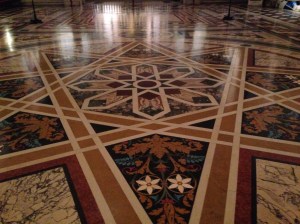
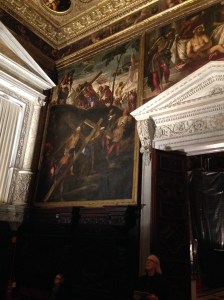
I wish I could’ve taken my own photos inside this beautiful building, but they do not allow it. Thank goodness for Wikimedia Commons, who actually has photos of the stunning insides. I must admit that though the outside is nice, I was not prepared when I entered and caught a glimpse of the interior.