I have to say that I was looking forward to Barcelona, but I hadn’t expected it to be one of my favourite places. It was also cleaner than some of the other European cities we’ve visited.
We arrived in Barcelona, and after a bit of confusion, figured out the subway, which we took to the metro stop near Sagrada Familia. The flat we arranged for our stay was a short walk from Sagrada Familia and was an amazing bargain, considering the location.
Our first sightseeing expedition was Sagrada Familia. We had pre-booked our tickets, which was definitely the way to go. We skipped the longer line and were inside in a matter of minutes.
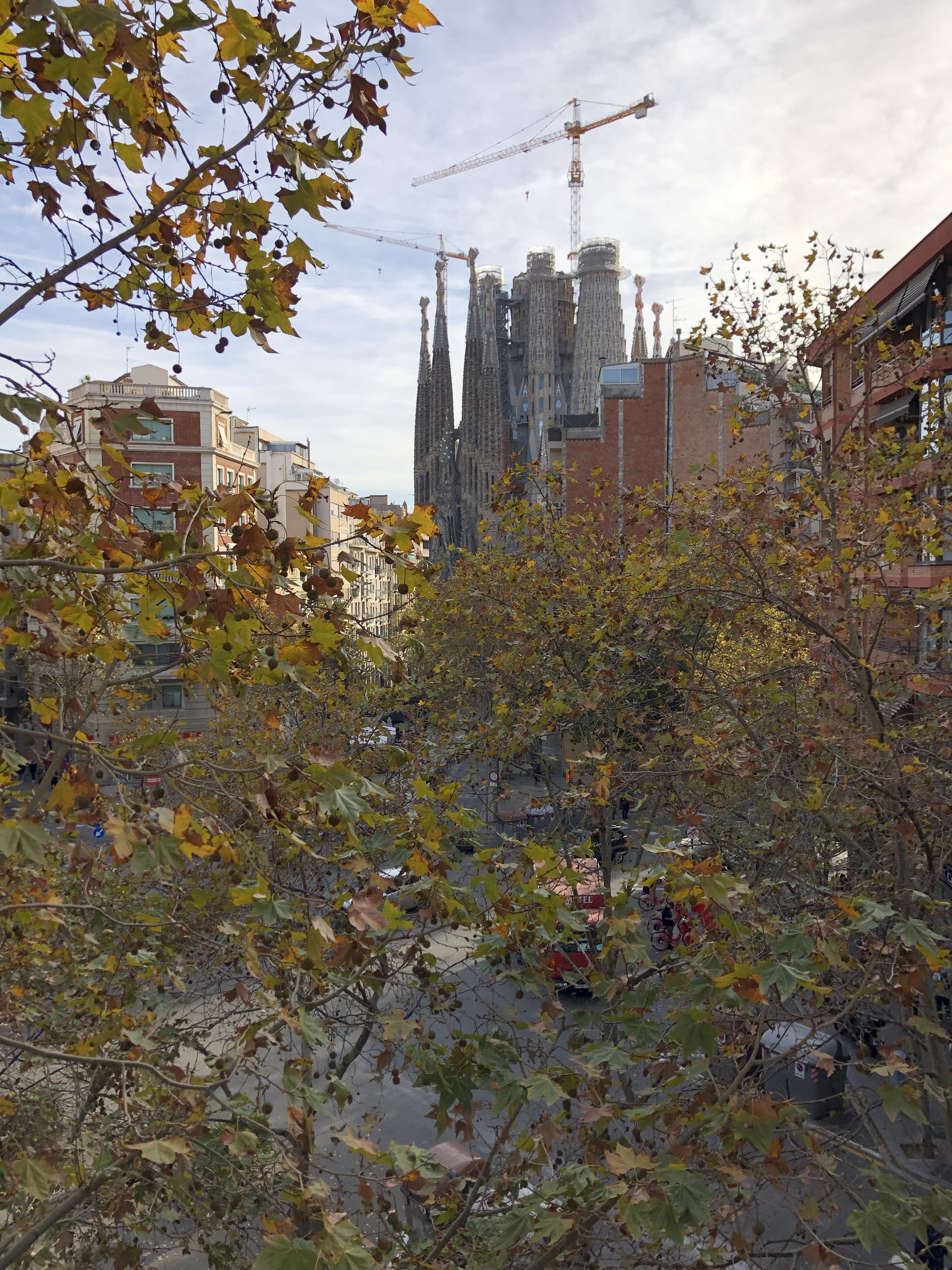
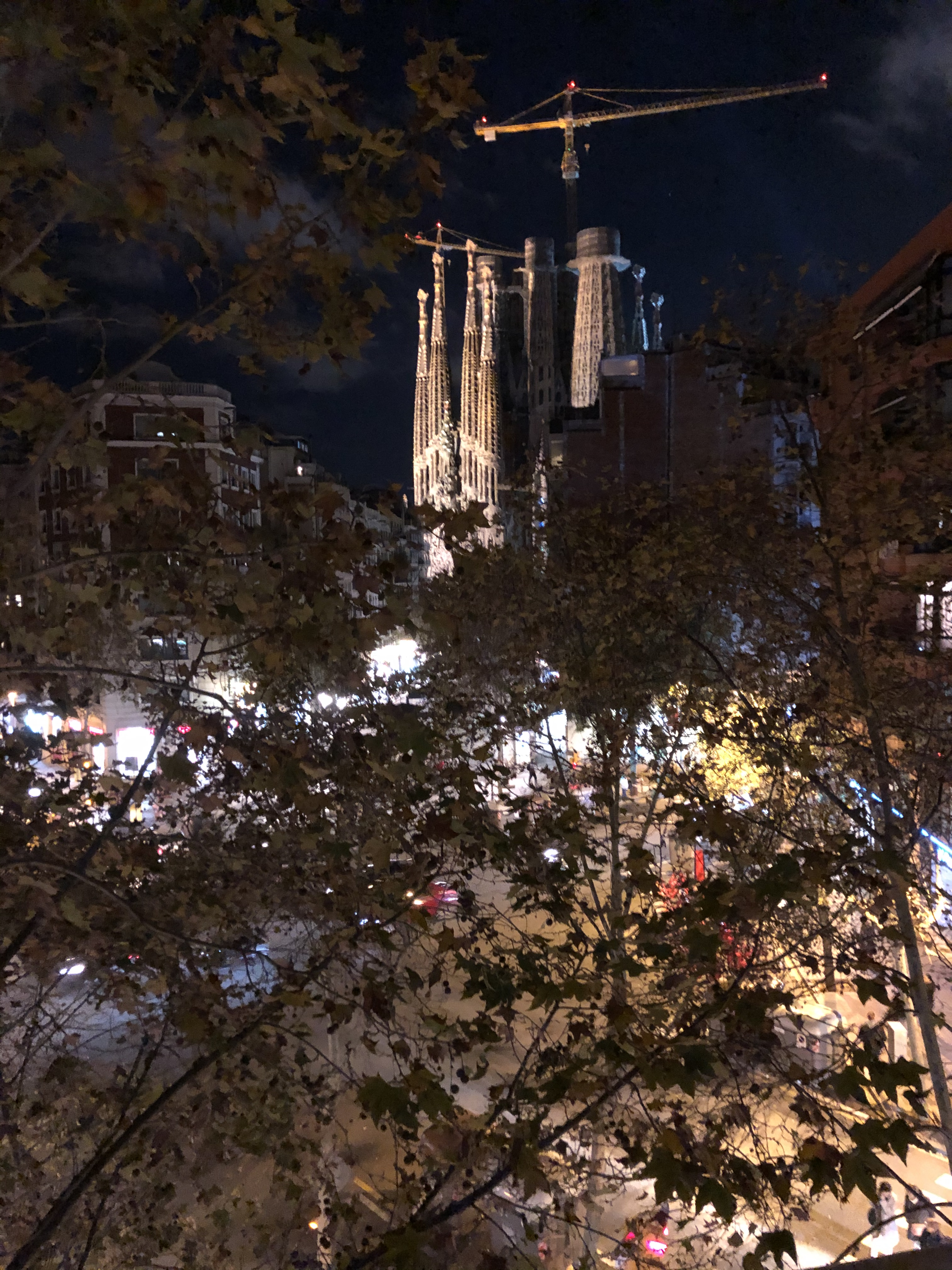
Sagrada Familia was designed by the great Antoni Gaudi. The first corner stone was laid 135 years ago, and the work still goes on to complete it today. Known for the amazing details on the exterior as well as the interior in a neo-Gothic design, Gaudi worked on the cathedral one bit at a time until his death in 1926. He is buried in the crypt of the Expiatory Temple of the Sagrada Família. Construction on Sagrada Familia still continues today. The plan is to finish in 2026, the two-hundredth anniversary of the laying of the first cornerstone.
When I studied Sagrada Familia in art history class, I can’t say I was particularly impressed by the detail and the overall design. Gaudi, after all, is far from a typical architect. However, standing inside that cathedral, the light coming into the stained glass was one of the most incredible things I’d ever seen. I would love to return and sit in the seats down the center of the structure all day and watch how the light and color changes as the sun crosses the sky.
The exterior has so much detail, you could spend a lot of time walking around to see it all. There is a marked difference between the newer pieces of the cathedral as opposed to Gaudi’s original portion of the cathedral. Unfortunately, it’s impossible to walk completely around because of the scaffolding. That’s another thing I would love to do one day.
Despite the continued construction, Sagrada Familia is certainly a marvel. The area around the cathedral, while touristy, is lovely and was an amazing place to stay. I definitely recommend it! I’ll go into more detail on that next week 🙂
I hope everyone is weathering their time safely. Stay healthy!
Ever since I took a class on the Bronze Age in the Aegean, I’ve wanted to go to Pompeii and Herculaneum. Of course, that usually means a trip to Naples. Having been to both Rome and Venice, I thought I knew what traveling to Italy would entail: good food, friendly people, and a lot of walking. I was right on some of it.
Before traveling to Naples, I researched the different ways of going to where we would stay to find the least expensive. In the end, we opted to use a service called the Alibus, which takes you to the Central train station for 5 euros/person. There are five of us, so it was definitely more cost effective than hiring a car, which was a minimum of fifty. From the Central station, the walk wasn’t too bad, so that was our plan.
First, it took us a bit to find the Alibus stop. If you don’t like crowded buses, then be prepared, because it is. You pay for your passage on the bus, which was very convenient. The drive into Naples didn’t take long and we were let off just near Central Station. Of course, Google Maps took us this roundabout route, and during the walk, we learned quickly you have to be very careful of drivers in Naples! In Rome, the traffic is insane, but the cars are pretty conscientious of pedestrians, not so much in Naples! When we reached the flat where we were staying, the woman who worked for the agency giggled and giggled and said we were crazy. We still hadn’t quite comprehended how bad it was until we walked a bit more. We understood her giggles completely by the time we returned home. Especially after a driver decided to skim close to my seventeen-year-old daughter and hit her with his wing mirror while they attempted to cross the street.
Once we were settled, we decided to grab a quick bite at a coffee shop a few doors down before we attempted to catch the train to see Herculaneum before the end of the day. Admission to Herculaneum stops at five p.m., so we thought we had plenty of time.
We purchased our train tickets on the Circumvesnia to Ercolano and found the platform easily. Then, we sat and sat. According to the internet, the train was on a certain schedule. If that was supposed to be the schedule, then the train was really late. That wasn’t the only time, however. We learned that you could never go by the online train schedule around Naples. The trains ran on their own schedule.
We made it to Ercolano with five minutes to spare. Unfortunately, we didn’t make the walk downhill in time, so we just missed the last admission. We took a few pictures from the walkway above and took the train back to Naples to hunt for dinner.
The next morning, we ate breakfast, had a quick coffee at the same cafe as the night before, and caught an earlier train out to Herculaneum. This time, we were one of the first admitted inside and didn’t have a big crowd while we took in the ruins, the artwork, and just the overall scope of the place. Most people want to see Pompeii, but there are several great reasons to go to Herculaneum as well.
Less of a crowd!
Herculaneum was unearthed after Pompeii and is better preserved.
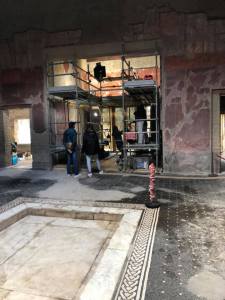
While touring, you’ll see people working to restore and preserve what is there.
Herculaneum street
Original wood in a wine shop
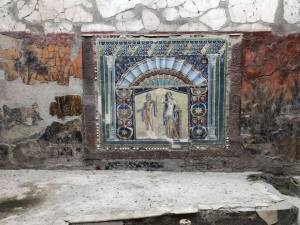
Neptune and Amphitrite
A Thermopolium where it is believed food was sold
Herculaneum with Pompeii in the background
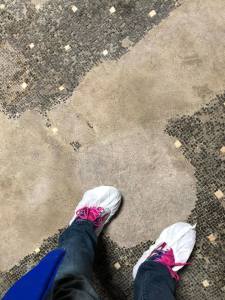
We spent several hours walking around Herculaneum, which is situated between Ercolano and about a mile or so of coastline before the sea, and were awed at the mosaics preserved within structures such as the bath house and another home where crews were actively restoring the mosaics as well as the frescoes. They even made us wear paper covers on our shoes so we didn’t damage their careful work.
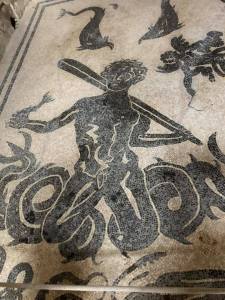
Mosaic in the female bath house
Squid
Octopus
What has been unearthed is amazing, but it’s even crazier when you realize how much of Herculaneum is still buried under the town of Ercolano. The unearthed section is quite small when you consider this was a city of 4-5,000 people. Seeing the original wood still intact in some of the structures and the mosaics is well worth the time—even in the rain! We spent several showers in certain structures before we could walk around again and enjoy the site.
Restoration in progress
Bootied feet!
Like a welcome mat
Another great mosaic floor
Horses in relief
Skeletons in the boat houses
When we left Herculaneum, we walked back up the hill to the train station. Restaurants in some European cities will have someone outside whose sole job is to get people inside to eat. When you stop in Ercolano, the restaurant just outside the train station is terrible about it! The man whistled at my underage daughter trying to get our attention. He didn’t seem to care that I was furious, only that he had my attention. Needless to say, we didn’t stop to eat and boarded the train in the direction of Pompeii.
Next up … Pompeii and the rest of our trip to Naples!