What is in store for October? Well, I’ve been busy prepping and pulling things together, so there’s bound to be something big! We’ll start from the beginning of the month and move forward from there.
Monday, the call for questions goes up for Ask the Author. Kara Louise is our guest/victim this month, so I’m certain everyone will want to submit a question or two. Someone is bound to be curious about one of her books!
I hope to get a few more expat posts up, though I feel as though I owe an apology to those who do follow my ramblings. I became side-tracked prepping The Earl’s Conquest for publication and it has almost taken over. I do promise to get a few posts up after Ask the Author is completed. I want to make sure Kara has your undivided attention for her interview. I just need to remember where I am on my trip. I think I was getting ready to tell you about Durham and Yorkshire–and then there’s Bath to add! I’ve been rambling a lot!
Last but certainly not least is the release of The Earl’s Conquest! Mark your calendars! October 28th is the day. Pre-order is up at Amazon, so don’t forget to reserve your copy. I doubt their estimate of 209 pages is correct, however, since I added a preview of the first two chapters of An Unwavering Trust in the event someone hasn’t read it. All I need to do is finish proof-reading and formatting it!
We arrived at Edinburgh after driving through the rain all day on a Friday. The weather had cleared by the time we arrived in Edinburgh, so we walked down to the town centre for a look around and dinner.
The next morning, we visited the Georgian House, which is a National Trust property in Charlotte Square. It was disappointing that I was not allowed to take photos inside the house, but it was interesting to walk through. They have a great medicine box with labelled bottles of old remedies with a legend explaining what each cures. The kitchen was great as well. The guide explained how everything worked, which fascinated my children.
After lunch, we went to Holyrood Park for a walk and to catch a glimpse of Arthur’s Seat. I didn’t realise we would be so close, so one of my daughters and I were not wearing the proper shoes for a climb. We ended up climbing the neighbouring hill to look at St. Anthony’s Chapel. The climb is a bit steep in a couple of spots, but not a difficult one or a long one. The view is definitely worth the effort!
Arthur’s Seat
View from St. Anthony’s Chapel
That evening, we returned to the town centre so my children could ride the ferris wheel and for dinner. Since we were in Edinburgh during the Fringe Festival, it was rather difficult to find a table for six, but a nice couple and their friend were kind enough to save us their table when they were ready to leave.
On Sunday, we spent the day at Edinburgh Castle, which has a lot of great places to see–the Great Hall, the Crown Jewels, and various war memorials. Then there are the views of Edinburgh, which vary depending upon where you are in the castle. It was an interesting place to visit and we enjoyed each of the different exhibits and views!
Edinburgh Castle
View of Edinburgh from the Castle
Edinburgh Castle
Edinburgh Castle
Some other things to do are The Royal Mile – we did walk down the Royal Mile while we were there. I enjoyed Rose Street, which is a pedestrian road with a multitude of pubs (We had a laugh at one named Dirty Dicks–especially because people would pose for pictures outside of it) and shops. Princes Street also has a view of the castle as well as a lot of shops and touristy things.
I wish I could’ve seen more of Edinburgh, but we left first thing Monday morning to visit a friend in Durham and to visit Yorkshire–which are up next!
Chatsworth was first built in the 16th century, but the home we are all so familiar with was when Chatsworth was re-built by William Cavendish, 1st Duke of Devonshire in 1696. Over time, the original structures were added to, and the North Face of the structure was altered by the 6th Duke of Devonshire in the 19th Century. All of the little renovations and additions over the centuries have culminated in one of the grandest homes in England.
The drive alone to reach Chatsworth is a scenic one since the property is in Peak District National Park. The countryside is beautiful, and the villages and towns are all old and quaint. As you enter the grounds, there are several old stone bridges which are one way, either you must watch and wait or there is a traffic light indicating when you have your turn; however, once you reach Chatsworth from the other side of the River Derwent, it cannot do anything but hold your eye.
Since I am exceedingly cheap and did not want to pay for parking, I purchased our tickets online a few weeks prior to our trip. There is a large car park to the left of the house, but we were ushered into the overflow parking in a large field between the front of the house and the river.
One thing I will say about Chatsworth is that the employees were some of the nicest people! When we began to approach the house, a woman at the gate gave us detailed information about the different places for us to get the children a snack and then after, she was in a different position, but directed us to the correct counter once we entered. It was preferable to waiting in the queue!
From the entry point, the house is roped off in such a way that you follow the path through the house for the tour. After passing through a corridor, you are taken to the Painted Room–the entrance hall in the 2005 Pride and Prejudice. In my opinion, while it is amazing in the movie, it is more incredible in person. The marble floors and the paintings covering the walls and the ceiling are breathtaking. There are also diagrams that tell you the identity of all the Greek deities on the ceiling. There are painted ceilings in quite a few rooms, when you tour this house, so always look up when you enter a room! You don’t want to miss any of the artwork!
After the Painted Room, the tour progresses through rooms built in the event of a royal visit. All have painted ceilings and ornate furniture with dark panelled walls. These rooms were interesting, but I did not enjoy them as much as the remainder of the house. The rooms that had authentic Georgian era chinese wall fabrics and were more likely family bedchambers and rooms intrigued me more.
The library is huge, and unfortunately, roped off, but the door is left open for the public to see inside.
And then there is the artwork!!! Portraits by Gainsborough and portraits of Georgiana, Duchess of Devonshire, George IV as well as others line the walls. Then there are the sculptures. My favourite was the “A Veiled Vestal Virgin” (Raffaelle Monti, 1847) who is near the library as you’re walking through. I heard people asking the guides posted throughout if the entire sculpture is marble and even had someone who looked at me amazed when they commented, “It’s all stone!” It is a marvel that the artist managed to give the detail of her face through her veil, and my favourite part of the piece.
The sculpture gallery is the last room of the tour and incredible on its own. I was already familiar with Neoclassical sculptor Antonio Canova, who has several sculptures in this room, as well as replicas of his work sculpted by the master’s students (the lions). The room is beautiful, and I have to say that I spent a good twenty minutes to half-hour going through the room piece by piece, taking photos and studying the works.
Of course, every house you tour has a gift shop, but what’s special in the Chatsworth gift shop? You can take your picture with the sculpture of Mr. Darcy (Matthew MacFadyen) from the 2005 movie. Did I take my picture with him? No. I did take a photo of him, and get a giggle over the sign asking ladies not to kiss Mr. Darcy.
I wish I could say that we were able to go through the entire gardens, but the day was one of those misty at times and drizzly days. Other than a few drops, we managed to avoid a lot of the rain as we looked, but my children wanted to go to the play area before everything closed, so after viewing Paxton’s rock garden (by the Paxton who designed the Crystal Palace), the maze (yes, there is a hedgerow maze), and a few of the conservatories and the cascade, we left the house for the playground.
At the end of the day we set up our picnic blanket at the edge of the River Derwent, but that was when the heavens opened and the rain began falling more steadily. My husband did pull over as we drove out so I could walk into a field and take one last picture.
First word of advice if you are looking to visit this site is to make certain your directions are good! I couldn’t get the sat nav/GPS on the car to find the site, and the Apple App found it first. We followed that to the Matlock town centre–not where this site is located!! The Google Map app found it, but took us to a narrow country road where it claimed it was at the bottom of a public footpath with a lay-by for parking. Fortunately, my husband asked someone passing, who told us where to go to find an easier trail.
The problem is that the site is not marked–at all! No street signage or anything until you reach the footpath at the top of the hill where there is minimal parking edged with stinging nettles. We had to all crawl across to the driver’s side to exit the car. Then about 100 ft into the walk is a sign explaining the site where the trail splits in two with nothing to tell you where to go. We discovered later that both trails take you to the same place, but we did worry that we had taken the incorrect path at first.
Now, complaints aside! I must say that it is an interesting place! Watch for the presents left by the cattle and sheep along the footpaths, but the view along the walk is pretty. There is an old train nearby because we could hear the whistle and the chug as it moved along through the valley.
Nine Ladies
Heather
Nine Ladies Stone Circle is a Bronze Age stone circle, which means it dates back to between 3200-600 BCE according to the European Bronze Age. The site is in Stanton Moor, located in Derbyshire in Peak District National Park.
When you get closer to the stone circle, you walk through a bit of a wood with heather interspersed with the long grass and other wild flowers and weeds. The Nine Ladies, which are traditionally thought to represent nine ladies turned to stone for daring to dance on a Sunday, sit in a clearing surrounded by trees and heather. They don’t come far out of the ground, but do make a circle.
A nearby tree has various ribbons and homemade ornaments adorning it. We were fascinated by them, and while looking were informed by the mother of another family visiting the site that they were “wishes”. She offered us a bit of torn material or “ribbon” from a scarf she was wearing, and the children had a great time making their own wishes and tying them to the tree.
For those who find the stone circle, there isn’t much more than a short walk (if you find the trail at the top of the hill) and the circle. The stop would have taken us not more than a half-hour detour out of our way to Chatsworth from where we stayed in Ashbourne if we hadn’t taken the scenic route through Matlock 😉 . I do have to say that it was fun driving through Matlock! Unfortunately, I was too busy navigating us around to take any photos! 😦
One can see a lot of beautiful scenery simply driving through Peak District National Park, but when you get the chance the ability to hike it is tiring but amazing. The National Trust site said the hike through Dovedale was easy, but once you pass Thorpe’s Cloud, the walk can be a bit more challenging. Climbing Thorpe’s Cloud is definitely difficult and I didn’t even go all the way up!
Ilam Park
The National Trust maintains Ilam Park, a 158 acre estate dating back to the 16th century. The grounds are still maintained around the house as part of the buildings contain National Trust guide offices. The house itself is leased to a youth hostel and did not appear to be open to the public.
The walk begins at the front of the estate and passes the church, through the town to a field across from the River Manifold.
Through the field
Along the trail
River Dove
After passing through several fields by gates and climbing stiles, you reach a car park near the River Dove where there is a small National Trust booth selling guide books and souvenirs.
From there, the walk proceeds down the River Dove which separates Derbyshire from Staffordshire until you reach the “Stepping Stones.” The stones have been reconstructed, but can be crossed to reach the opposite side of the river, depending upon whether you crossed the river by the bridge near the car park.
Stepping Stones
Stepping Stones
Peaks from partway up Thorpe’s Cloud
At the Stepping Stones, Thorpe’s Cloud can be climbed and crossed to reach the town of Thorpe on the opposite side. I admit to climbing a portion where I stopped and let my husband take my children to the top. It can be rather steep and I wanted to walk more of the path which stretches to Milldale.
Tissington Spires
Tissington Spires from a different angle
Once you pass Thorpe’s Cloud, the walk becomes a trail of natural sites, which you can trace in the guide-book, should you purchase one or a map printed from online. We passed Dovedale Castle, Lover’s Leap, Tissington Spires, and followed the path to Reynaud’s cave where we turned back.
I have seen maps online which suggest there is a path which circles back when you reach Milldale, but we were at Lover’s Leap when my children and mother-in-law were worn out. My husband and I were the ones who pushed further forward. Maybe next time we’ll finish the entire trail!
For those who enjoy hiking with your dogs, the trail is a common destination for people and their dogs. It was a great time watching those who enjoyed playing in the water. I have to say that the water was some of the clearest I’ve ever seen for a river. My children said that it was freezing when they waded in it! I’ve posted a map with this post to get an idea of the entire trail and the part we walked. I definitely recommend the experience. The scenery is breathtaking!
This was a difficult trip! We set out to drive almost an hour and a half to see this nature reserve just outside of Colchester in Sussex, but from there we had a myriad of difficulty finding the place. We punched the location into the sat nav (GPS) and found ourselves in the middle of a neighbourhood. We happened to find one entrance by a single sign, but there was only street parking and no one else was parked along the road. We then tried the second sat nav and after giving up on its direction, turned around to happen upon another place to enter the park, but again, no parking other than on the road (I won’t even go into our attempt to turn into the local Aldi for parking!) — I will say that the parking issue was unusual in our experience for an English Heritage Site. Eventually, we decided to park on Church Lane and go into an entrance labeled Lexden Nature Reserve. According to Google Maps, it is a part of the Earthworks, but we could not tell on the map on the sat nav, and it’s not labelled as such when you arrive at that entrance.
Field upon entering
Old Oak Tree
Trail
The forest was lovely with a myriad of paths and pretty views. There are plenty of old wide-trunked oaks that are a lot of fun. Unfortunately, we had no idea through means available to us how large the Earthworks was, so after a short time and not seeing anywhere new to wander and due to the rain, we decided to leave.
I wish I had more on this, but I felt it might help someone else if I posted our experience. If you want to give the Earthworks a try, I wish you better luck than we had!
During Jane Austen Regency Week, we had a free day, so a group of us ventured to Winchester to the Cathedral so we could see Jane Austen’s grave and the house where she died.
The drive in itself was lovely, and I enjoyed catching glimpses of the picturesque countryside as I drove along. Parking is simple as it was just as we came into town from A31 and we made our way to the cathedral only to find that it was closed to prepare for a flower show that occurs every two years at the Winchester Cathedral.
We were disappointed, but moved on to College Street and the home where she died where we took pictures of the house and the surrounding area as someone pounded away on a piano inside.
Wykham Arms
House where Jane Austen died
A short walk down the road was the Wykeham Arms, a pub that was once a coaching inn and was likely where a post coach carrying Jane Austen would have come into Winchester.
Street view
Guildhall
After a quick cup of coffee, we walked down to the mill and toured the old flour mill. The best part of the experience would be going downstairs to see the water wheel, and the small island behind the mill where it now resembles a garden rather than something for livestock.
waterwheel
back garden at Mill
Winchester has a great old feel and it was a lot of fun just to wander. I can’t wait for next year when the flower show is in Chichester and we can see Jane Austen’s grave! (Why does that seem strange to be excited for that?)
In my previous post, I went over the Alton portion of Jane Austen Regency Week and in this post, I shall cover the Chawton events and sights I was able to enjoy while in Hampshire.
It is very difficult to find anything on the history of Chawton prior to Jane Austen. The fact that she lived there from 1809-1817 seems to have taken over any search of Chawton history, yet the town is steeped in Austen whether a particular cottage housed a labourer who worked on Chawton Cottage, or you venture down to Chawton House to take a tour of the library and its gardens.
My first experience of Chawton was walking to the village for lunch prior to the walking tour I took on the first Sunday of Jane Austen Regency Week. We dined at Cassandra’s Cup, a quaint teahouse directly opposite Jane Austen’s house, and chatted until it was time for the tour.
Jane Hurst discussing the thatched cottage in the background
A Cottage in Chawton
Labourer’s cottage
The walk, given by local historian Jane Hurst, began at the underpass between Alton and Chawton and made its way through the picturesque village as she explained different aspects of the roads in the early 19th century and a multitude of cottages. Ms. Hurst is remarkably knowledgeable and able to quote Jane Austen’s letters when she explains the connections, giving you a more in-depth and personal look in to the occupant of the dwelling and their impact on Austen’s life.
We returned to Chawton on Tuesday when I was able to tour Jane Austen’s house. The experience for me was extremely moving–particularly her writing table. I could not help but take a photo of the table and her chair, but also the top, which has some small holes and is very dark, almost indicating a good deal of ink made it to the table itself.
Jane Austen’s House
Jane Austen’s Writing Table
The worn and stained top
Tuesday night at the house was a special opening and tea service. Guided tours of the attic were given, and I was thrilled to be allowed inside a part of the house rarely opened for visitors. With the narrow and confined quarters and warped floorboards on the stairs, it is no wonder they do not open it on a constant basis.
View from the Attic Window
The unfinished portion of the attic
I must say that I enjoyed wandering the house and gardens. I found it rather surreal to look out of the windows and knowing that Jane must’ve looked out and viewed a similar prospect.
Pasture as you walk up the drive to Chawton House
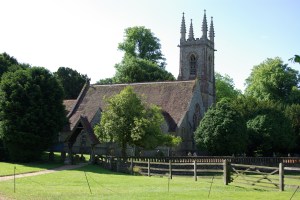
St. Nicholas Church
Chawton House
My adventure with Jane Austen Regency Week ended on Wednesday morning, but I had not been able to see Chawton House, the home of Edward Austen-Knight, Jane’s brother, so I drove down and parked along the roadside. I could not resist the lure of grabbing my camera and taking a multitude of pictures as I walked down the lane–until I met up with the gate since the house was closed. Not to worry though! I will see it another time!
July is upon us and it’s definitely summer here in England–I have the sunburn to prove it!
Anyway, as everyone has likely seen on my Facebook thread, I have returned from Jane Austen Regency Week with a ton of photos that I have posted. The group who attended from Austen Variations has posted their photos as well, and we will be blogging the event on the Austen Variations site over the next two weeks as well.
I have already blogged my impressions of the week here, but of course, the Expat will cover each location and a bit of the week as well. You can look forward to those.
For those awaiting Ask the Author, Maria Grace has graciously offered to answer your questions this month! Her new book, Mistaking Her Character is out at Amazon, Barnes and Noble, iBooks, etc. Don’t forget to stop by and ask that nagging query you’ve always wanted to know! Call for questions goes out Monday, July 6, and Maria Grace has offered an e-book as a giveaway!
Other than the blog, I plan on writing! My calendar has cleared of travel–except for sightseeing on weekends, that is, and I look forward to attempting to get some of this in my head down in a document. We’ll see where that goes! 🙂
The town of Alton began as a Saxon village first noted in historical record in 1101 and grew into a small market town by the 13th century. Today, it is a pleasant mix of old architecture and new with a unique feel and atmosphere. I visited Alton as a part of Jane Austen Regency Week that is held here and in Chawton during the last full week of June every year.
For those who are unfamiliar with Jane Austen’s link to Alton, Alton is adjacent to Chawton where Jane Austen lived from 1809 to 1817 with her mother and her sister Cassandra and also where she wrote the final drafts of Sense and Sensibility (1811), Pride and Prejudice (1813), Mansfield Park (1814), and Emma (1815). Although Persuasion was completed in 1816, it was not published until a year after her death (1818), the same year as Northanger Abbey.
The 2015 Jane Austen Regency Week kicked off with a Regency Day, which was very much an outdoor market environment with vendor stalls. A variety of merchandise was for sale including children’s handmade dresses, Jane Austen inspired books (I’ll leave you to guess who manned that table 🙂 ) and I believe I even saw one selling ale and cider.
Author’s table
Hoppy Horse
Sword fighting!
For additional entertainment, the Dandy Chargers glided down High Street on their “Hoppy Horses” along with a maypole dance, and sword fighting exhibitions.
Unfortunately, a muggy day (For England) and intermittent rain slowed down the people attending the event, although many still took a chance with the weather to come out and stroll down High Street where quite a few buildings boast connections to Jane Austen.
Before the Ball
Dance re-enactment
Saturday evening, a ball held in the Assembly Rooms drew quite a crowd with a group who led and helped teach the Regency dances we so commonly see in movie adaptations or read of in novels.
On Sunday, I took part in a walking tour of Chawton (I will blog about this when I cover Chawton), and attended an Evensong service at St. Lawrence Church where two of Jane Austen’s brothers preached and several of her nieces and nephews were christened. The music was lovely!
Abigail Reynolds Talk
Writer’s workshop
The last of the events I attended were an Abigail Reynolds talk at the Quaker Meeting house and a writer’s workshop also given by Abigail Reynolds at the Alton Community Centre, which were both entertaining and informative.
Unfortunately, all good things must come to an end, and so did my time in Alton. Please check back for my part of the week in Chawton. There was simply too much to put into one blog post!
Lastly, I would like to thank Kate of Old Timbers Bed and Breakfast for her wonderful cooking and for sharing her amazing old home! I was just outside of Chawton in Farringdon, which is a picturesque village and convenient (with a car of course) for access to both Alton and Chawton.
 Monday, the call for questions goes up for Ask the Author. Kara Louise is our guest/victim this month, so I’m certain everyone will want to submit a question or two. Someone is bound to be curious about one of her books!