One thing I’d heard about and hadn’t done was the Hitchin Lavender fields, so we packed up one Saturday in late June and headed out to Hertfordshire to pick some lavender. The farm is open 10-5 almost all summer and I thought the cost was pretty reasonable for a day of picking. Adults cost £6 and under 14 cost £3 and under 5’s are free. For that price, you get a small shopping bag and the loan of a pair of scissors to cut as much lavender as you can fit into the bag.
Armed with our scissors, we started into the rows. They ask you go a certain distance in before you start cutting, so we walked in and started filling. It takes longer than you might think to fill that little bag, but of course, that depends on how picky you are about which pieces of lavender you take.
My advice is to wear trousers/pants–even if it’s hot! One thing is that bees are everywhere! My husband and I both wore shorts and both of us ended up stung because we missed the bee hiding on the underside of a stalk as we made our way through the lavender.
My hubby in the grey shirt
Hitchin Lavender also has a gift shop, a place to buy lavender to grow, as well as a cafe where you can sit on a patio and eat lavender flavoured ice cream. It’s not a full day, but it’s definitely a fun couple of hours. We didn’t stay too long because it was a really hot day and we wanted to cool off and eat some lunch, which was easier said than done in England when England is playing on that day in the World Cup.
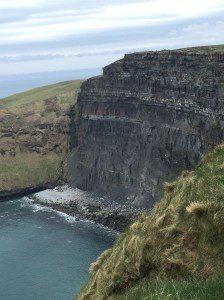
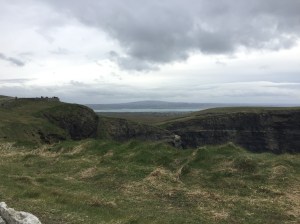
From Kerry, we travelled north, taking the ferry between Tarbert and Killimer on our way to the Cliffs of Moher. Located on the western coast, you might recognise these famous cliffs as the Cliffs of Insanity in The Princess Bride or as the cliffs with the cave in the beginning of Harry Potter and the Half-Blood Prince. However, these cliffs are far from a new tourist attraction. Irish travel journals from as far back as 1780 even document the scenic nature of the cliffs.
Now, a tourist centre and education centre marks the site at the bottom of the hill. The admission is not unreasonable. Adult admission is 8 euros, but children under 16 are free, which helped a lot!
My son was fascinated by the geology of the site. 320 million years ago, the cliffs began to form when heavy rainfalls and floods caused dirt and sand to be washed into a river and collected in the delta where it ran into the sea. Those sediments were compressed, forming what we see today. The education centre focusses on this and has some wonderful interactive pieces for children. The weather was windy and cold when we visited, so the education and visitors centre were great for a break from the chill.
A portion of the cliffs have walkways and barriers to help prevent accidents, but trails do extend beyond the limits of the site. Due to the proximity to the edge and the wind, we decided not to take the trails. Frankly, it made me uneasy with the children. The wind threw us off-balance a little while we looked around, I didn’t want it to happen on a trail so close to the drop. Many tourists did opt to take the trails, and I’m certain the views were incredible.
We spent a good bit of time exploring the cliffs and ate lunch in the cafe before we loaded back up into the cars and continued our journey to Galway. The drive up the coast was beautiful. I wish I could say that we explored Galway more, but by the time we checked into our lodgings and ate dinner, it was raining and late. We opted to sleep rather than explore before we left early the next morning for the north.
Next . . . Northern Ireland, Giant’s Causeway, and the Dark Hedges.
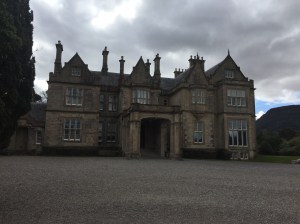
While in Killarney National Park, one common tourist attraction is Muckross House. Finished in 1843, Muckross House was built by Henry Arthur Herbert next to the picturesque Muckross Lake. The house is now furnished in the style of the 19th century and has several furniture pieces crafted locally back in the day. There are also renovations from when Queen Victoria visited the house in 1861.
Muckross House
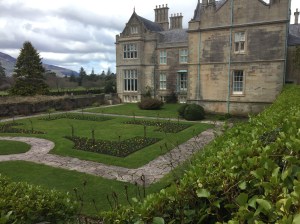
Gardens
Muckross Lake
Muckross House is by tour only, so when you arrive, you pay and sign up for a guided tour. The tour takes you through nearly all of the house and is extensive. Unfortunately, they do not allow photos inside the house, so I cannot share any from inside the house with you. I can, however, share a few from the gardens.
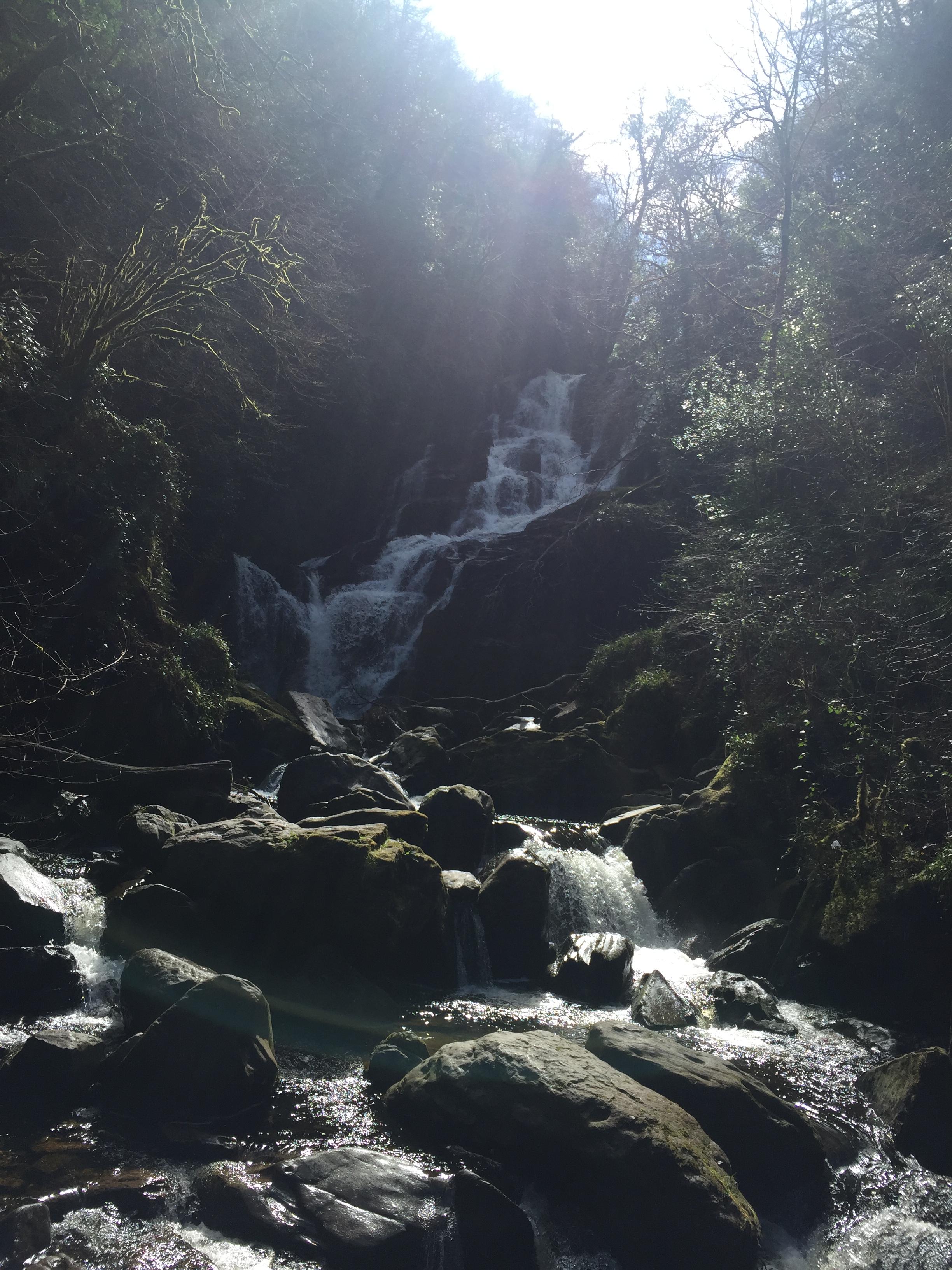
After our tour of Muckross House, we walked to Torc waterfall, which is not far from Muckross Lake. It is a popular tourist attraction and lots of the bus tours of the area stop to see the falls. They are lovely and it was nice to simply sit and watch them. There are additional stairs to climb Torc Mountain and view the lakes below, but my daughter and I opted to sit near the base of the waterfall and enjoy it since our legs were rather tired from all of the walking.
While I loved Killarney National Park, I found myself disappointed with Muckross House. Maybe I’ve been spoiled a bit by National Trust Homes in England, but I felt let down after the tour. I also don’t care much for guided tours since I enjoy taking my time and studying the artwork and not being hurried along to keep up.
I did enjoy the grounds and Torc Waterfall is definitely worth the stop. However, there is a car park just off the main road that is much closer than parking and walking from Muckross House.
From Rock of Cashel, we continued driving west to County Kerry where we toured for two days. We stayed in a great Airbnb home near Kenmare and drove out from there. The location turned out to be perfect since we were situated right at the beginning of the Ring of Kerry, which is what we did on the first full day.
If you’re wondering what the Ring of Kerry is, it’s a drive actually. If you’ve ever driven down Highway 1 in California, it reminded me a little of that except it curves down through the town of Killarney as well as Killarney National Park. It’s a 3-4 hour drive (approx. 110 miles) of quaint Irish villages, forests, rocky coastlines, and a few sandy beaches along the way—and a castle or two of course. We really didn’t stop for any of the castles. We stopped more for scenic vistas than anything else.
Driving out from Kenmare, we set off mostly through the forest, though you could see the bay peeking through the trees. Not all of the drive was directly along the coast, which made for some amazing views with the pastoral landscape in the foreground.
From the beginning of the drive
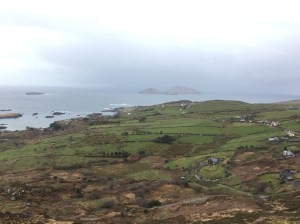
Amazing views
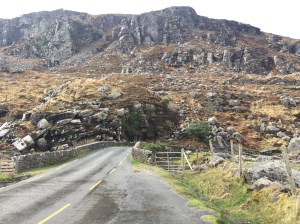
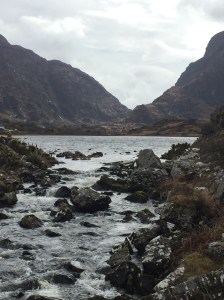
As we curved south toward Killarney, we stopped at the Gap of Dunloe, a rather narrow pass between MacGillycuddy Reeks and Purple Mountain. This amazing place was formed by glacial flows and where the Loe river now flows. We followed the GPS/SatNav until we reached a small cafe. We briefly stopped thinking we could drive no further. The weather had been rainy all day and it was still a bit drizzly when we arrived. There is a horse and cart for hire than can take you out along the small winding road into the Gap, but we didn’t take one. I will say that when we mentioned driving, the cart drivers told us not to even though we saw a lot of cars driving out from the road.
Looking back at Wishing Bridge
Wishing Bridge
Gap of Dunloe
Since the weather seemed to be clearing a bit, we decided to chance it and drove down to a small lay-by on the other side of the “Wishing Bridge.” It’s said that wishes made on the bridge come true. I wish I’d known that at the time. We then walked around the bridge and took pictures before walking back to the car and driving a little further. Worried we might not find a better place to turn around, we turned back before the end and headed back along the Ring of Kerry towards Killarney.
Killarney is a neat town and we stopped in for a late lunch and to grab a few groceries for breakfast the next morning before we drove back through Killarney National Park, finishing the Ring.
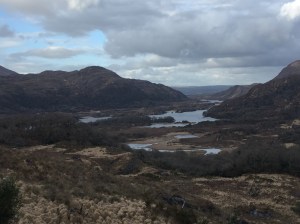
The road through Killarney National Park is much more windy and a little more narrow than the road along the rest of the Ring of Kerry. That said, there are lay-bys where you can get out and take pictures of the more picturesque views. Killarney National Park is a mountainous area where you can see the highest mountain range in Ireland as well as the Killarney lakes.
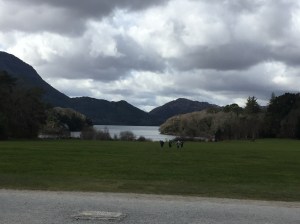
Killarney National Park
The park is a total of 25,425 acres and became a national park in 1932 when Muckross House was donated to the country. It is now a UNESCO Biosphere Reserve and a Special Area of Conservation as it contains the only Red deer herd remaining in Ireland as well as Sika deer which were introduced for hunting by the owners of Muckross house in the 1860s. We had one a Sika deer cross the road in front of us during one of our drives through the park. Thank goodness I wasn’t driving very fast!
The Ring of Kerry and Killarney National Park are definite must-sees for this part of Ireland. I wish we’d had more time to see a lot of the little bits and pieces we missed along the way.
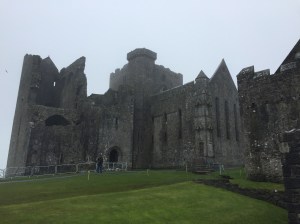
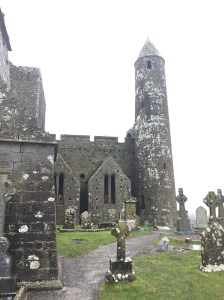
After two days in Dublin, we packed up and loaded into the car for a drive to Kerry, but on the way, we took a little longer route to stop at Rock of Cashel. Rock of Cashel (Carraig Phádraig) has also been called St. Patrick’s Rock and Cashel of the Kings. Sitting high on a bed of limestone, Rock of Cashel is a Medieval castle located on the edge of the town of Cashel in County Tipperary.
Rock of Cashel from the entrance
The round tower
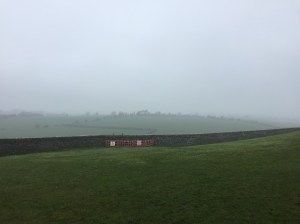
The foggy view
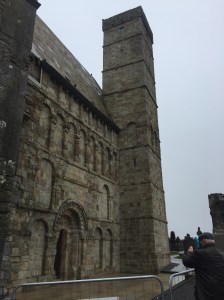
According to legend, Rock of Cashel is where Aenghus the King of Munster by St. Patrick in the 5th century. It was also the seat of the High Kings of Munster before the invasion of the Normans in 1101. What is present at the site now was built in the 12th and 13th century and includes the round tower (dating from 1100), Cormac’s Chapel (built 1127-1134), the cathedral (1235-1270). A graveyard surrounds the site where people are still buried to this day.
In the cathedral looking toward the altar
Inside the cathedral
Inside the cathedral
We had cold, foggy, rainy weather during our visit to Cashel, but it didn’t stop us. Rather, we made a detour into the wool store at the bottom of the hill for gloves and hats before we took the steep walk up. Admission is very reasonable, especially considering they have regular guided tours around the grounds. We didn’t follow one of the guided tours, but we did listen in to two of the tour guides as they talked to their groups. They had a lot of great details. For example, where most churches are built east to west in orientation of the gothic cross, Cashel is set the opposite. It’s said it brings bad luck.
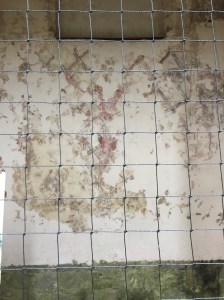
Remains of a Fresco inside the cathedral
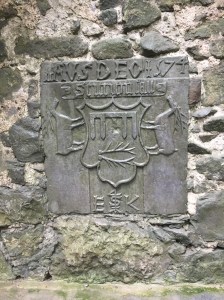
Headstone inside cathedral
Cormac’s Chapel
The cathedral itself is still sizeable, even in ruins. The clergy buried inside at the altar were moved at some point and have great carvings on the gravestones. The guides even show the small holes where lepers were once allowed to listen to the service.
Renovations were currently underway inside Cormac’s Chapel, so part of the grounds were blocked off. Cormac’s chapel is alongside the cathedral and almost seems much newer by the difference in the stone from the rest of the structure, however, it’s just as old.
If you’re out and about in Ireland, it’s definitely a must see!
Next up… Ring of Kerry, Killarney National Park, Gap of Dunloe
For spring break, we planned a crazy circuitous route around Ireland. We started by driving to Holyhead, Wales to board a ferry that would take us to the port in Dublin. I’ve never been aboard a ferry before, but because the trip is a little over three hours, the ship is more of a mini-cruise ship. Two floors were dedicated to entertaining guests with a place to eat, a bar, a duty-free shop, and a small cinema, giving something for everyone in the family. We took the eight a.m. ferry and were in Dublin just after noon. While we travelled, we ate breakfast, my son watched a movie in the cinema, and the rest of us alternated between walking on the deck and working/homework.
Once in Dublin, we met the rest of our travelling party at Jervis shopping centre, checked into the flats where we would be staying, and a large part of our party went to the Jameson distillery for a tour while I stayed with the children. (I’m trying to get my husband to write a guest post for the tours he took that I didn’t.)
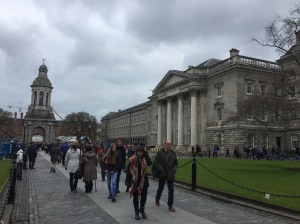
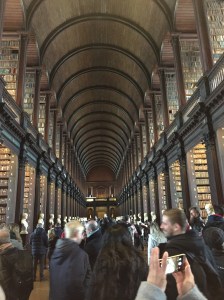
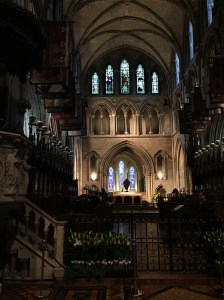
The next morning, we walked to Trinity College to see the Book of Kells and the Long Room. The Book of Kells is an illuminated manuscript made in the 9th century and details the four Gospels containing the life of Jesus. It is displayed along with other artefacts and very interesting, though you can’t take photos of the book. You can take photos in the old library long room, which is gorgeous and it’s nice to just sit and take in the surroundings.
Trinity College
Trinity College
I definitely recommend purchasing your tickets ahead of your visit. We purchased ours online, which kept us out of the queue, but we still had a thirty minute wait until our show time. The manuscript was interesting and I loved the Long Room. I even found a Jane Austen link!
Long Room
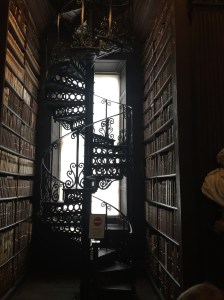
Love that staircase!
It’s Tom Lefroy!
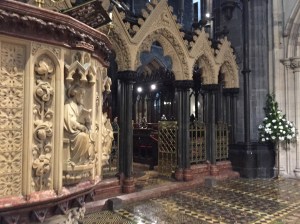
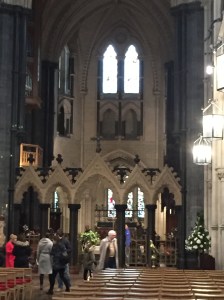
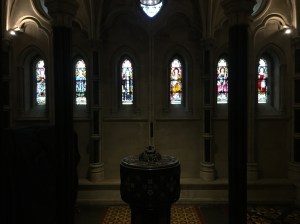
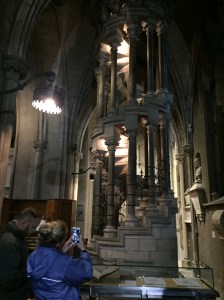
After Trinity College, we toured Christ Church Cathedral. Where the church sits began as a site of worship in 1028, and in 1108, the previous wooden structure was replaced with a stone building that was added to over time until it is what it is now.
Christ Church Cathedral
Christ Church Cathedral
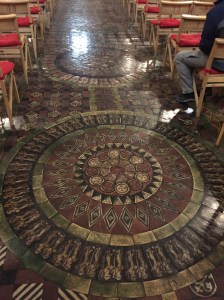
I love the floors!
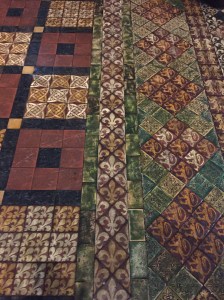
More of the tile work!
Baptismal font
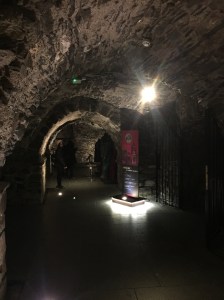
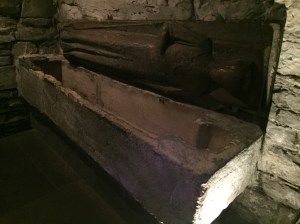
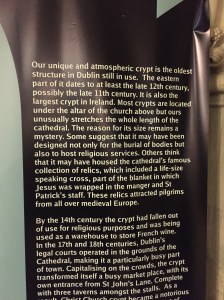
Christ Church Cathedral also has the largest crypt in the UK and Ireland. Visitors can walk around inside the crypt and there are also a number of exhibits down there. It’s said that at one time part of the blanket from the manger was stored down there.
Crypt
Crypt
Crypt
About Christ Church Crypt
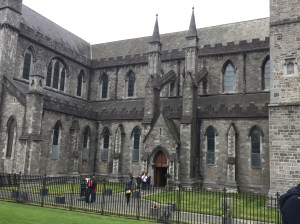
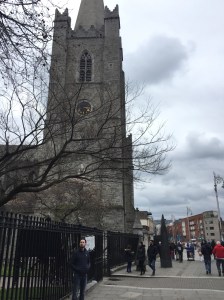
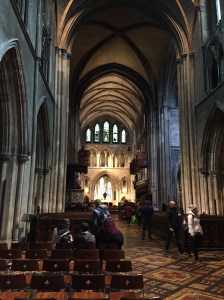
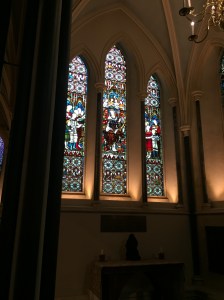
After, we walked down to St. Patrick’s Cathedral. History says St. Patrick baptised people on the site, which became a church in 890. The first cathedral was built between 1191 and 1212 and the current cathedral was built between 1220 and 1260. Like most large cathedrals, the original structure was added to over the years until it became what it is today.
The inside of both cathedrals was amazing and definitely worth seeing! We walked and took pictures until we didn’t know what to take pictures of anymore. After we ate dinner and returned to the flat to get some sleep for the next day.
One thing we didn’t get to do the last time we were in Venice was take a water taxi out to Murano and Burano. When you walk through Venice, the stops for the water taxis are scattered all over, but we just never thought to take one since you could see so much by foot.
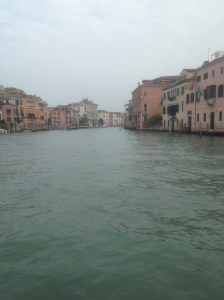
Down the Grand Canal
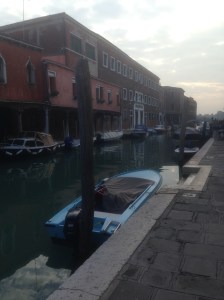
A canal in Murano
A square in Murano
Murano is a cluster of islands located in the lagoon near Venice. A series of bridges link these small islands and allow for you to walk around Murano much like you would Venice. This part of Venice was originally settled in the sixth century and thrived as a fishing colony until the glass makers moved to this area to keep fires from breaking out in Venice. Since then, Murano has been all about glass. When you tour Venice, there are stores boasting of Murano glass and when you exit the water taxi, there are stores immediately off the boat selling everything from water glasses and hand blown animals to the ornate.
We paid for a day pass on the water taxis and started at Ferrovia, which is the stop just outside of the train station and travelled down the Grand Canal until we exited into the lagoon. We skirted along the Cimetero San Michele, an old island cemetery I’d love to walk through if I had the time and chance, until we reached Murano at the Colonna taxi stop.
We perused several shops and even bought a few small pieces of Murano glass (hopefully we didn’t get suckered into Chinese rip-offs!) and eventually walked to the Faro taxi stop where we boarded another boat headed to Burano.
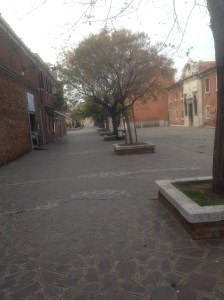
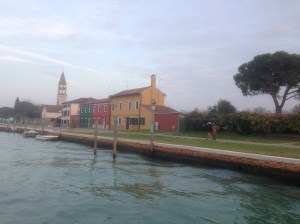
As you approach Burano, the first thing you notice is how different it is to Murano as well as Venice because of the brightly coloured homes visible from the boat. Burano, however, is famous for its colourful homes as well as lace and seafood. We arrived in Burano late afternoon and our first stop was for food. We found a nice little restaurant, but little did we know what would come of this little adventure.
Approach to Burano by water taxi
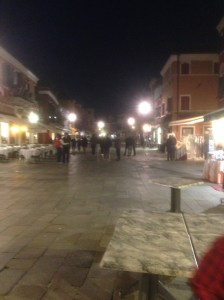
Burano at night
A number of restaurants around Venice have a seating charge, so they charge so much per person as soon as you are seated. This one not only had the seating charge, but each meal was actually more a meal for two or three people and the charge in the menu was per person. It added up quickly. That said, the food was incredible and the Prosecco, made homemade there was amazing, the bill left something to be desired at the end.
(The day had turned a little misty by the time we made it to Burano, so my photos weren’t great, but I found this one below to give an idea of how colourful the houses really are.)
By the time we finished our meal, it was getting dark, and everything in Burano was closing since it was a Sunday. We waited for a water taxi and boarded the first one even though it went to Treporti and then doubled back. We just wanted to sit. We took the boat to San Marco at the Piazza San Marco and then found a boat that took us back to Ferrovia so we could take the train back to Marcon.
If you go to Venice, Burano and Murano are not to be missed!
I still owe you blog posts on my last trip to Venice, but February last year and this year has been a busy time. I coach on a swim team that travels (which is why sometimes a place gets blogged twice!) and we had our Divisionals competition as well as Champs this month. It’s been a bit of a whirlwind, but the group of kids is amazing and I’m privileged to help them along. They always amaze me with their dedication and the ability to come through when it counts and improve. Most of our swimmers had personal best times, and that alone makes me celebrate.
On a writing note, I’ve completed the Christmas story I started in shorts during December. A bit has changed since then because it didn’t work as well in a longer format, but it’s in betaing at the moment and I plan on releasing it in time for the holiday season this year. I do plan on including the short story at the end for a bit of fun and for those who enjoyed it and would like having a copy in the book. 🙂
So, what am I working on now besides editing? I am back to work on writing a full-length story from the 50 Shades of . . . Jane? shorts. I have six chapters and I’m hoping to get going again now that my schedule has a slight break. When I’ve completed that, my plan is to write Lydia’s story from Particular Attachments. I love Regency, but I do admit that I’m enjoying the break and writing moderns!
I plan to get going again with the travel blog and hopefully, I can think of something clever to fill in with as well. I have trips to Venice (as I said earlier), Belgium, and a quick trip to London and the Aquatics Centre (where I was this weekend!). I didn’t get a lot of pictures there, but it’s still a neat place when you’ve never been.
Rome is riddled with historical monuments. I commented in the first post that you can turn a corner and find a fresco or a sculpture on the next, but it’s almost that way with monuments as well. You can turn a corner and find columns sandwiched between two buildings, or just a wall of columns that once belonged to a great building. It’s one of the most fascinating things about Rome.
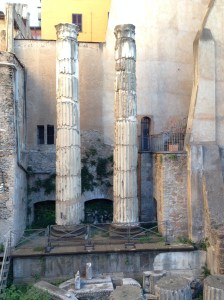
The flat where we stayed had tourist maps of Rome, and I carried one around everywhere, taking us so our route crossed as many historical bits as we could. Some of these brilliant bits are on the map, but some aren’t. For example, below are two pictures. The first we crossed somewhere down by Trajan’s Forum. Nothing is on the tourist map and there are no signs to indicate what this once was, but two columns stood between old, yet newer buildings with pieces of others below. They are fenced off so no one can tamper with them.
Columns between two buildings
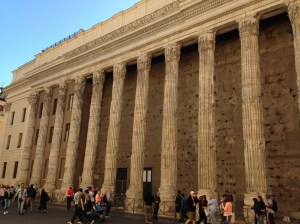
Temple of Hadrian
The second photo, the Temple of Hadrian, is marked on the map and is nestled in a small courtyard when you walk between the Pantheon and Trevi Fountain. The original structure was built by Antoninus Pius in 145 AD. The only bit left, this row of Corinthian columns, was added by Carlo Fontana to the plans for a 17th century papal palace. The building today, however, is not quite so lofty as it houses a bank.
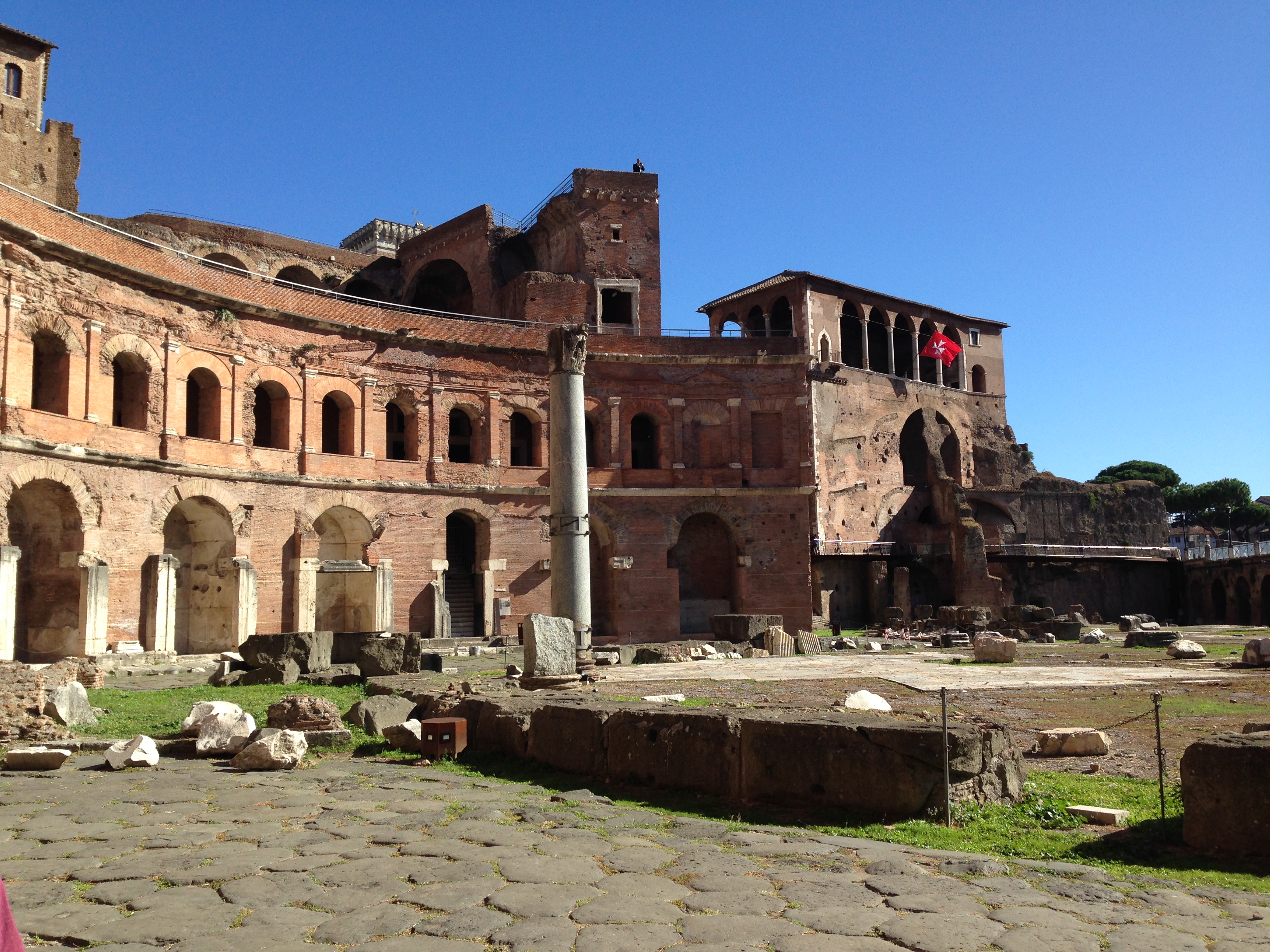
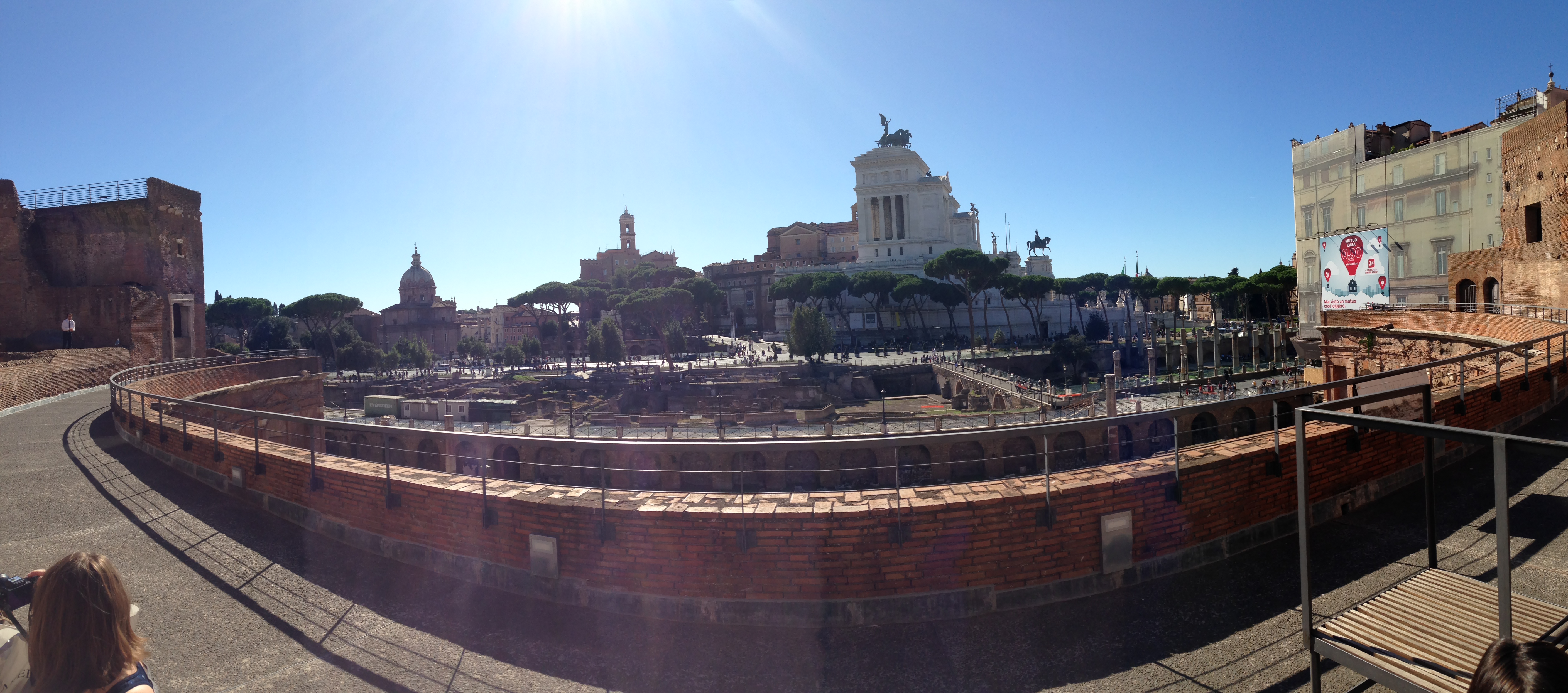
Trajan’s forum was at the end of a long day, but it made it no less interesting. Designed by the architect Apollodorus, Trajan’s Forum was built in the second century and consisted of a series of markets, a temple, a basilica, and three monuments to honour Trajan. This side that is curved in a hemisphere is believed to have contained the markets of the day. There are many small rooms behind those arches that now hold more of the broken columns and pediments that are still beautiful works of art.
Inside Trajan’s Forum
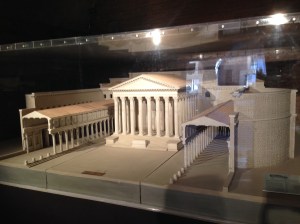
A representation of the forum
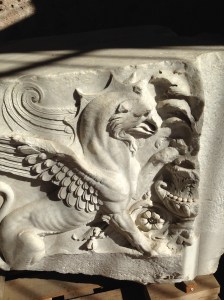
A broken piece of amazing sculpture
From the hemisphere of Trajan’s forum, a great view of Trajan’s column and the Vittoriano can be seen.
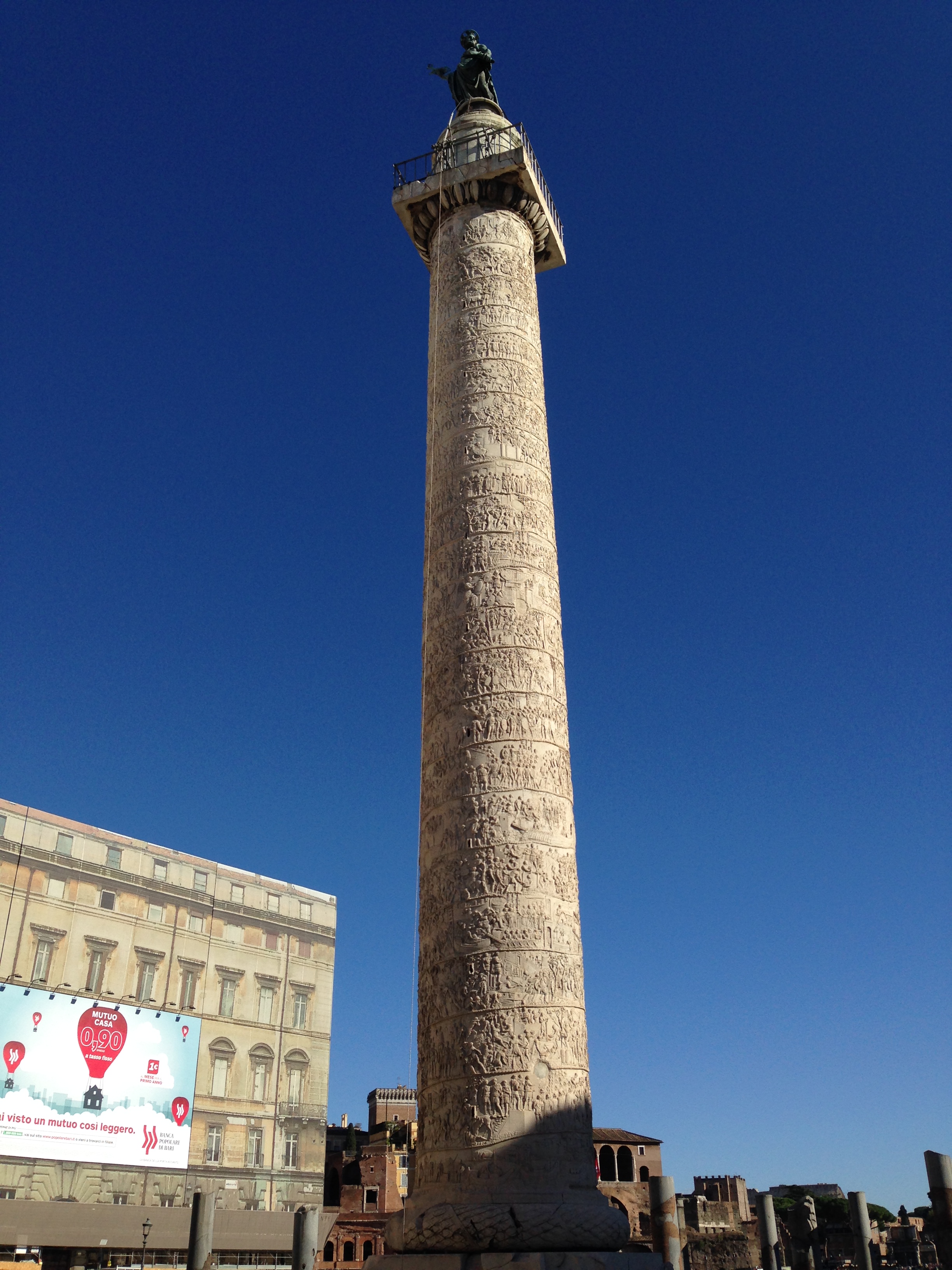
Trajan’s Column
Trajan’s Column is just behind the forum and is one of several columns around the city of Rome. Trajan’s Column honours the Emperor Trajan’s defeat of the Dacians in a war from 101-106 AD, considered the “defining event” of his time in power. The relief carvings that wind up the tower depict the battle and defeat of the Dacians, which brought a “staggering” amount of riches to Rome and paid for the construction of Trajan’s Forum. The bronze statue at the top is none other than Trajan himself.
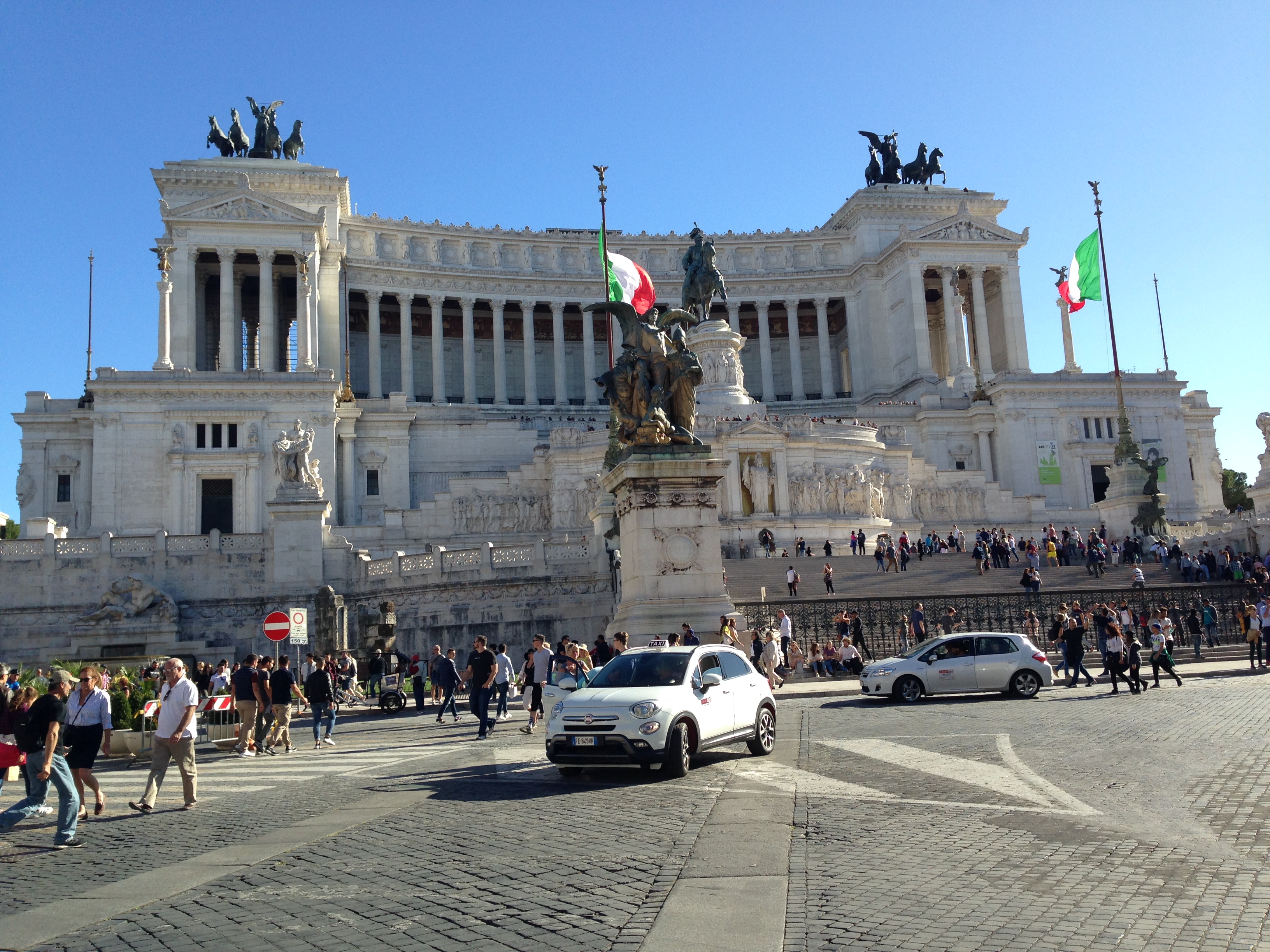
The other landmark that can be seen from the back of Trajan’s Forum, Vittoriano, is huge! Designed by Giuseppe Sacconi, this monument to Victor Emmanuel II was built between 1885 and 1911 to celebrate the first king of a unified Italy. The enormous building houses the Museum of Italian Unification, the Tomb of the Unknown Soldier, and the Shrine of the Flags.
The monument is a huge tourist attraction now, but it isn’t without its controversy. A part of the historic Capitoline Hill as well as a medieval neighbourhood were destroyed to build it. Because of the bright white colour in an area of Rome that is not white, it stands out and has earned some nicknames from the people of Rome, who still are not thrilled with its presence, including the wedding cake, the set of false teeth or la dentiera, the typewriter or macchina da scrivere and English soup dessert or la zuppa inglese.
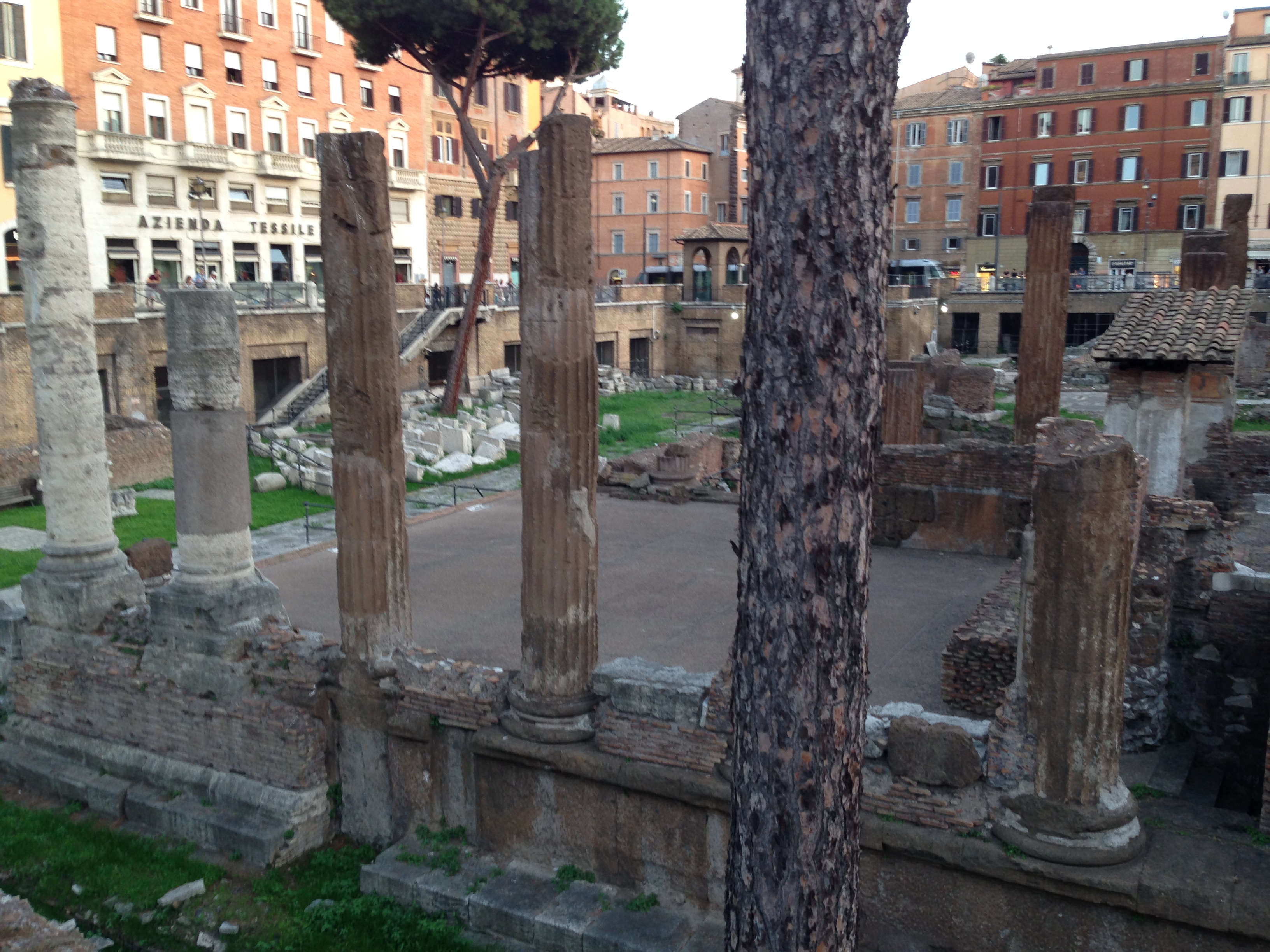
Lastly, for today’s post is one of the first smaller bits that we stumbled upon on the tourist map. It’s called “Area Sacra” or Sacred Area. It’s fenced off and it has obviously been excavated out since it sits a bit lower than street level. It’s also surrounded by several busy streets, but is quite interesting.
In fact, its full name is Area Sacra Di Largo Argentina. Discovered in 1920, this archeological site contains the remains of temples that date back to the Republic of Rome and was once part of Campus Martius. In fact, this spot also contains the remains of Pompey’s Theatre, so nearby was the “curia” or building where Julius Caesar was killed. Frescos can be seen if you look carefully under some of the more modern constructed roofs there to protect them from the elements and if you stand there long enough, you will see a cat or two in the ruins since the site is a cat sanctuary.
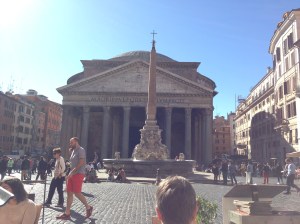
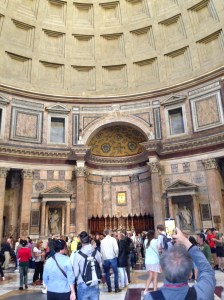
The Pantheon was built between 118 and 125 AD on the ruins of another pagan temple, which was destroyed by fire in 80 AD. When the Pantheon was built, it was used to worship the pagan gods of Rome (though no one knows specifically which ones) until 609 when it was converted to a Catholic church by Pope Boniface IV and subsequently called Santa Maria of the Martyrs. The Pantheon also houses the tombs of Vittorio Emanuele II, Umberto I and Margherita of Savoy, as well as the renowned artist Raphael.
Front view
View as you enter
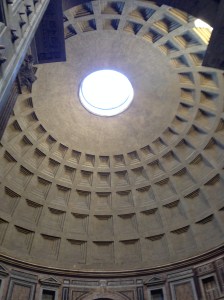
Dome with Oculus
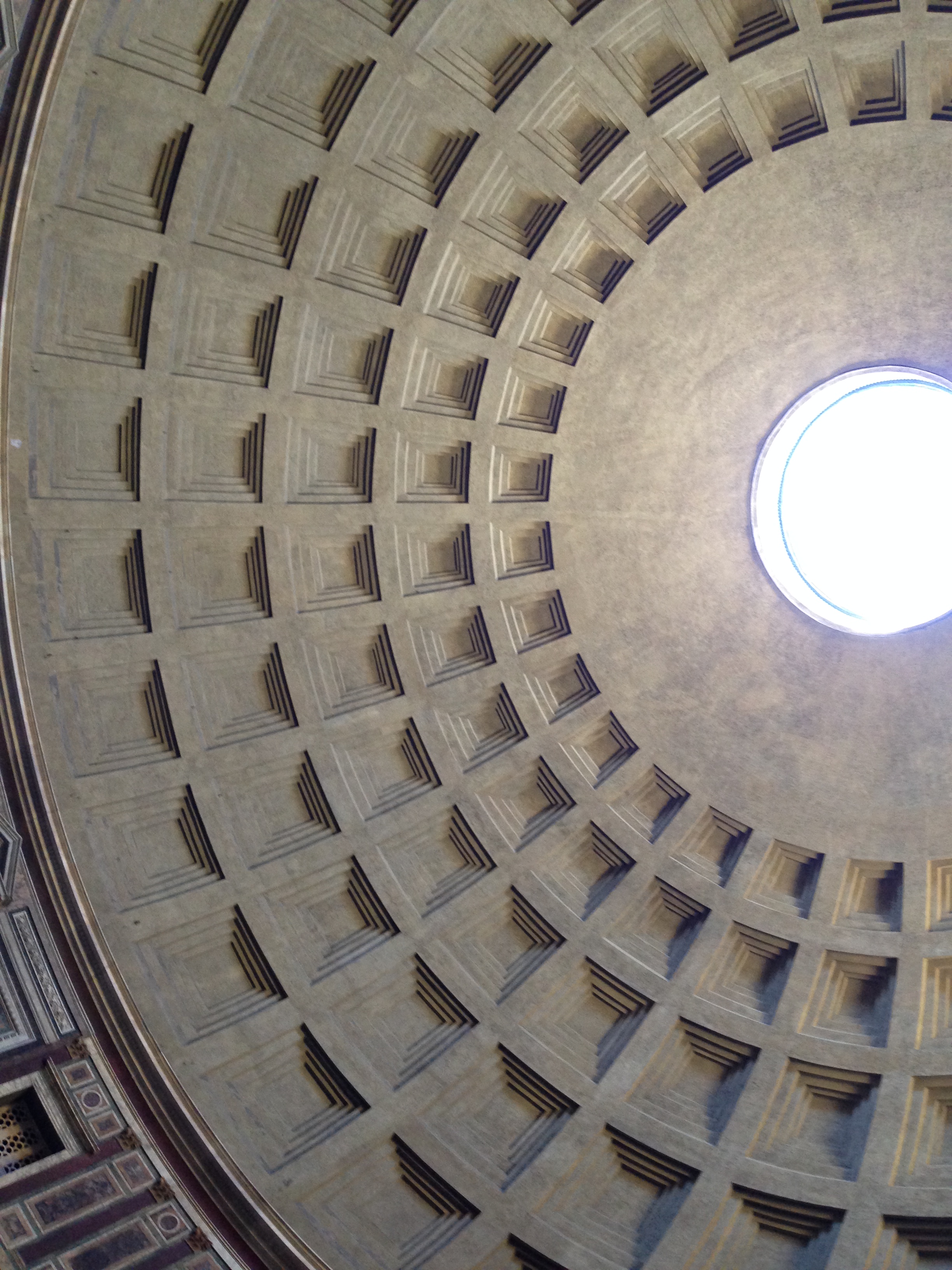
Found on the Piazza della Rotonda, a steady stream of tourists walk in and out since there is no admission to go inside. While the inside is beautiful, it is the dome of the Pantheon that is the most fascinating part of the architecture. The ancient Romans who built the Pantheon took into consideration the weight of the materials they used to build their temples since they used travertine, tufa, and pumice to construct the dome and to reduce the stress on the lower part of the building. Possibly why this amazing structure is still around and it such amazing condition.
Ceiling and oculus
At the top of the dome is an open oculus, so when rain falls, the rain comes inside the Pantheon, but does not puddle since there are tiny holes in the flooring that leads to the old Roman pipes beneath the building. The oculus is fascinating and beautiful. It gives the inside an interesting glow when the light enters just so and adds to the draw of the dome ceiling.
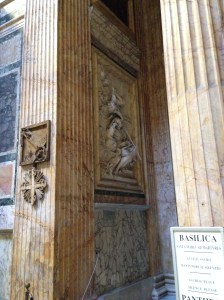
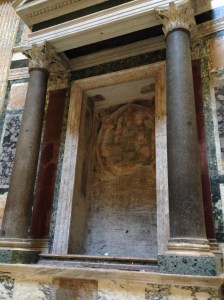
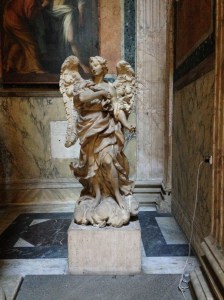
sculpture inside Pantheon
View as you enter
Old fresco
Statuary
When inside the Pantheon, a huge touristy thing to do is to set your phone on a timer and take a selfie with the dome behind you. It does create a cool picture, but the angle of the sun can be problematic. Ours look more like shadows than us 🙂 Also note that this is considered first and foremost a place of worship and the noise level is kept at a minimum with a recording asking those inside for “silence.”
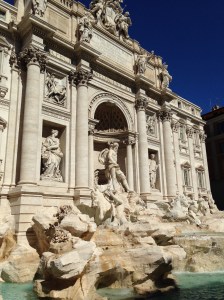
Trevi Fountain is not too far of a walk from the Pantheon (and there are a number of smaller sites to see along the way). A fountain in this location dates back to Roman times when Aqua Virgo Aqueduct provided water to the fountains in central Rome as well as the Roman Baths. The original fountain in this spot was called Trevi fountain, or “Three street fountain” because it was located at the meeting point of three roads.
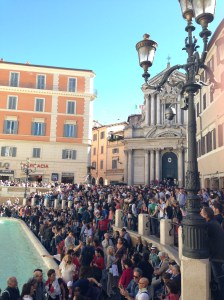
Trevi Fountain
The masses at Trevi Fountain
Pope Clemens XII held a contest in 1730, to design a new fountain for the location, with Nicola Salvi winning the right to design it. Unfortunately, he died before the fountain was completed.
Today, Trevi Fountain is huge and people crowd around it all to take a photo of themselves throwing a coin into the water, which is said to bring the person throwing the coin back to Rome. Interestingly, it’s a crime to take money from Trevi fountain, which brings in a staggering 3,000 euros a day. The money is collected nightly and given to Caritas, a charity that provides rechargeable grocery cards to Rome’s needy.
Even in October, Trevi Fountain was packed with people and there was a significant police presence. People try to stand on railings to get photos and other not so swift things in the hopes of getting a better selfie or look and the police do their best to keep those adventuresome lot from getting hurt.
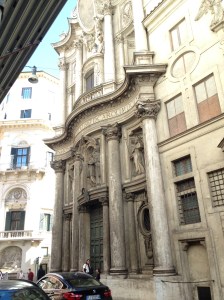
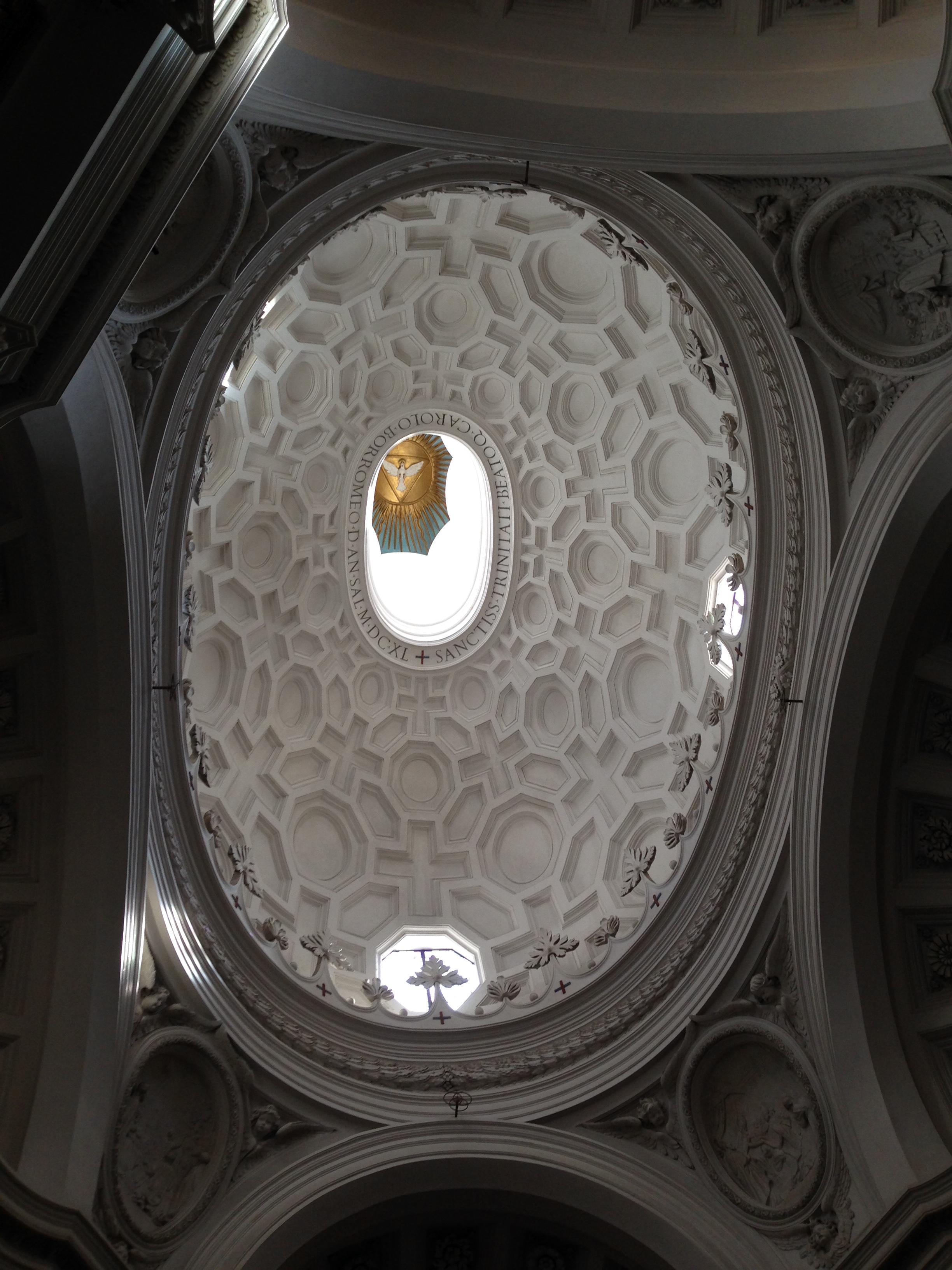
One sight I wanted to see because I studied it in art history was San Carlo Quattro alla Fontane. Built in the 17th century, this quaint, yet beautiful little Baroque church designed by Francesco Borromini. The plans were a challenge since the site was small and cramped, yet Borromini used a Greek cross for the layout of the interior and an undulating facade–a feature other architects copied later.
Facade
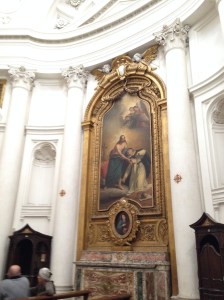
painting to the side
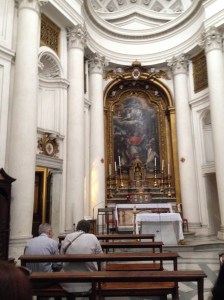
altar
When you walk from the Pantheon to Trevi Fountain and then out to San Carlo Quattro alla Fontane, the church seems a little far from the old centre of Rome, but obviously it wasn’t sandwiched between buildings the way it is.
In photos, I always found the facade interesting because of that wave effect, but when we reached it, I found myself disappointed because of the dirt and grime accumulated on the white stone. Entering the small church was another matter.
The chapel is far from large and for the most part simple, with only the altar and two additional paintings adorning the walls, but the dome is stunning. While the dome isn’t painted or incredibly ornate, it’s a slight oval, which is quite different, as well as stark white. The gold dove in the oculus the focus. While simple, I could’ve sat and stared at it for much longer than I was able since they needed to close the church. I was disappointed, but I sat inside for a few minutes at least and took my photos 🙂