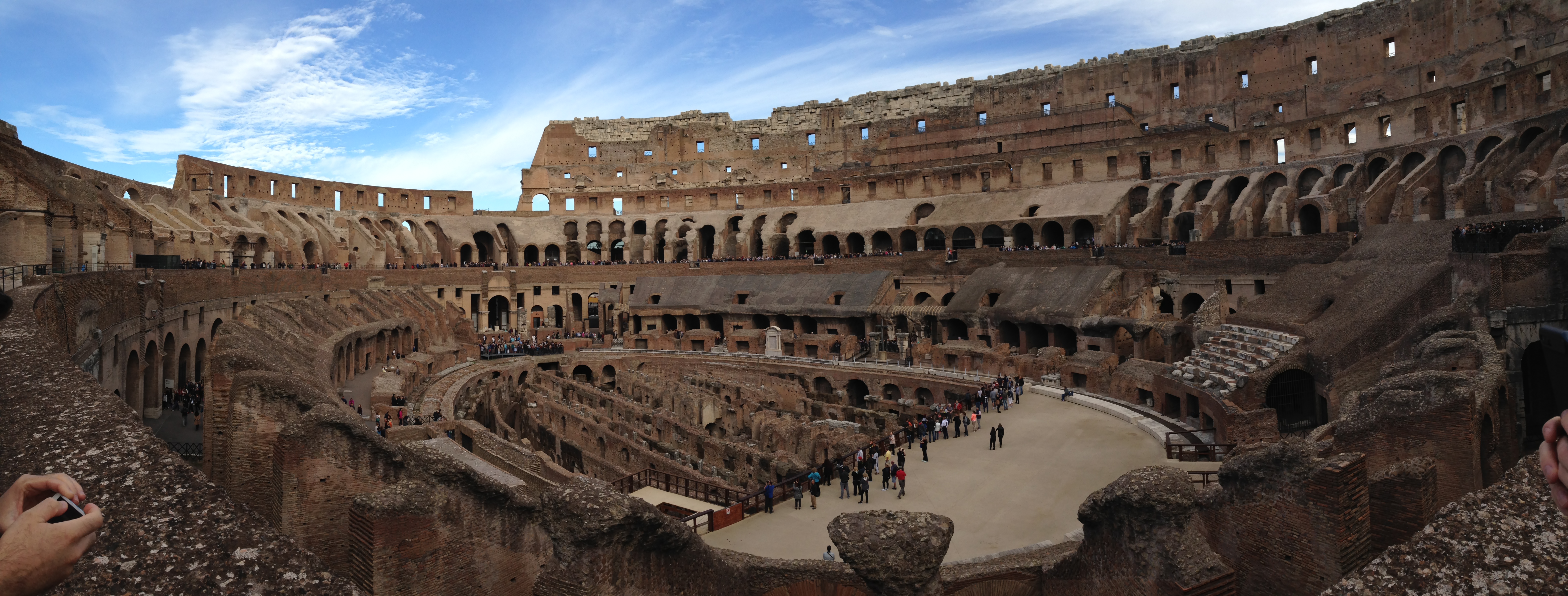
After the Colosseum and the Arch of Constantine, we checked out the lines for Palatine Hill. It was part of the admission for the Colosseum and we could see the ruins from outside and were definitely interested. We ended up having to go to lunch first. The lines were long before, but we hoped they might die down, which they did. By the time we were done eating, we had to simply show our ticket and walk through the gates.
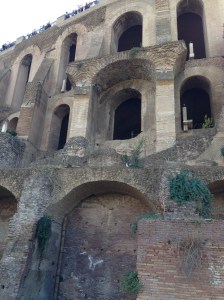
Palatine Hill is the original site of Rome where mythology claims Romulus and Remus were found by the wolf Lupa and it is claimed Romulus built the sanctuary of the Curiae Veteres on one side of the city. This 131 foot plateau was the centre point of the Seven Hills of Rome and has a circumference of 5,700 feet. This site contains everything from prehistoric Roman ruins and later palaces and temples. It looks upon the Roman Forum on one side and Circus Maximus on the opposite and just a warning–bring your walking shoes!!
Evidence shows people have been living on Palatine Hill since the 10th century BC until the emperors made Palatine Hill their domain and built a series of palaces there. When the Roman Empire fell, Palatine Hill deteriorated until a stronghold was built in the Middle Ages. During the Renaissance, wealthy families built homes on Palatine Hill. Now, it’s an archeological site and still being excavated.
There’s just too much to Palatine Hill to go through it all and I know we didn’t even get to walk through all of it. It’s an entire day and maybe two if you are particularly thorough. The views from the top of the hill as well as the little bits that you find looking into some of the alcoves is worth every bit of it. It’s amazing to get a tiny glimpse of what existed here. Just by the ruins, you can see how amazing and fantastic much of it was.
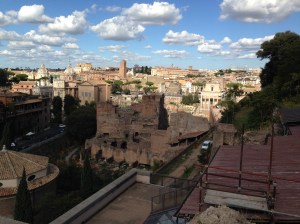
Panorama of Palatine Hill from a higher vantage point
In 64AD after the fires in Rome, the Emperor Nero decided to build himself a palace that would be called The Golden House. Upon Nero’s death, Rome was engulfed in a civil war until Vespasian took the throne in 69AD. Instead of building a monument of palace for himself, he decided to build an amphitheatre for the people to enjoy, erecting it on the lake of Nero’s palace. Construction began in 72AD, but the huge structure wasn’t completed until 80AD when Vespasian’s son Titus was emperor. The finished structure was capable of holding 50,000 people, making it the largest of its kind in the Roman Empire.
Over the years, the Colosseum was plundered for multiple reasons–the wealthy as well as the popes wanted its travertine and marble for their buildings and robbers made holes in the walls looking for iron clamps. This continued until the church halted the destruction. They couldn’t completely destroy a building so rooted in Christian history, too many Christians became martyrs within its walls.
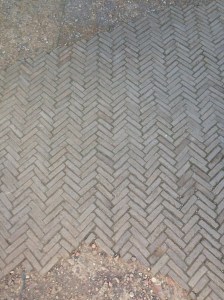
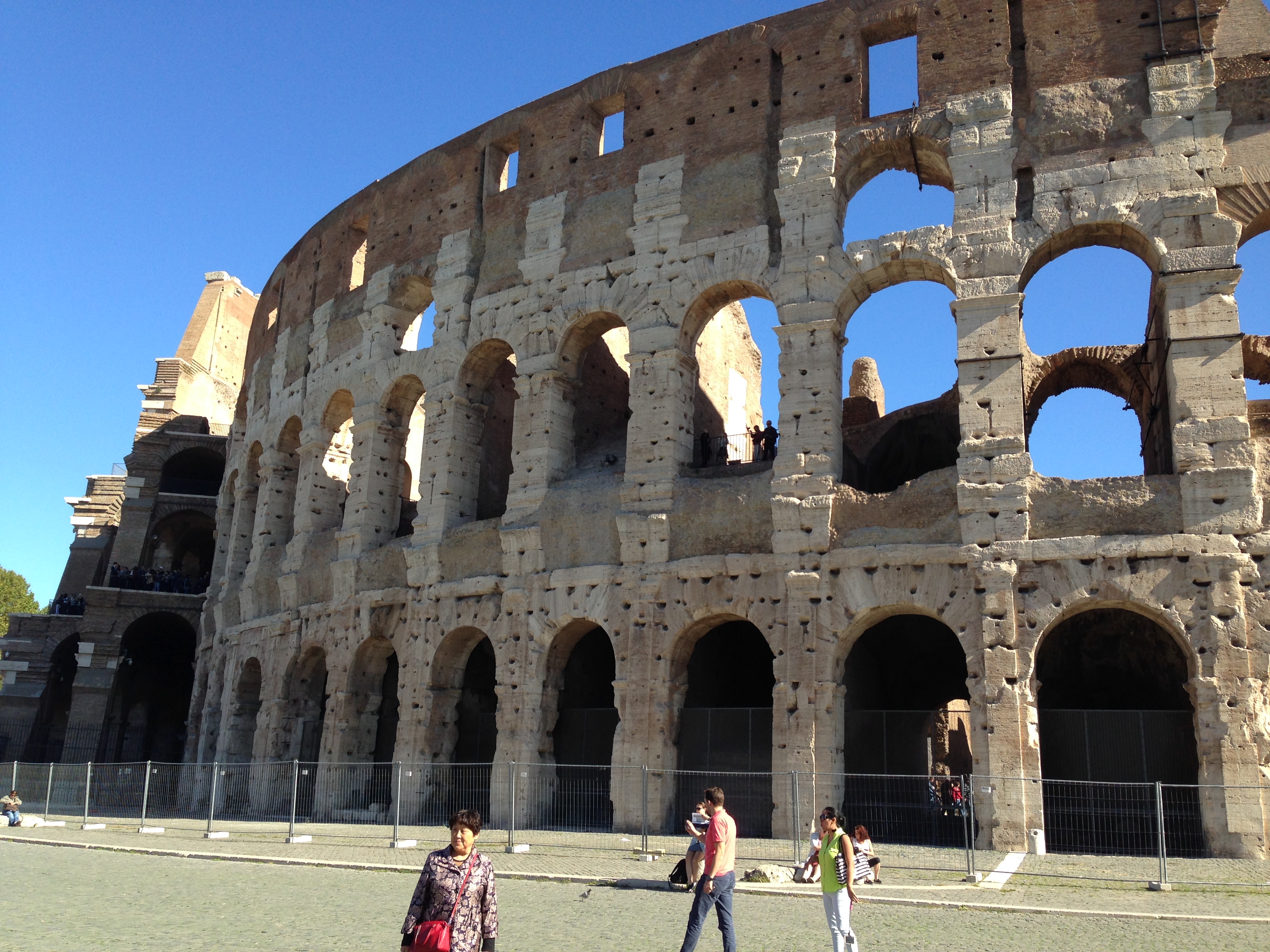
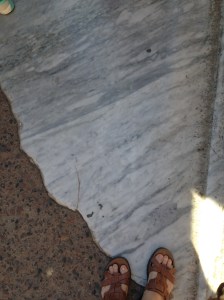
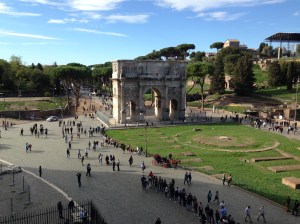
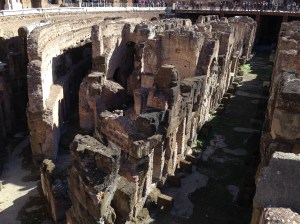
Today, we get a glimpse of what the Colosseum once was. It’s still huge when you approach, and when you stand at one end and look at the scale, it’s impressive. When you walk around, don’t just pay attention to the scale and the big picture or you’ll miss the little things. One one side, you can still see a hint of the rows that once existed, if you look at the floors where you walk, you will sometimes find a brick pattern or marble that was a part of the original flooring, there is also a great view of the Arch of Constantine from one side.
Part of the original flooring
Arch of Constantine
Lower level
A good portion of the Colosseum can be seen without paying for a private tour, however, if you want to go below into the catacomb portion, a tour and guide is required. We arrived as the place opened and were not a part of the tour, so we walked all over the upper levels that are accessible and took lots of pictures. Upon the approach to the Colosseum, you will have the same staggering of tour companies from a good mile to half-mile from the building, all trying to garner attention and extra money. One became angry with me and yelled at me because I told my husband to ignore her. After the Vatican, I was done with the tourist trap racket.
Whether you opt for a tour guide or not, the Colosseum is definitely a must see! Just make sure you look at the little things as well.
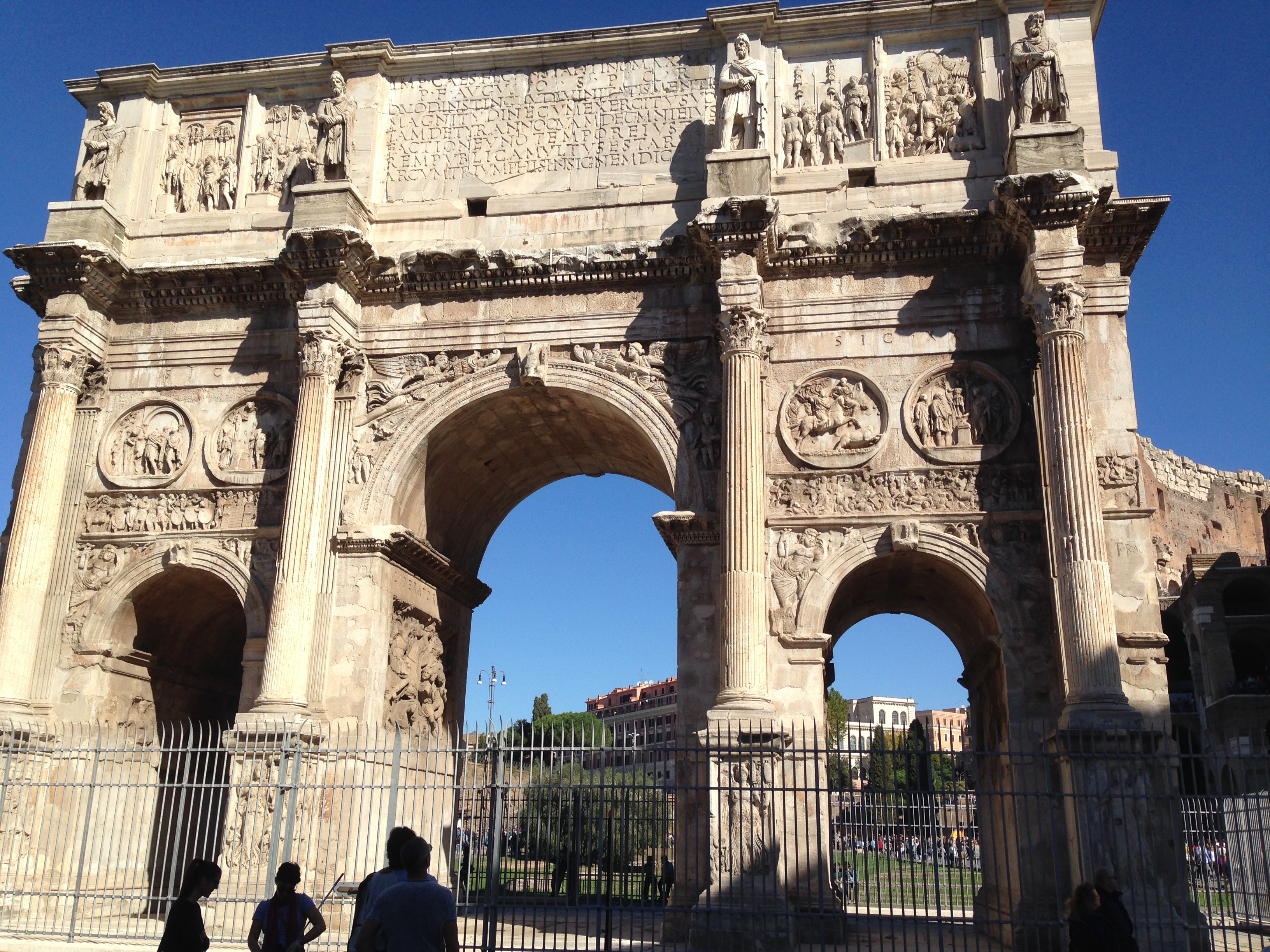
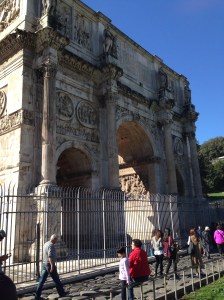
If you’re at the Colosseum, the Arch of Constantine can’t be missed since it’s right there beside the Colosseum. The Arch was built by the Senate and dedicated in 315AD as a commemoration of the emperor Constantine’s victory at Milvian Bridge in Rome over Maxentius for control over the western portion of the Roman Empire.
The Arch is huge and made of a grey and white marble, but was technically not all original at the time the Arch was built. The eight round medallions around the building have been dated to 200 years prior to Constantine and are actually from the emperor Hadrian’s reign, some of the rectangular reliefs come from an Arch built to celebrate the victories of Marcus Aurelius (the emperor was re-carved to look like Constantine), and there are also relief sculptures that came from Basilica Ulpia in Trajan’s Forum. Even the Corinthian Columns surrounding the Arch are from another monument that no longer exists.
Arch of Constantine
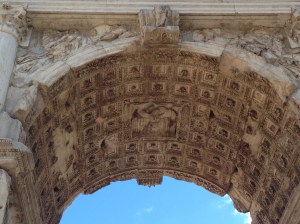
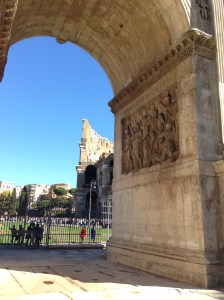
Inside the centre arch
Despite it’s less than original bits and pieces 😉 the Arch of Constantine is still amazing to see. There are sculptures within the arches as well as the many sculptures and columns on the outside. With the Colosseum in the background, it can also be a lot of fun to photograph. It made me wish I’d had my good camera instead of just my phone.
Coming up next… Palatine Hill and a wrap up of Rome
Rome is riddled with historical monuments. I commented in the first post that you can turn a corner and find a fresco or a sculpture on the next, but it’s almost that way with monuments as well. You can turn a corner and find columns sandwiched between two buildings, or just a wall of columns that once belonged to a great building. It’s one of the most fascinating things about Rome.
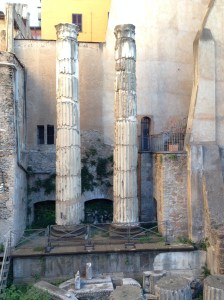
The flat where we stayed had tourist maps of Rome, and I carried one around everywhere, taking us so our route crossed as many historical bits as we could. Some of these brilliant bits are on the map, but some aren’t. For example, below are two pictures. The first we crossed somewhere down by Trajan’s Forum. Nothing is on the tourist map and there are no signs to indicate what this once was, but two columns stood between old, yet newer buildings with pieces of others below. They are fenced off so no one can tamper with them.
Columns between two buildings
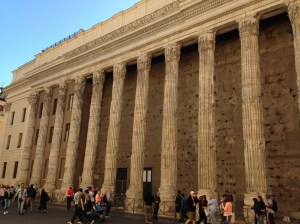
Temple of Hadrian
The second photo, the Temple of Hadrian, is marked on the map and is nestled in a small courtyard when you walk between the Pantheon and Trevi Fountain. The original structure was built by Antoninus Pius in 145 AD. The only bit left, this row of Corinthian columns, was added by Carlo Fontana to the plans for a 17th century papal palace. The building today, however, is not quite so lofty as it houses a bank.
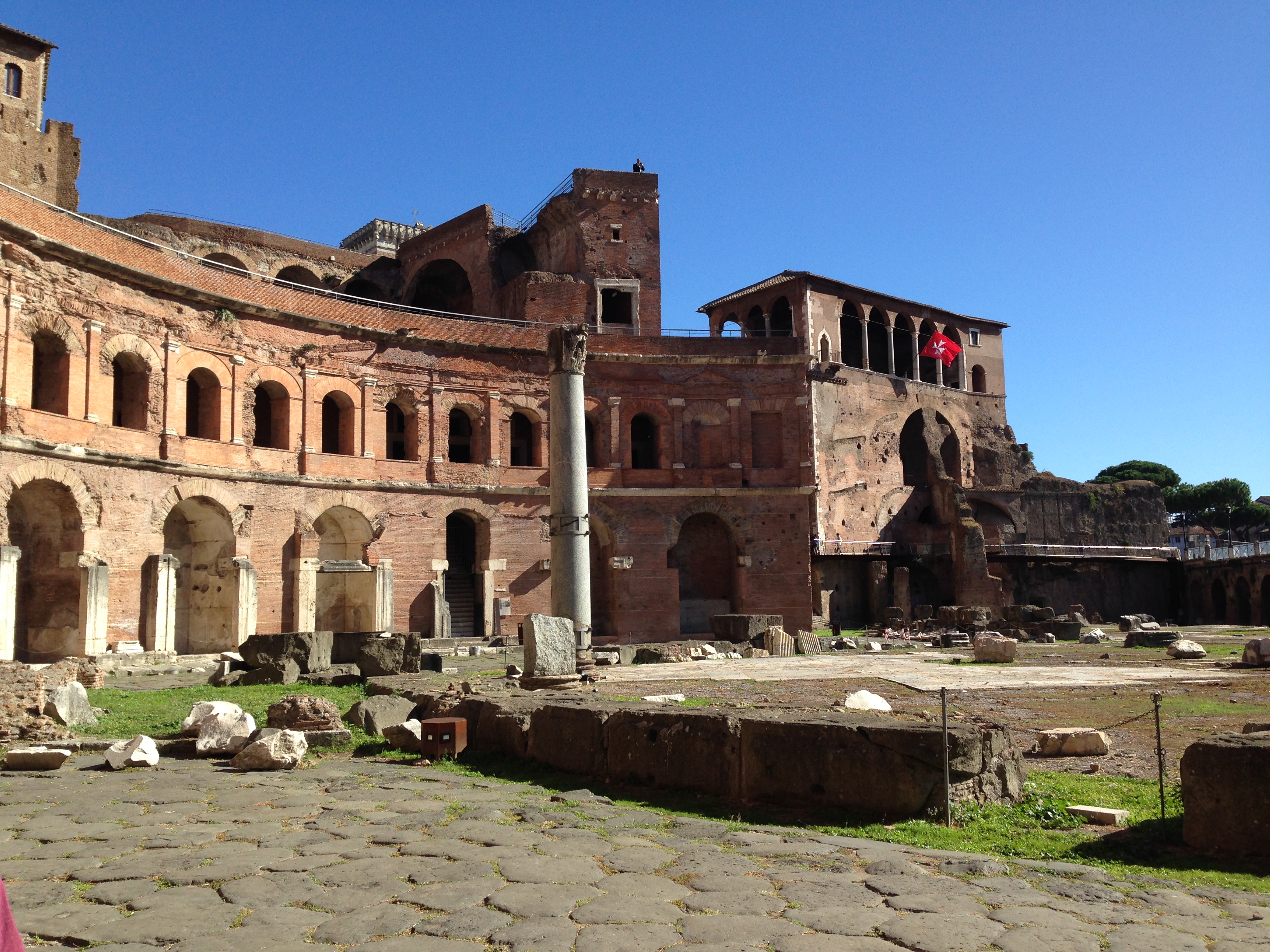
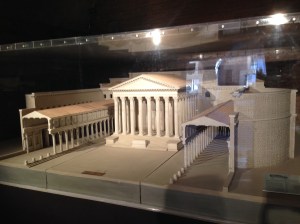
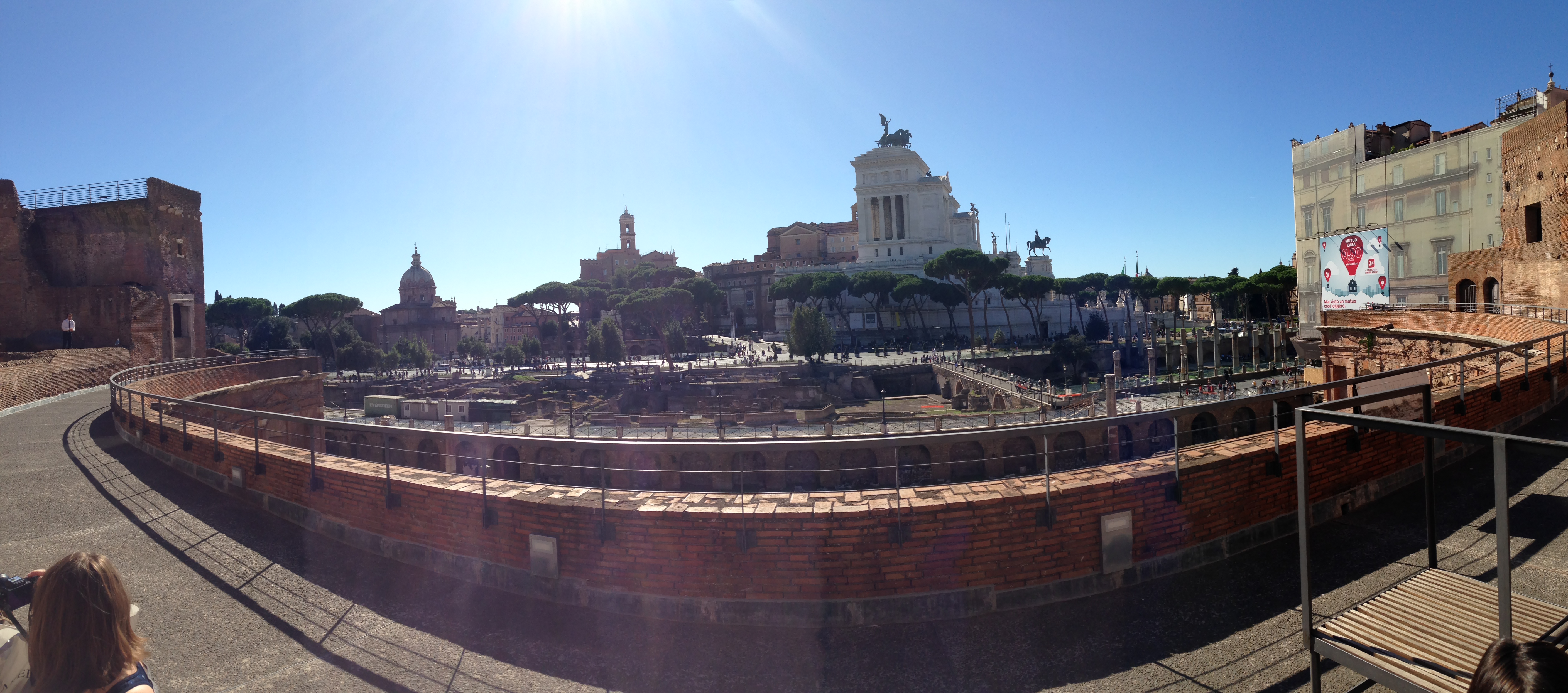
Trajan’s forum was at the end of a long day, but it made it no less interesting. Designed by the architect Apollodorus, Trajan’s Forum was built in the second century and consisted of a series of markets, a temple, a basilica, and three monuments to honour Trajan. This side that is curved in a hemisphere is believed to have contained the markets of the day. There are many small rooms behind those arches that now hold more of the broken columns and pediments that are still beautiful works of art.
Inside Trajan’s Forum
A representation of the forum
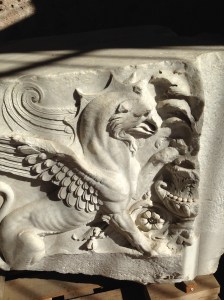
A broken piece of amazing sculpture
From the hemisphere of Trajan’s forum, a great view of Trajan’s column and the Vittoriano can be seen.
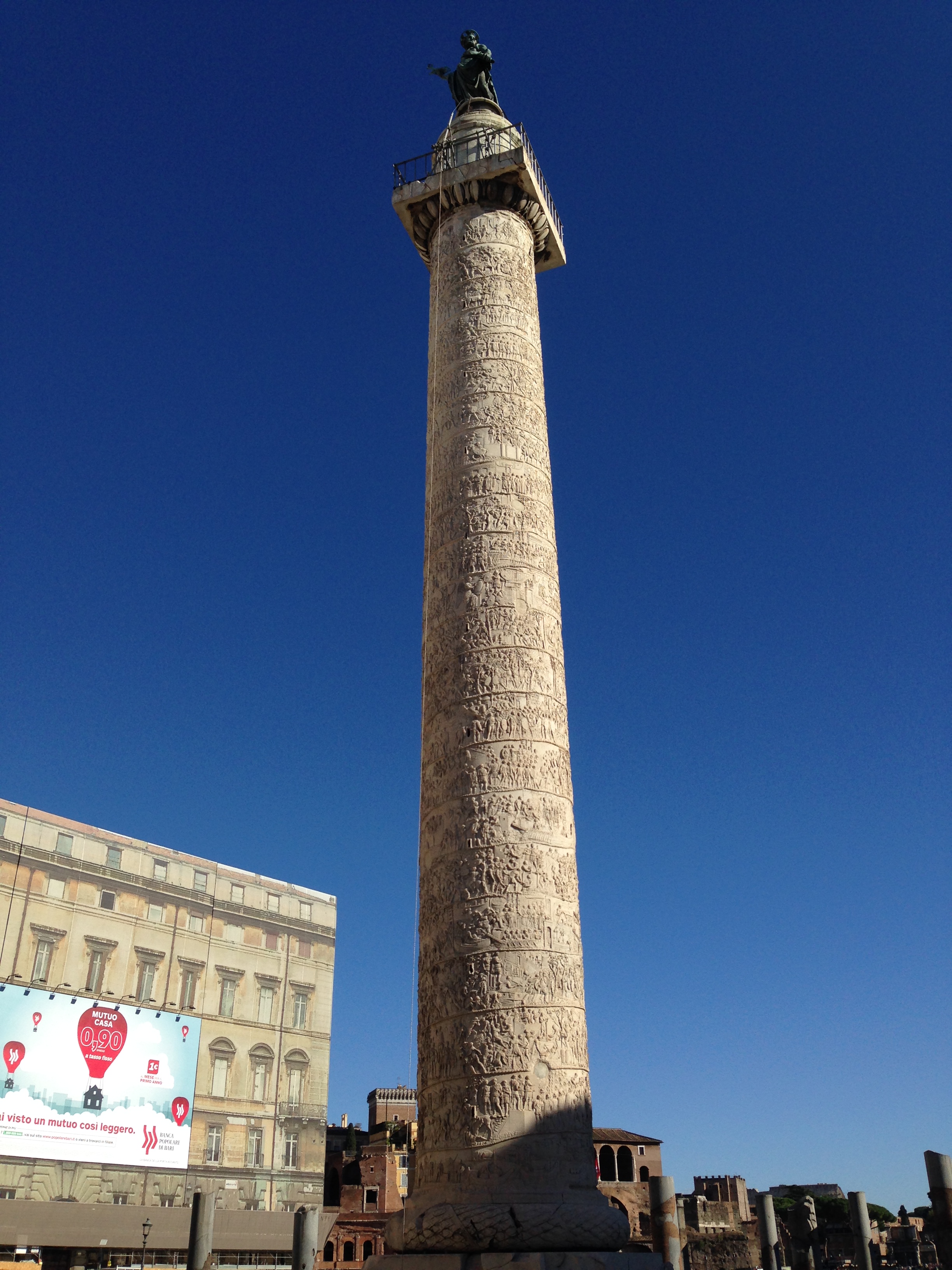
Trajan’s Column
Trajan’s Column is just behind the forum and is one of several columns around the city of Rome. Trajan’s Column honours the Emperor Trajan’s defeat of the Dacians in a war from 101-106 AD, considered the “defining event” of his time in power. The relief carvings that wind up the tower depict the battle and defeat of the Dacians, which brought a “staggering” amount of riches to Rome and paid for the construction of Trajan’s Forum. The bronze statue at the top is none other than Trajan himself.
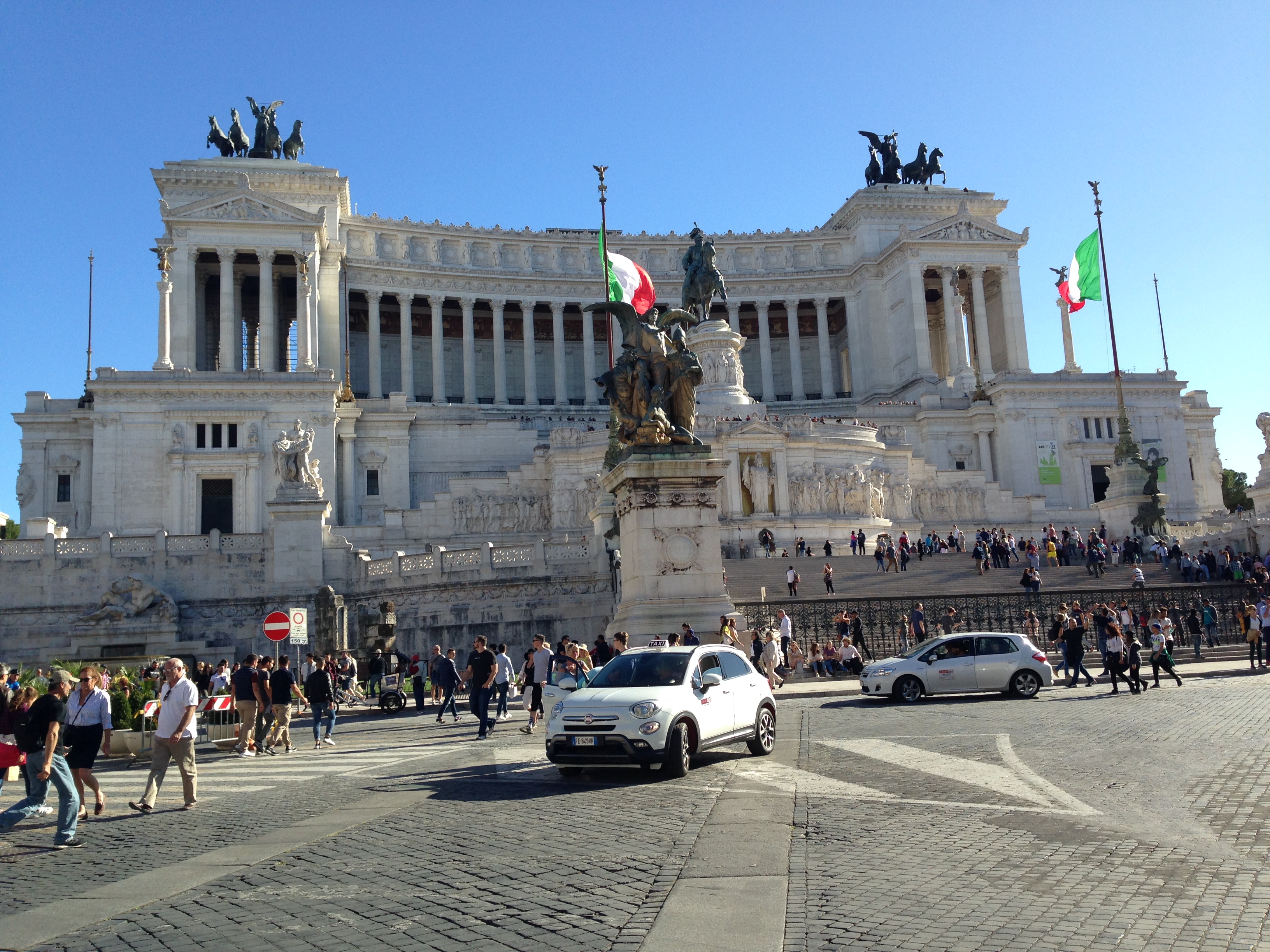
The other landmark that can be seen from the back of Trajan’s Forum, Vittoriano, is huge! Designed by Giuseppe Sacconi, this monument to Victor Emmanuel II was built between 1885 and 1911 to celebrate the first king of a unified Italy. The enormous building houses the Museum of Italian Unification, the Tomb of the Unknown Soldier, and the Shrine of the Flags.
The monument is a huge tourist attraction now, but it isn’t without its controversy. A part of the historic Capitoline Hill as well as a medieval neighbourhood were destroyed to build it. Because of the bright white colour in an area of Rome that is not white, it stands out and has earned some nicknames from the people of Rome, who still are not thrilled with its presence, including the wedding cake, the set of false teeth or la dentiera, the typewriter or macchina da scrivere and English soup dessert or la zuppa inglese.
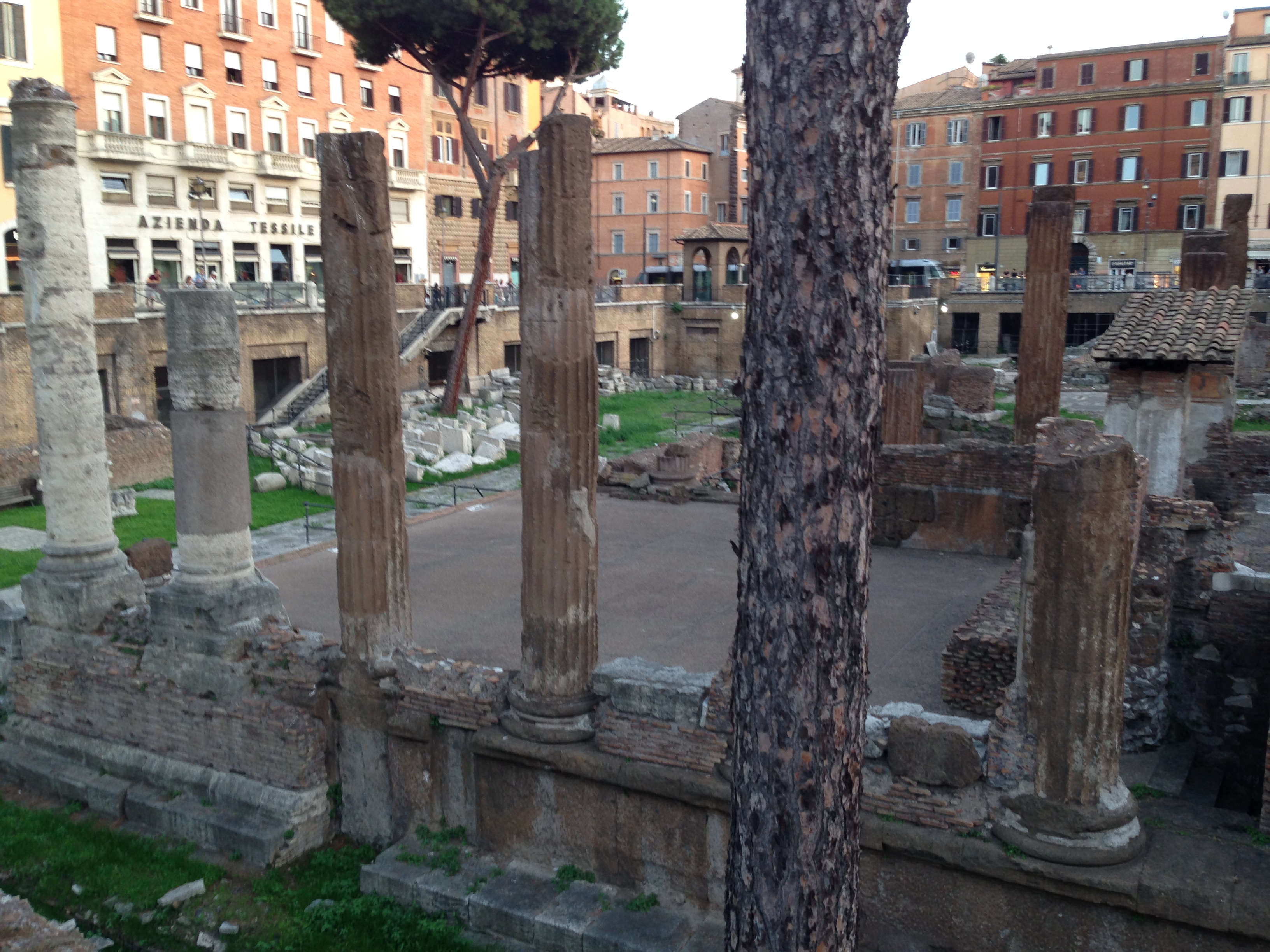
Lastly, for today’s post is one of the first smaller bits that we stumbled upon on the tourist map. It’s called “Area Sacra” or Sacred Area. It’s fenced off and it has obviously been excavated out since it sits a bit lower than street level. It’s also surrounded by several busy streets, but is quite interesting.
In fact, its full name is Area Sacra Di Largo Argentina. Discovered in 1920, this archeological site contains the remains of temples that date back to the Republic of Rome and was once part of Campus Martius. In fact, this spot also contains the remains of Pompey’s Theatre, so nearby was the “curia” or building where Julius Caesar was killed. Frescos can be seen if you look carefully under some of the more modern constructed roofs there to protect them from the elements and if you stand there long enough, you will see a cat or two in the ruins since the site is a cat sanctuary.
One of the major attractions of Rome is, of course, the Vatican. The Vatican is known for having a tremendous amount of artwork as well as the Sistine Chapel, so obviously a big thing to do and see when visiting Rome. We booked tickets for the Vatican Museums for our first day in Rome. Little did we know that even during October, this would be a packed and still crazy place to visit.
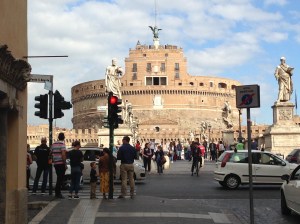
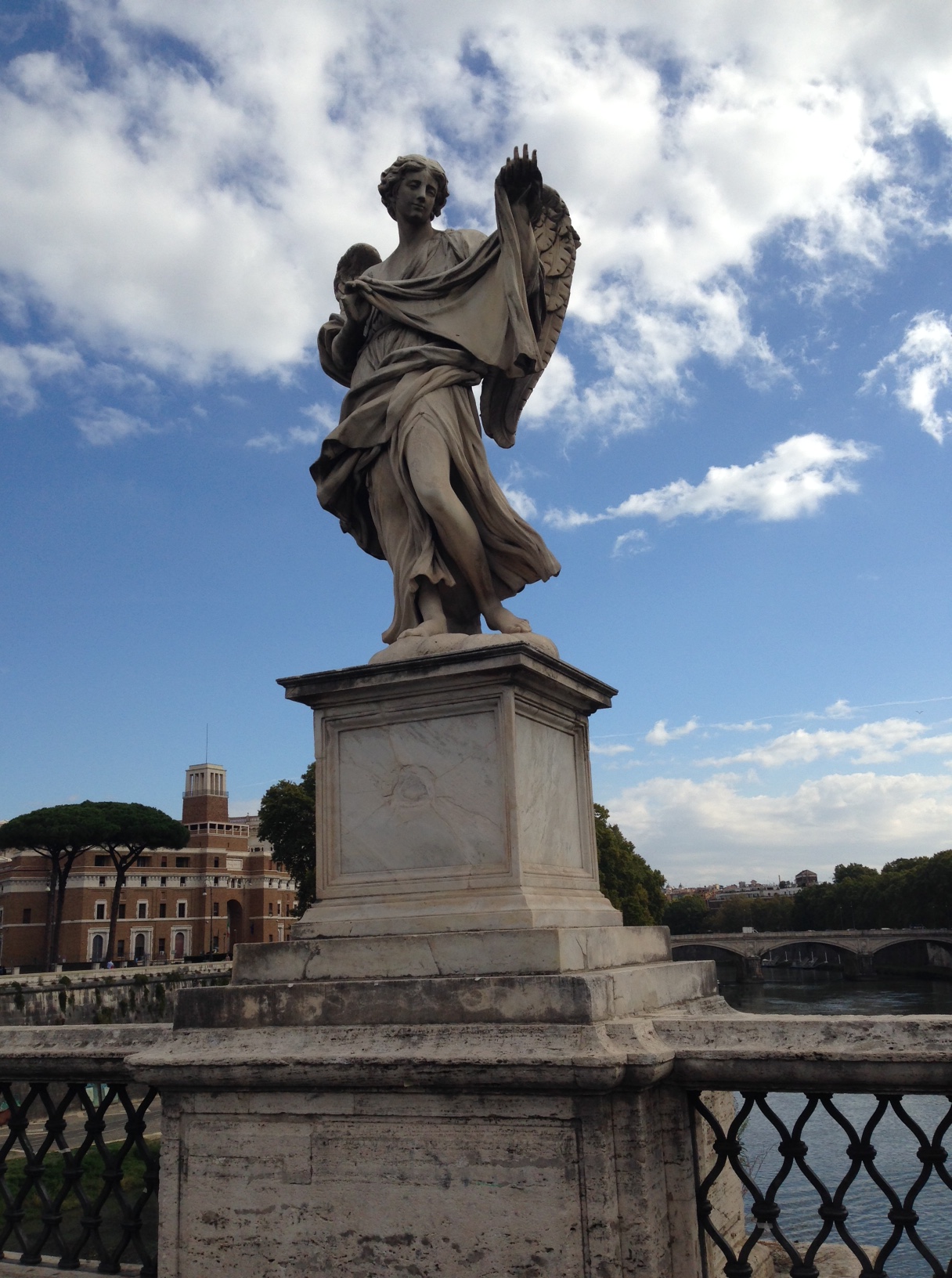
Ponte Sant’Angelo with Castle Sant’Angelo behind it.
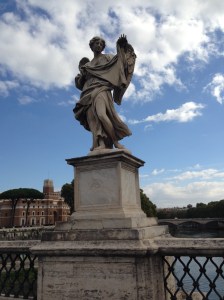
Ponte Sant’Angelo
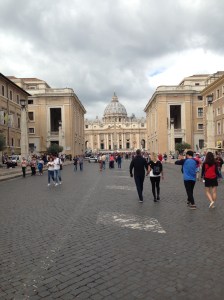
We crossed the Tiber river at Ponte Sant’Angelo, and turned left, heading towards the dome of St. Peter’s Basilica. What I didn’t expect as we turned from the bridge towards the Vatican was the immediate assault of tour guides who line the path to St. Peter’s Basilica and around to the Vatican Museums trying to sell tours. They are paced about every 10-15 steps, and all start with the same line “It’s a 2 hour wait to get into St. Peter’s! Skip the lines!” This continues as you walk to Via della Conciliazione all the way until St. Peter’s Square.
Walking down Via della Conciliazione
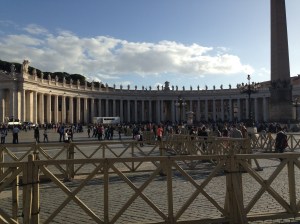
Bernini’s Colonnade
Now, a couple of things we learned from this. They have badges that say “official” but they don’t work for the Vatican or St. Peter’s Basilica. They are official to their company maybe, but they aren’t employed by the church. Most of them use the same line, but sometimes, you’ll get one tour guide who will try a different approach. With us, it was “You know you can’t go in there dressed like that!” As far as we knew, our shorts and tops were fine, but the tour companies also make a mint selling souvenir scarves for 5 to 10 euros each and try to sell you their tour in that they can provide them to you with the tour or you can purchase the scarves from their shop just to the side.
St. Peters and the Sistine Chapel do have dress codes, so if you go, simply where a top that covers your shoulders and shorts or capris that cover your knees, and you won’t require any sort of scarf. We rebelled against the tour guides and purchased them from a street vendor for the same price. I will say that even with the scarves, we didn’t put them on in the Sistine Chapel and no one said a word. They were more concerned with the photography than my shorts or my daughter’s exposed shoulders.
When the Vatican and St. Peter’s were first built, Via della Conciliazione weren’t there. Instead, a bunch of old homes and windy roads led to St. Peter’s Square and Bernini’s amazing colonnade. Mussolini was the one who tore down those old homes and paved the road creating an impressive avenue and linking Rome more indelibly to Vatican City.
Now, the Vatican Museums are almost around the back of St. Peter’s Basilica, so you have to turn right before you enter St. Peter’s Square and follow the annoying tour guides still posted regularly, around the back to the entrance. We pre-booked our tickets, so we didn’t have to wait in line except to check in for our tour time because they stagger it to keep things from becoming too packed. We showed an hour early, but we still were able to enter and begin the tour.
Painted Ceilings and Vaults
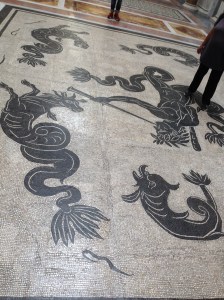
Mosaic tile floor
Hall of Maps
Lacoon and his sons
The Vatican Museums are basically a crazy winding path through various old papal apartments, rooms, and porticos all decked in amazing frescos, tapestries, and both religious and mythological statuary. It takes several hours to get all the way through and at times you have to fight crowds to see particular pieces like Laocoön and His Sons in one of the small porticos, but it’s definitely worth it.
The security and guides become more rude as you approach the Sistine Chapel. We were told to hurry through some portions until we were packed into the Sistine Chapel. It is certainly a chapel and not large–especially considering the number of people standing inside to get a look. People are supposed to remain quiet in a show of respect, so security and a recording will tell people to be quiet. Security is also calling out for people to put away their cameras and not to take photos.
The frescos and the entire atmosphere is overwhelming really. While it was beautiful, I found it a little disappointing. We all stood and looked at the ceiling for some time and then the walls before we exited and moved on to the last little bits before we exited the museums.
Unfortunately, the lines were still extremely long for St. Peter’s Basilica, so we ate a late lunch and walked around before calling it a day with the plan to be at St. Peter’s first thing when it opened. If I had to do it again, I would’ve had us get up early and be at St. Peter’s within a half hour of opening and then book the Vatican Museums a few hours later. You could put lunch between the two viewings or you could simply walk down the Tiber until your viewing time.
For first time travellers to Rome, we did a number of things correctly and a number of things caught us completely off-guard. Hopefully, after reading our experiences in the next several posts, you will know what to expect and won’t run across the same pitfalls we did! We still had an amazing time, so it wasn’t anything terrible, but definitely something that would’ve made things much easier if we’d known at the time.
Ponte Sant’Angelo
We had a rather late arrival, and after reading nightmare horror stories about taxis from Ciampino airport to the city centre (which is anywhere in the Aurelian Wall), we ended up hiring a car. Yes, it was more expensive since there is a law in Rome that dictates a flat rate charge from the airport (30 euros from Ciampino and 48 from Fiumicino) for a maximum of 4 people and their luggage for licensed Taxis. It’s even posted on the outside of every taxi, but for one, we number 5 people. I’ve also read horror stories of people being dropped off at the walls or taxi drivers claiming that to the walls is the flat rate and beyond is an extra charge. The practice is illegal, but how many tourists really understand the law or are in a position to enforce it with the police if there is a problem. If it had just been me and my husband, we probably would’ve just made the attempt to get the lower price, but with three children along for the ride and the evening arrival. We weren’t willing to try.
We stayed not far from the Tiber and had a really quick walk to the Ponte Sant’Angelo when we crossed to see the Vatican. We had decided when we booked our place that we would walk everywhere and as long as you’re planning on touring what’s within the Aurelian Wall, it’s completely achievable.
So, if you’re not familiar with Rome, you might be asking ‘What is the Aurelian Wall?’. Most old cities had some sort of original wall that surrounded the city for protection and some cities still have remnants of that fortification to this day. Bath has bits of the original walls still intact around the city, though because they’re partially buried, they don’t seem much like walls; however, Rome’s Aurelian Wall, which was built by the emperors Aurelian and Probus in the 4th century still stands tall to this day. When it was first built, the entire wall, that encircled the right bank of the Tiber, was 26 feet high, surrounded 12 square miles, had 383 towers, 18 main gates, and over 2,000 windows.
When you approach the walls, even at night, you can’t miss them. We passed through one of the gates, which is one lane, and once we were inside, the traffic became even crazier before. If you’ve never driven in Rome before, you’re in for a shock! As opposed to British drivers, who tend to be rather mannerly on the road and rarely use their horn, the Italians are the opposite. Everyone uses their horn, they cut each other off, and then squeezing through tight spaces–I thought we’d never make it in a couple of places.
Arriving at night was fascinating and beautiful, though. We passed by so many historical places that were illuminated and looked just amazing in the dark.
Once we were shown around where we were staying by the property owner (We had the same experience in Venice as well. They took us around the entire flat and showed us everything.), we needed to eat. With several of us requiring gluten-free, that can always be a struggle, but my daughter found a place with 4 stars on Google, so we headed in that direction.
Voglie di Pizza is not large and it’s not the fanciest place when you look at it. It’s not much more than a narrow strip of hallway inside with outdoor seating, but it was one of our favourite places to eat by the time we left. We even returned on our last night. For those who need gluten-free, there is a regular menu as well as a decent gluten-free menu. A lot of places will only have pizza or only have pasta, but they also had Melanzane Alla Parmigiana (Eggplant/Aubergine Parmesan) and a few other options as well. I also had Tiramisu, which is something I haven’t had in forever. The food was good, the prices were not as high as a lot of places, and the people who worked there were extremely friendly and helpful. Definitely a recommend if you’re in the area!
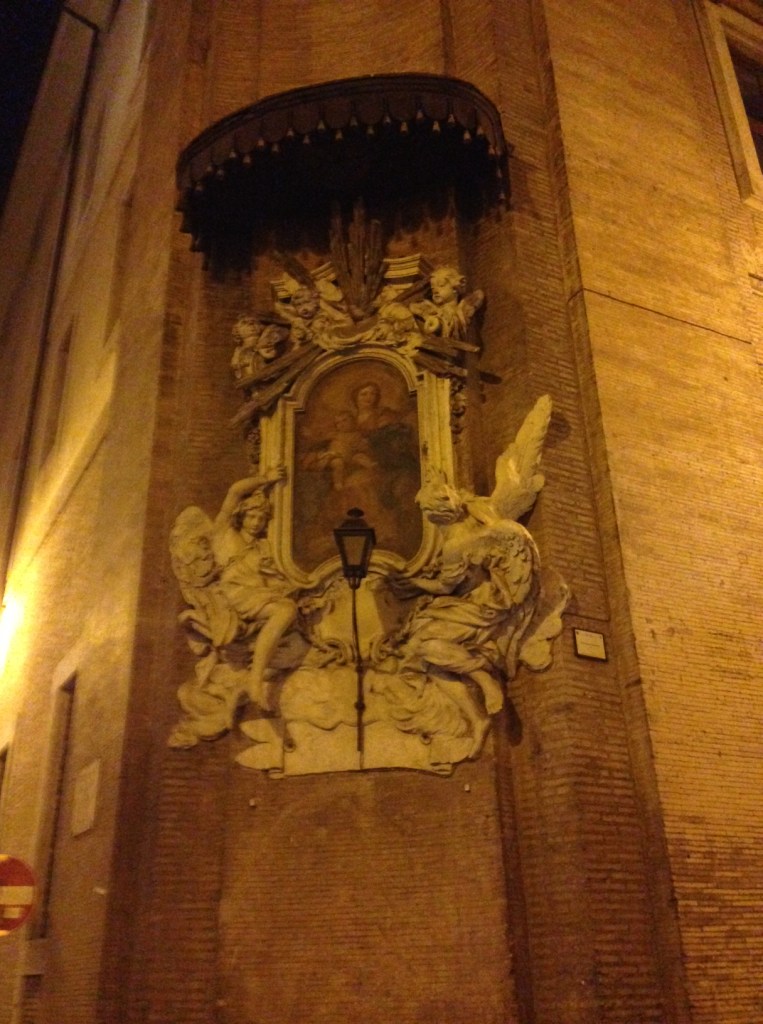
Street Corner
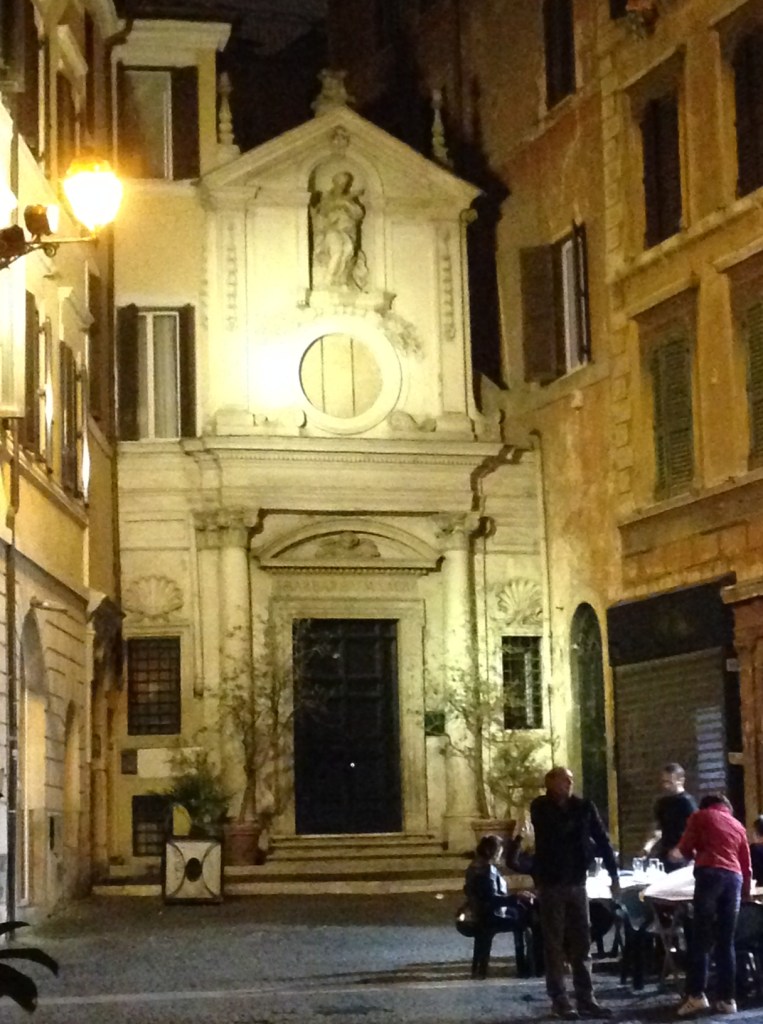
Chiesa
We ended our first evening in Rome with a leisurely walk back to the flat so we could start sight-seeing the next day. It’s amazing all the little things on random street corners whether it’s statues or paintings, and then the churches tucked up into little niches along narrow cobbled streets. It’s definitely worth seeing!