Skip to content
  • About Me
  • My Books
  • Short Stories
  • The Expat’s Travel Guide
  • Ask the Author 2014
  • Ask the Author 2015
  • Privacy Policy

L.L. Diamond

  • First Trip to London

    January 3rd, 2015

    I feel I do not have to give you any of the history of London since it is perhaps one of the most noted cities in the world. We had waited a while, acclimating ourselves to a new country, before we attempted to tackle a large city. In the end, it was not as difficult as I had imagined it would be. I will say a good sat nav (GPS) is not a bad idea. I suppose the best way to describe everything is to take it as we did. We did not take any tours, but instead just learned to navigate our way around while we took in some of London’s most famous sites.

    We parked at one of the outermost tube stations-not the most popular as the parking was atrocious-but instead took one of the next stations where the parking was ample. Almost everywhere is pay and display in England, which means you pay at a machine located somewhere in the lot, and then place the ticket on your dashboard. Every lot has a time limit, fortunately, ours gave us until 2am. We didn’t need nearly that much time.

    Our two youngest children were free when riding the tube, so we purchased three day passes (somewhere around £23 = $35), which would take us anywhere we wished to go for the entire day. We then took the next train in to London. We did have to change to another tube line. It isn’t as difficult as it may seem. There are maps of the entire tube system on every train, and in the tunnels leading to the trains there are breakdowns of what direction takes you to what stops. The tube stations were busy, so I did not take photos. Sorry!

    We decided before venturing into town that we wished to see the poppies at the Tower of London before they were picked up on November 11 (Armistice Day), so our first stop was Tower Hill. Apparently, all of England had the same idea! We were delayed on our approach to the Tower Hill tube station twice before finally having the ability to disembark. We were then funnelled through the station in a massive crush. We did not even have to scan our passes when we left the station. It was too crowded and the authorities had opened the gates to allow everyone off.

    Tower of London is, of course, mentioned in gobs of literature and referenced in many stories. It originally dates back to 1066 when William the Conqueror established the Tower to keep the “hostile Londoners at bay.” In 1536, Anne Boleyn was beheaded on Tower Green. Elizabeth I was imprisoned within the Tower. And, lastly, in 1605, Guy Fawkes was tortured in the Tower after his failed attempt to assassinate James I and Parliament using gunpowder to blow up the parliament building. The tower is known for all of these things as well as being the current location where one can see the Crown Jewels.

    The tower, for the 100th anniversary of World War I has an amazing installation piece called Blood Swept Land and Seas of Red created by the ceramic artist Paul Cummins. 888,246 ceramic poppies were slowly added to the moat around the tower – one for every British and colonial soldier killed in World War I. Poppies are what the English wear for Remembrance Day, which is a lot like the holiday of Veterans Day in the U.S. Each poppy for this exhibit was made by hand and set out by volunteers. Each has already been sold, and after November 11, will be shipped off to the people who purchased them.
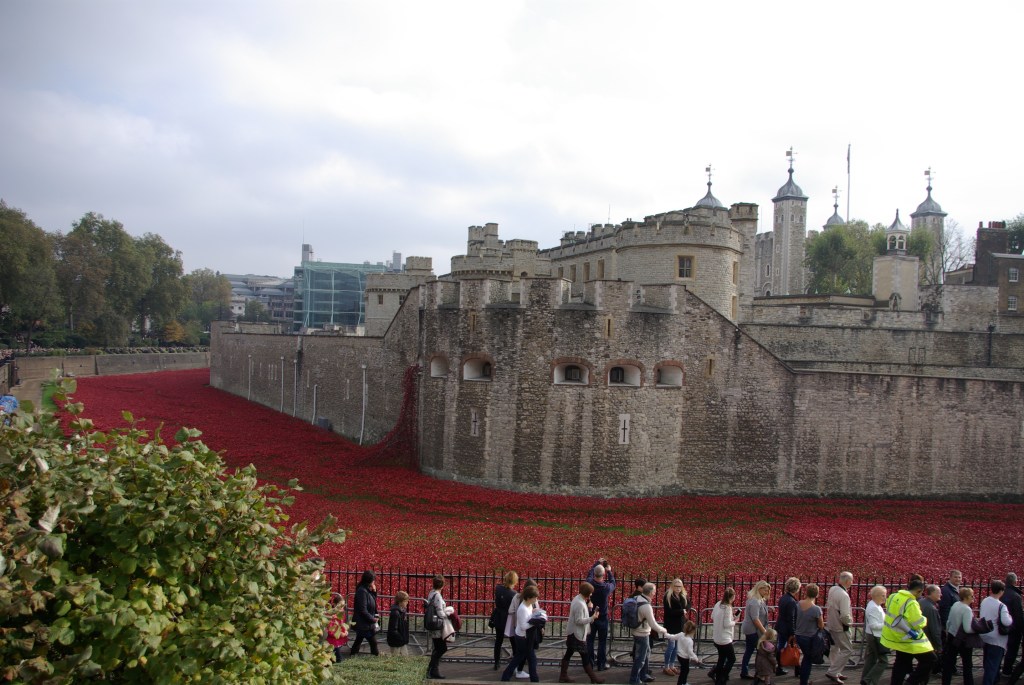
    Tower of London

    When you stand and take in exactly how many poppies there are, it is astounding. It is very humbling, and even my 9 year-old’s eyes bugged when she was told what each poppy represented.

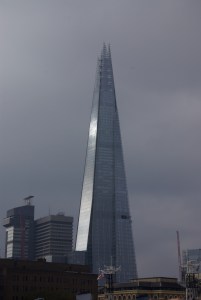
    The lines to tour the Tower were atrocious, so we decided to walk. We initially walked up to St. Katherine’s Dock, where we ate lunch. Then we backtracked to the Tower of London Bridge. We crossed the bridge to Southwark. From the bridge, you have a great view of the buildings along the Thames, and the Shard.
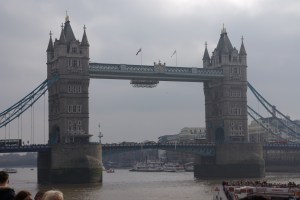
    Tower of London Bridge
    The Shard

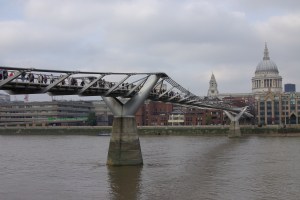
    We continued along the Thames, passing a reproduction of the Golden Hinde, Sir Francis Drake’s ship that circumnavigated the globe, and Shakespeare’s Globe Theatre. The Globe is also a reproduction based on the 1599 and 1614 models of the site. The new Globe opened in 1997. We had been heading toward Westminster, but we forgot to turn toward a particular road we were supposed to take and stuck to the river front, happening upon the Millennium Bridge. This was the highlight of the day for my children. If you are a big Harry Potter fan, you will recognise this as the bridge the Death Eaters destroyed in the movie Half-Blood Prince. They all were very excited and insisted on crossing the Thames.
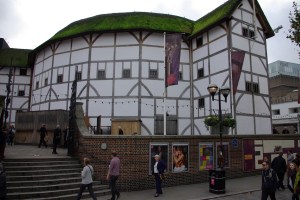
    Shakespeare’s Globe Theatre
    Millennium Bridge

    millennium Bridge crosses the Thames between the Tate Modern (which I completely missed!) and St. Paul’s Cathedral. I thought my children might be excited to see the cathedral from Mary Poppins, but they only reinforced my belief that I haven’t had them watch the movie enough. I was singing “Feed the birds, Tuppence a bag…” and they were telling me they didn’t remember the movie well enough. (*sigh*).
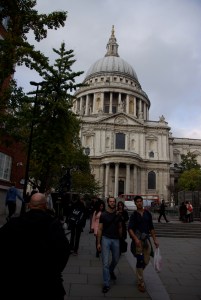
    St. Pauls coming from Millennium bridge
    Taken on the steps of the Cathedral

    We did go inside the Cathedral briefly, but there is a tour and they do not allow photographs within the Cathedral. We hope to return to take the tour. The children had lost patience with walking by then, which is why we hunted down the nearest tube station to go to Westminster. It is really an incredible sight when you exit the station and immediately see Big Ben before you.

    I studied the Parliament Building in a History of Architecture class my final semester in school. I was taken by the photos, and I was fascinated by it as we walked to see it. We had to go out on the bridge to really get a scope for the Gothic Revival building (My son must have been bored, because he took enjoyment in spitting in the Thames. *facepalm*). My husband is used to most of the gothic churches being built between 1200 and 1400, so I had to ask him when he thought the Parliament building was built. He was very incorrect.
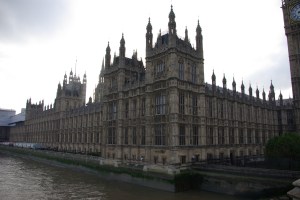
    Palace of Westminster (Parliament building)
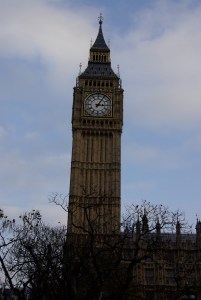
    Big Ben

    As we were taught, the government required a larger Parliament building than the one they were using, so in the process of deciding to build a new one also decided the new home of Parliament should be a distinctly “English” architecture. As a result, they dictated the design should be Gothic or Tudor, which they felt to be the most English forms. Charles Barry and Augustus Pugin were the architects, Pugin being responsible for the addition of Big Ben, an iconic symbol of England and London. Barry was supposedly looked at the big picture or larger details of the building, while Pugin had the eye for detail. I will say the detail is amazing when you stand on Westminster bridge and examine this building. This exacting eye had a price in that Pugin went insane before the completion of the building around 1870.

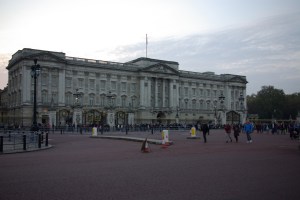
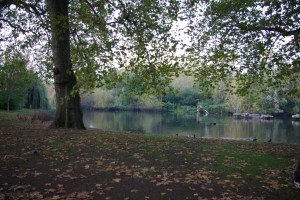
    From the Parliament building, we began to walk. Stopping to sit outside of Westminster Abbey before venturing through St. James’ Park, which has a lovely walk along the pond. We walked past Buckingham Palace, and then up the road to Charing Cross Station where our day ended.
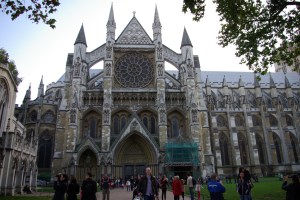
    Westminster Abbey
    St James Park
    Buckingham Palace

    Fortunately, we were able to bypass the Tower Hill tube station on our way back to our car! I had been informed earlier by someone working in one of the tube stations that Tower Hill had been closed numerous time that day because they could not handle the crowds!
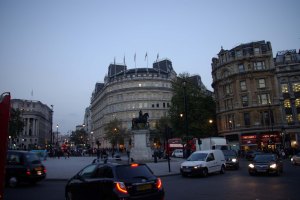
    Crazy Roundabout!

    This roundabout made me glad we didn’t drive into London! I cringe to think of what parking would have entailed!
    http://www.hrp.org.uk/TowerOfLondon/stories/timeline
    http://en.wikipedia.org/wiki/Shakespeare%27s_Globe

    Share this:

    • Share
    • Tweet
    Like Loading…
  • Blickling Hall

    January 3rd, 2015

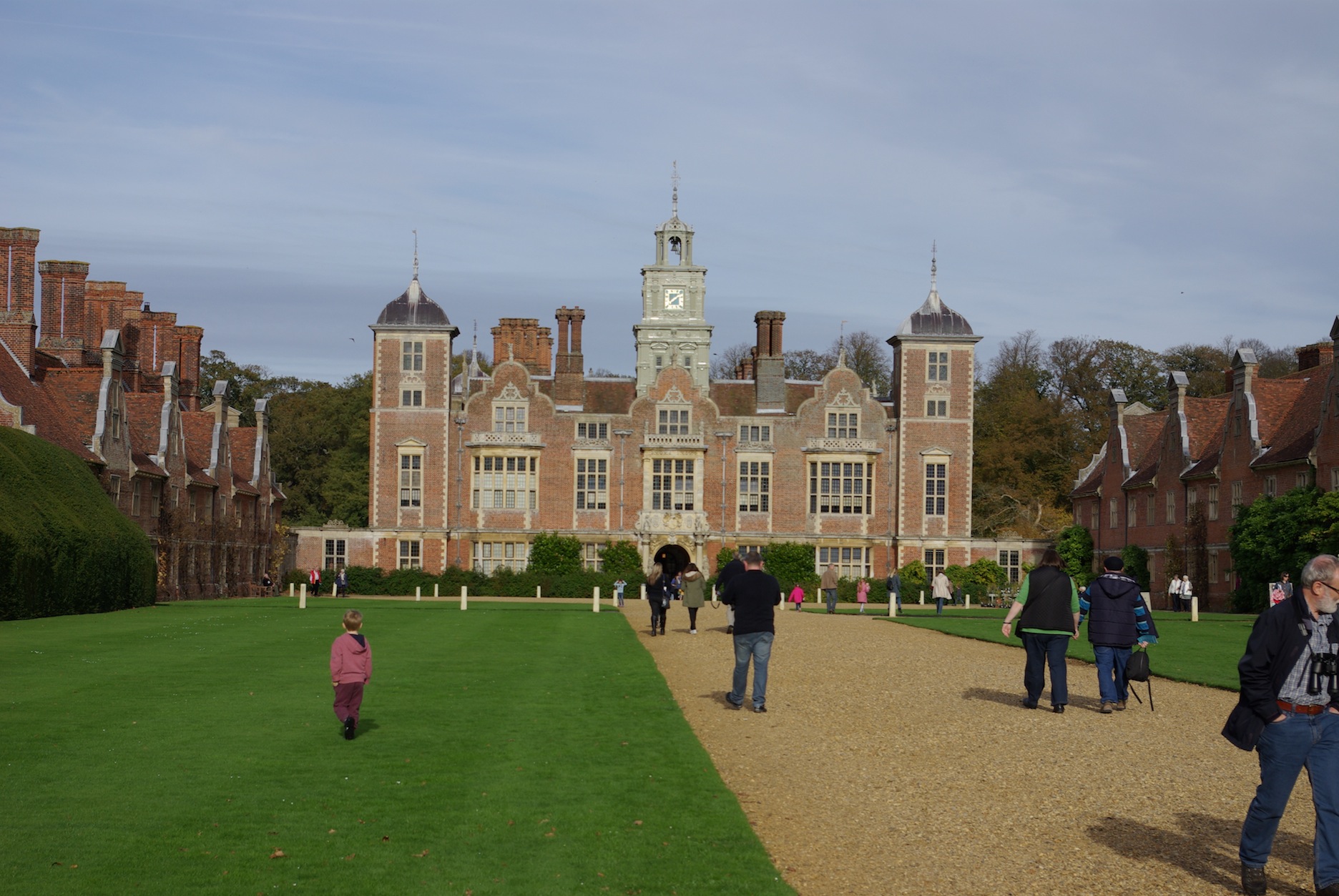
    Blickling Hall in northern Norfolk can only be called fascinating. The property and house both have a long and notable history from the Boleyns to World War II. From the outside, it may seem much the same as many of the grand estates in England, but I must say that the National Trust workers who work there do help in making it an exceedingly interesting tour! I must say as far as National Trust guides, this house boasts some of the best–in my opinion at least.

    Now, on to some of that history I was mentioning. Blickling Hall is built on what was once the estate of the Boleyn family. (If, for some reason, you aren’t aware of the Boleyns. Henry VIII, who founded the Church of England, wed Anne Boleyn in 1533 after the annulment of his marriage to Catharine of Aragon. Anne was later beheaded due to being found guilty of adultery, treason, and incest.) There is proof that the property was sold in 1459 to Geoffrey Boleyn. It is believed Anne was born at the home on the Blickling property and it is said that every year on the anniversary of her death, her headless ghost arrives at Blickling by a carriage driven by a headless driver and four headless horses. She roams the halls until daybreak.

    It is also said that Anne’s father, Thomas Boleyn haunts Blickling. It was through his machinations that  his daughter wed Henry VII. As a result, he lost his daughter and his son, so as his penance he is required to cross a dozen bridges before cockrow for a thousand years. He has a specific route that is from Blickling to Aylsham to Burg to Buxton Cotishall to Meyton to Oxnead and finally to Wroxham. Like Anne, he was also beheaded and the claim is his ghost carries his head under his arms with flame coming from his mouth, rather than blood.

    The next name of note in regards to the property is Sir Henry Hobart, 1st Baronet, who purchased most of the Blickling property in 1596. He did not acquire the house until 1616 and for £5,500. Hobart then brought in Robert Lyminge as architect to build what now stands on the property as Blickling Hall.

    Caroline Hobart, Lady Suffield, inherited Blickling in 1793 and lived at Blickling until her death in 1850. There is a room that houses the first editions of Pride and Prejudice and Sense and Sensibility that explain a great deal about Caroline and her elder sister, who was Lady Harriet. Their father John Hobart, the Earl of Buckinghamshire, had arranged Harriet’s marriage to one Earl, but she ran away with William Kerr, 6th Marquess of Lothian and was disinherited as a result, leaving Blickling to Lady Caroline.

    Caroline is noted in much of the house due to her mark on Blickling. She brought in Humphry Repton and his eldest son John Gunton to redesign the gardens and reconstruct the central clock tower. She was also an avid book collector and according to information within the house was responsible for the collection of almost 900 books in the gallery (the name for the library at this home), which included three first edition Jane Austen’s (Pride and Prejudice, Sense and Sensibility, and a reticule sized Pride and Prejudice). Pride and Prejudice and Sense and Sensibility are on display under glass, but the reticule sized was hidden amongst the thousands of books in the gallery. I look forward to returning to see that particular volume!

    Royal Air Force Oulton was a bomber base on a portion of the Blickling Estate. Created in 1939, it undertook work vital to the war effort before being closed for operations in 1946. It was decommissioned in 1949. There is a RAF Oulton Museum, but we did not have a chance to explore the museum.

    There is also another ghost that is claimed to roam this old house. Sir John Fastolfe was a 15th Century knight on which Shakespeare based his character Falstaff  has been seen throughout the old house. There have also been sightings of a “Grey Lady” floating through walls.

    Most of the paranormal activity is claimed to occur around May 19, which is the anniversary of Anne Boleyn’s execution.

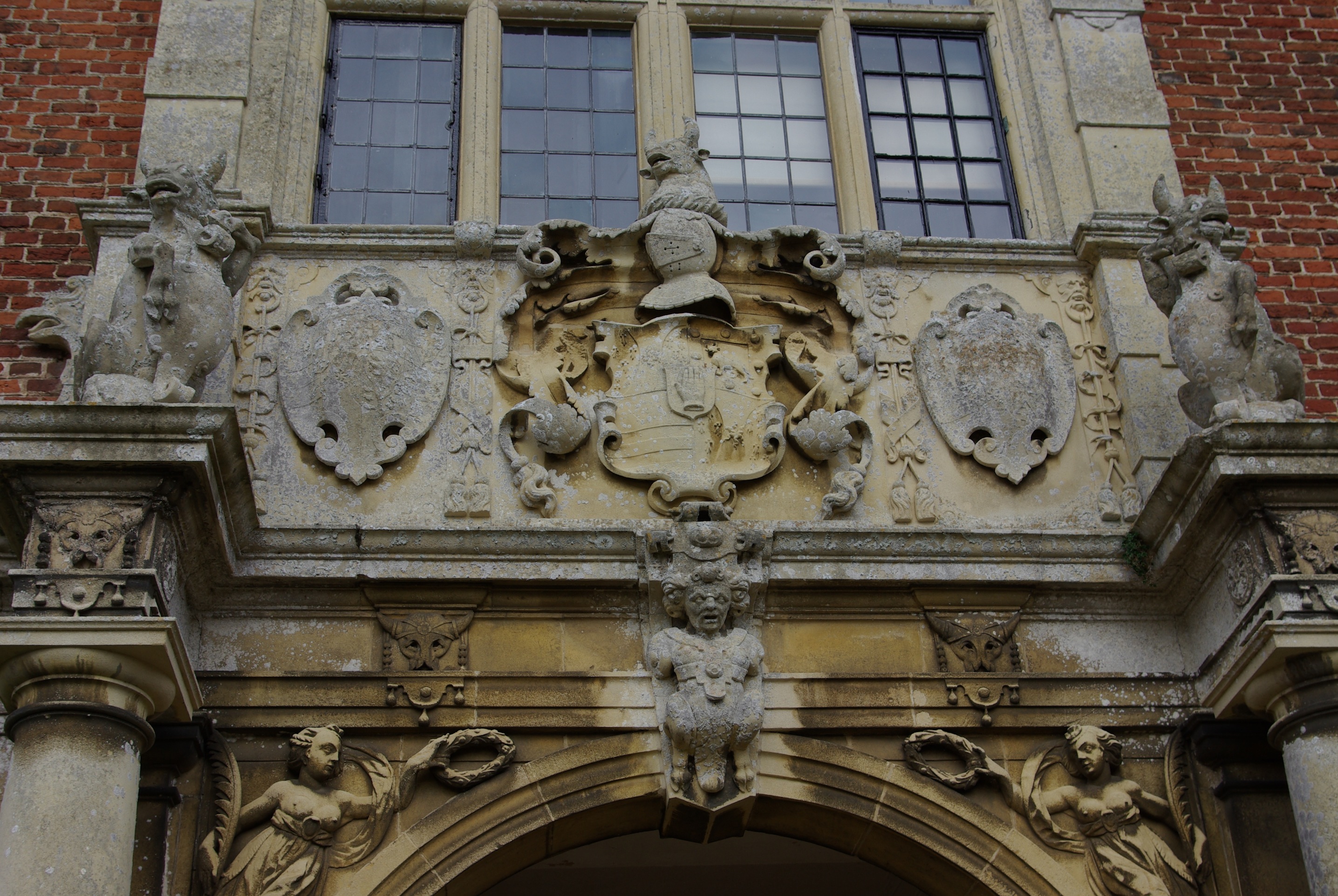
    The house is huge, and ornately done, which seems common for Jacobean manor homes. There are sculptural and relief elements crests on the exterior of the home as well as ornately done fireplaces and ceilings on the interior. Upon entering, you find yourself in a large room with a great deal of wood paneling and the large staircase that splits to go up to each side of the upper floor.

    The parlour appears to be a rather comfortably done room. There are lots of antiques, of course, but in these Jacobean homes, the ornate fireplaces and ceilings are what always seem to attract my attention. This one painted rather than an ornate plaster ceiling really attracted my notice. The last fireplace is located in a bedroom that was redecorated in 1767, and has true chinese silk wallpaper. They even have a portion under plexiglass that remains unfaded due to its location that is amazing to see.

    The library, which is referred to as the “Gallery” by the staff at Blickling is probably the most impressive I have seen so far. The National Trust apparently had not even known what they had until they began cataloguing the contents recently. The library at Blickling boasts of three Jane Austen first editions (I know, I mentioned it before) and an Eliot bible, which was the first Bible printed in the United States in 1595. All one has to do is just look at the rows of books to see the age and value of this collection. They have found numerous first editions other than the Jane Austen’s and I think it would be interesting to see a catalogued list of the contents when the curator is done.

    Unfortunately, the day we chose to visit was grey and it began to drizzle when we finally made our way to the grounds. I do not have many pictures of the grounds, but I do look forward to returning to see more of the grounds when we have a chance. The gardens look like they are beautiful in the summer and there are 50 acres in the park alone for people to wander. The entire property spans over 4,000 acres. We spotted one temple and I have seen pictures of the mausoleum Lady Caroline had built for her father.

    Avid historians and ghost hunters should find common ground with Blickling Hall. It truly has a bit of something for everyone, I think; although, my oldest daughter missed not having any Greek or Roman style sculptures, so I might be mistaken.

    Next up….London Baby!!!

    Bibliography:
    http://www.nationaltrust.org.uk/blickling-estate
    http://www.hauntedrooms.co.uk/blickling-hall-norwich-norfolk
    Wikipedia 

    Share this:

    • Share
    • Tweet
    Like Loading…
  • Anglesey Abbey

    January 3rd, 2015

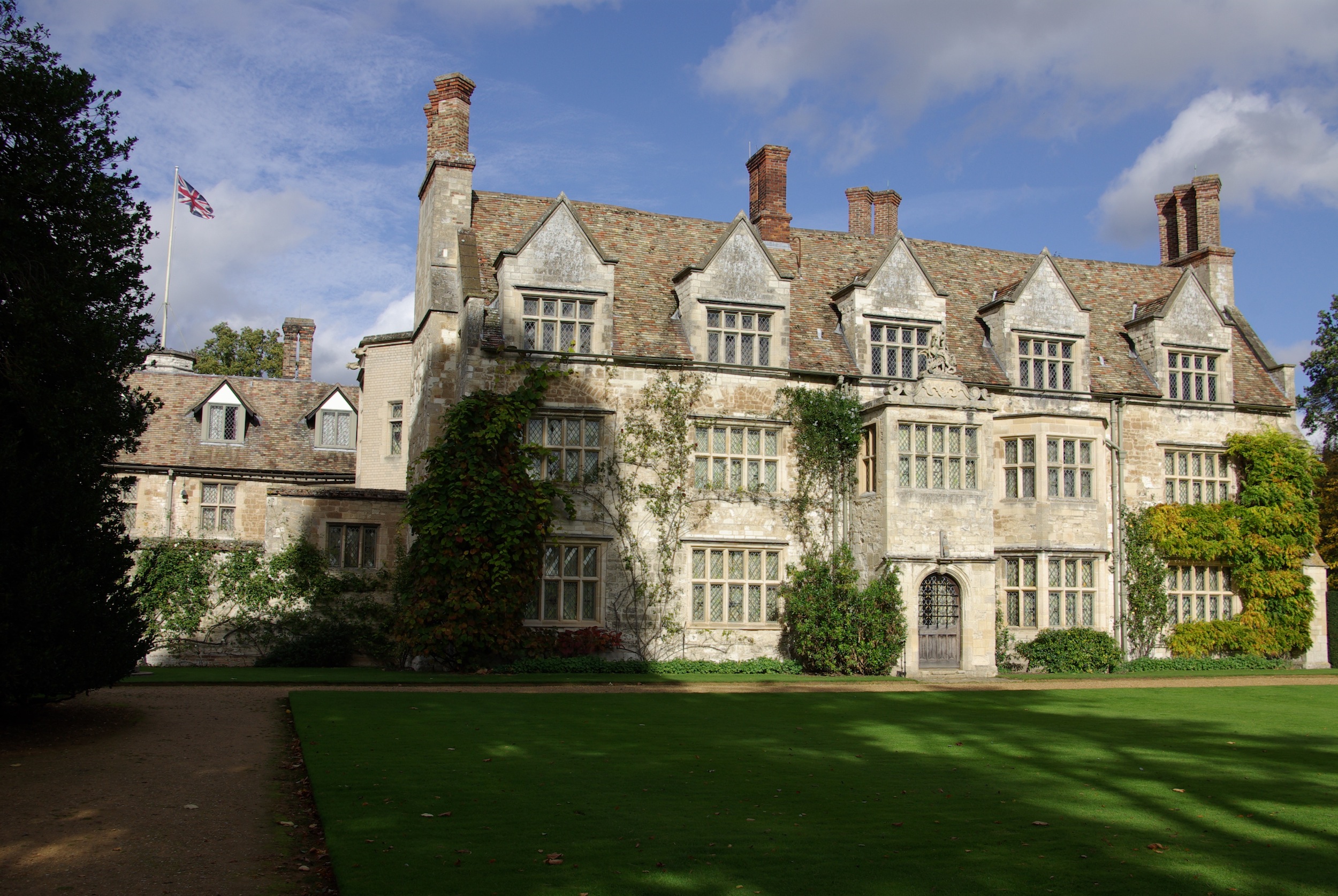
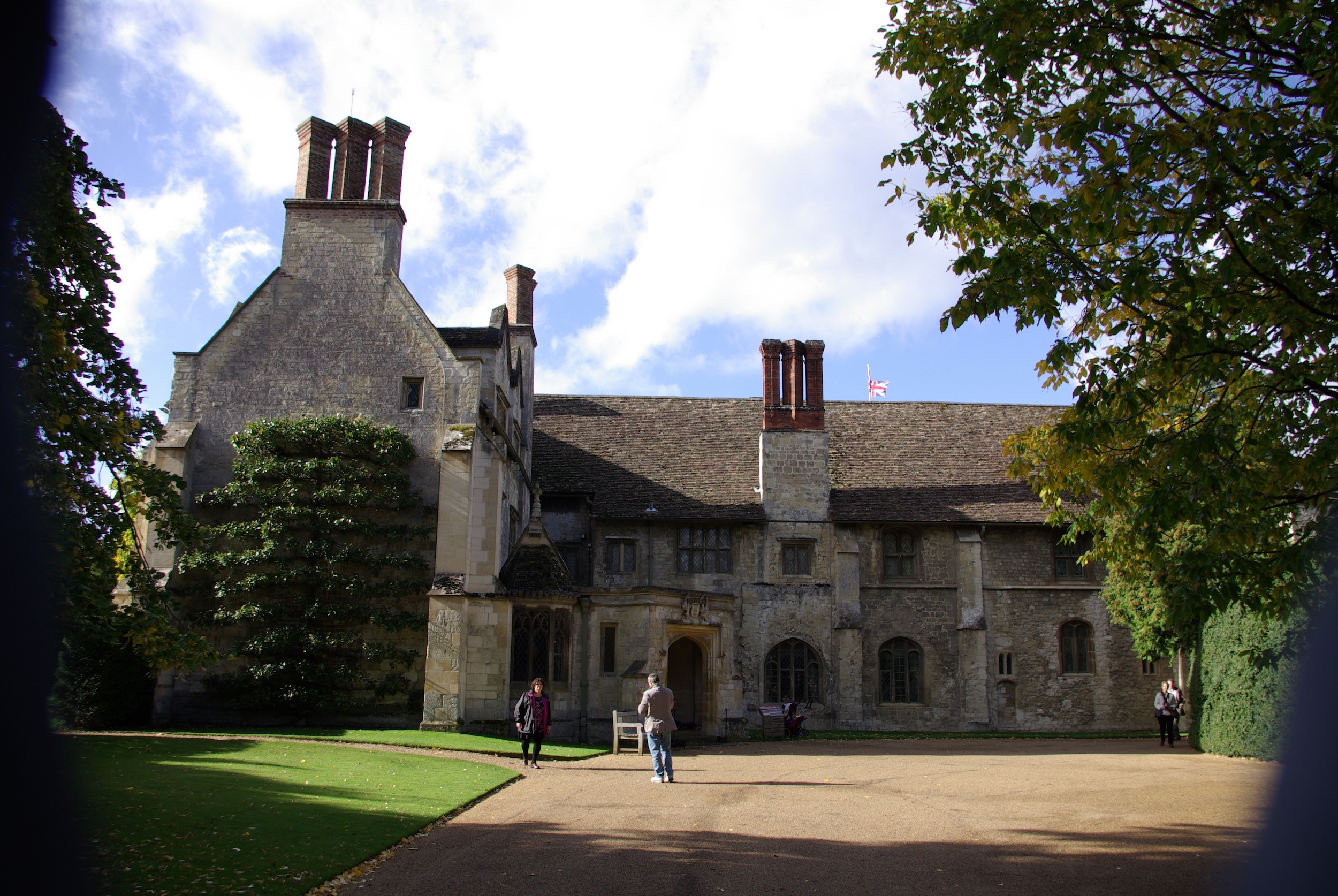
    Anglesey Abbey is a Jacobean style manor house built on the site of a 12th century Augustinian priory located just north of Cambridge. What remained of the priory was purchased by Thomas Hobson around 1600 and was converted to a country home for his son-in-law.

    Huttleston Broughton, who became the first Lord Fairhaven, purchased the home in 1926. Anglesey had fallen into disrepair, so Lord Fairhaven renovated the home and began to collect furniture, artworks and statuary. He never married, so when he passed in 1966, he left Anglesey to the National Trust.

    Touring the home today, you can truly get a sense of Lord Fairhaven’s penchant for collecting works of art. There are tapestries hung throughout the home, and works from artists such as Claude Lorrain, John Constable, and Thomas Gainsborough. There are even some of the original arches from the 12th century priory that can be seen in the dining room of the home. The arches are lovely and give the room such an interesting feeling. (I apologize for the quality of the image. I had a hard time with how dark the dining room was. It either didn’t focus or was a bit blurry.)

    At the moment, they are renovating some of the rooms and artwork, so two of the beds are moved into another room, and I am sure there might be a few prominent pieces of art that may be hidden away as they are restored. That was one of my complaints was all of the bedrooms of the were roped off at the door, and you can see that there are a few amazing pieces, but you cannot truly see the works or the plates that give you the artists name. There is a Constable that is immediately inside one of the doors, but the lighting is dim and the painting is dark. It makes it impossible to see it much less take a photo.

    There are multiple libraries. There is a small library off the hallway where Lord Fairhaven’s bedroom is located as well as the main library with his desk and the bulk of the books. One National Trust volunteer claimed there were almost 4,500 books and another claimed between 7,000 and 8,000 books. I am not sure which is correct, but given the gentleman who claimed the higher number could tell you the number of animals in the artwork of the parlour to the number, I would imagine he is not mistaken.

    My children and I enjoyed the kitchen and the servants areas. They are as they were in the 1930’s and there are even old bottles of food coloring and extracts that are interesting to view.

    The exterior of the house is beautiful. I do truly think it is one of the most interesting exteriors I’ve seen. I enjoy the windows and the chimney pieces. It also fits in very well with the surrounding gardens.

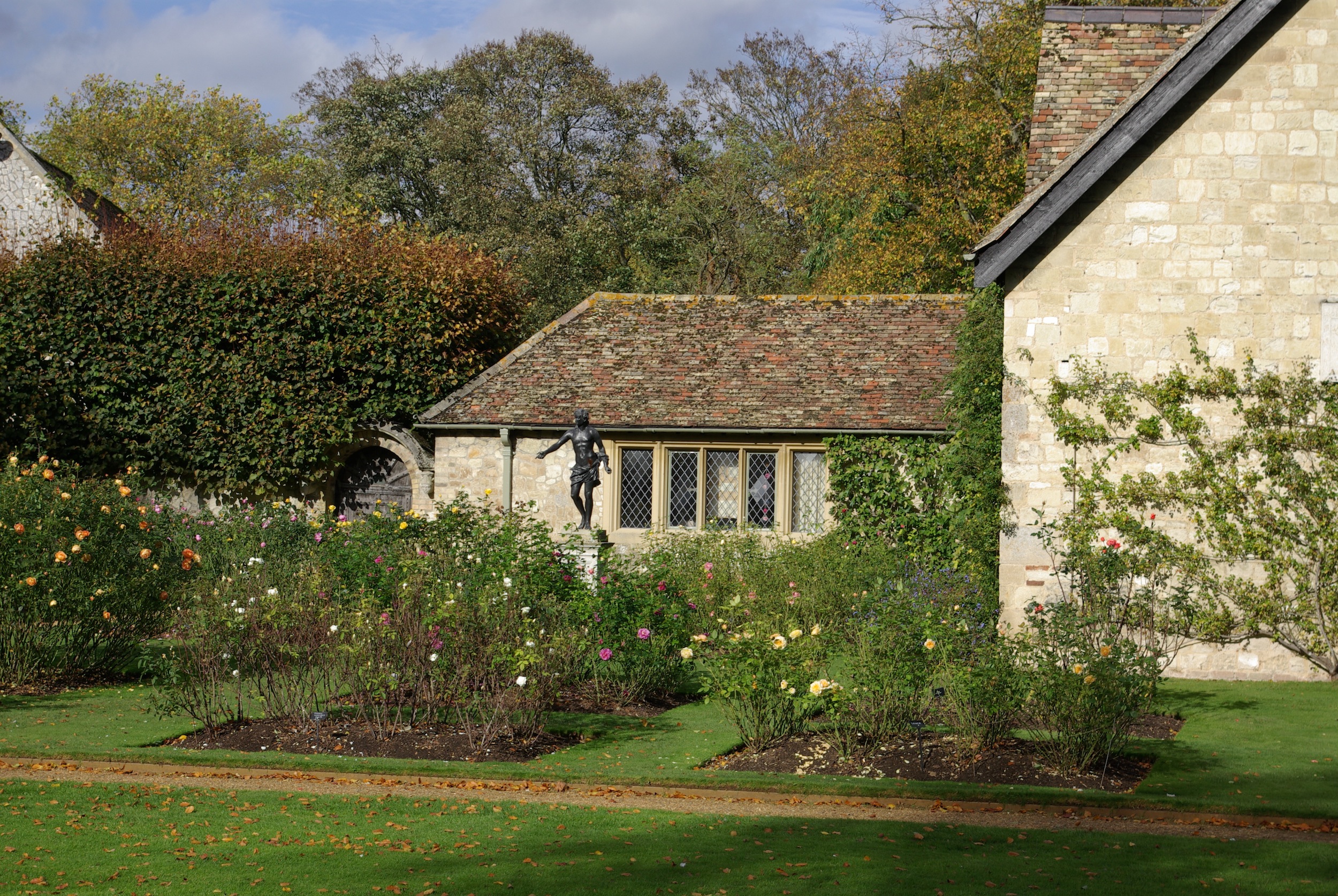
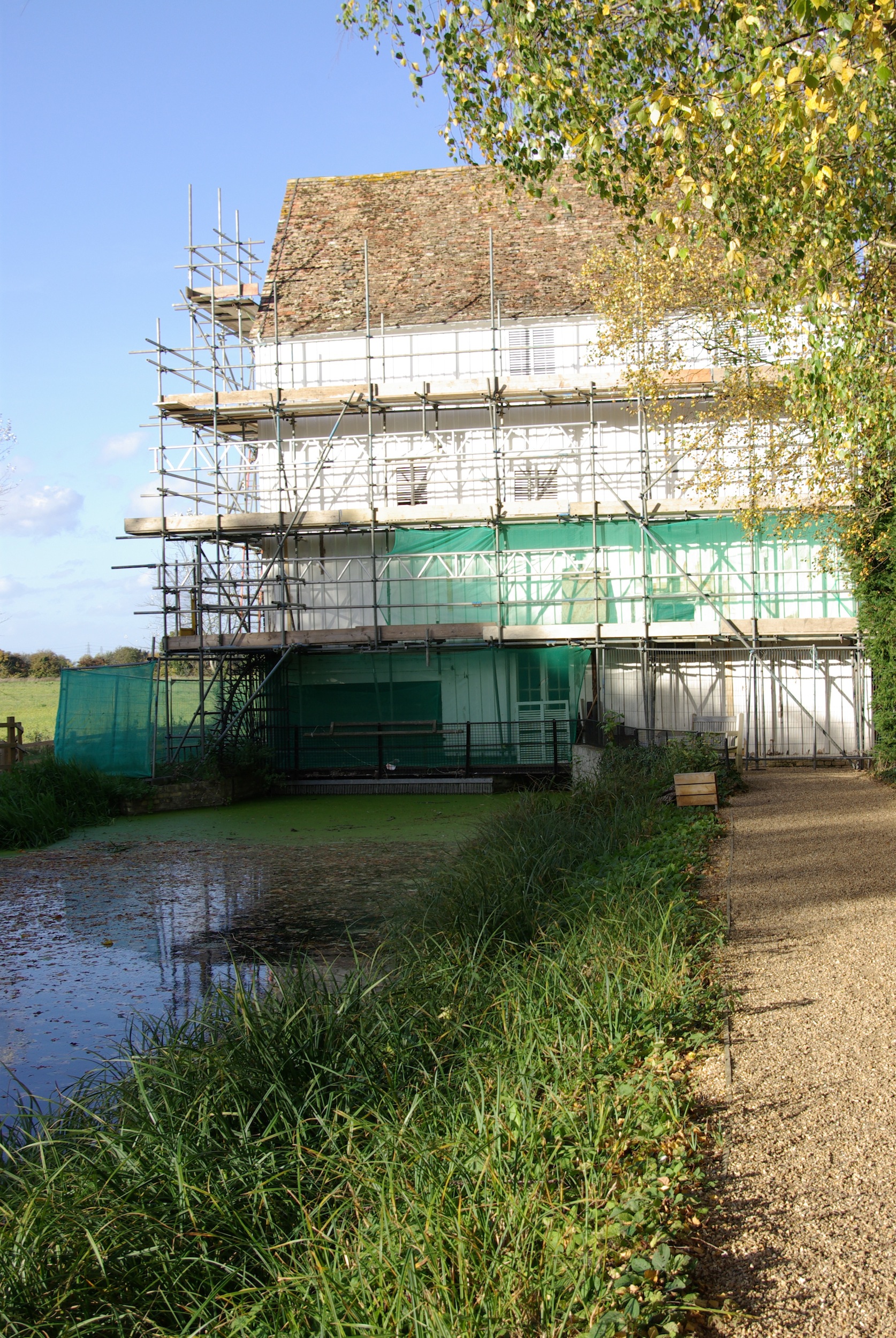
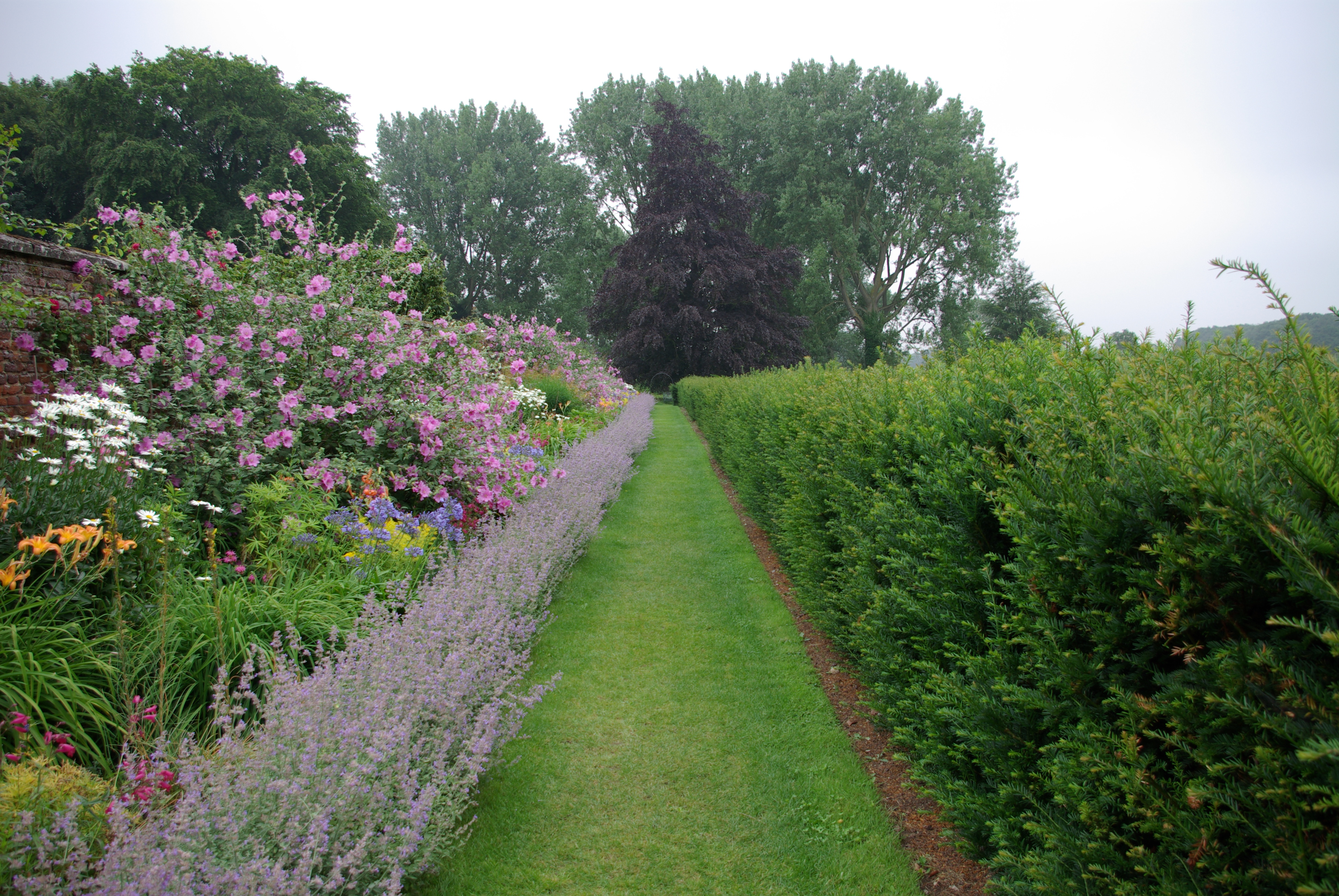
    The Gardens! The gardens are stunning! Even in the fall! There seem to be gardens for just about every season with statuary scattered throughout the 114 acres of land. There is even a working mill.

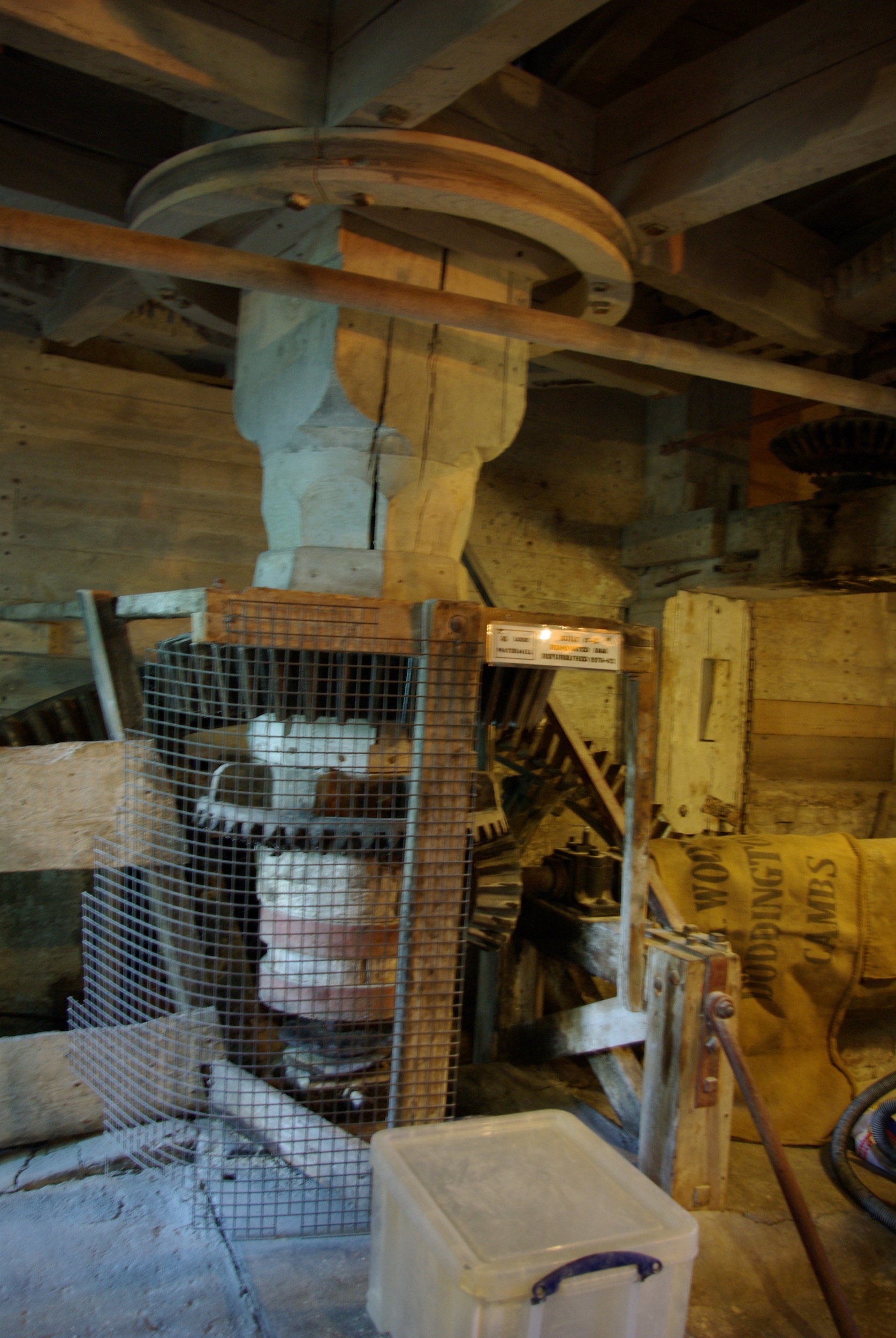
    The exterior of the mill was under renovation, but the interior was extremely interesting. Beware the steep stairways/ladders to access the upper floors where there is a small threshing machine and the chutes where the grain flows down into the grinding stones. They still mill flour and oats, and even have smaller stones for children to turn and grind flour by hand. There are  bags of flour and oatmeal for you to purchase at the mill and in the gift store before you leave.

    When you work your way around the front of the house, there is a rose garden. I know I saw a Dahlia garden on the signs, and then there are the avenues and the winter garden. I know my feet and my children’s feet were a bit sore by the time we called it a day!

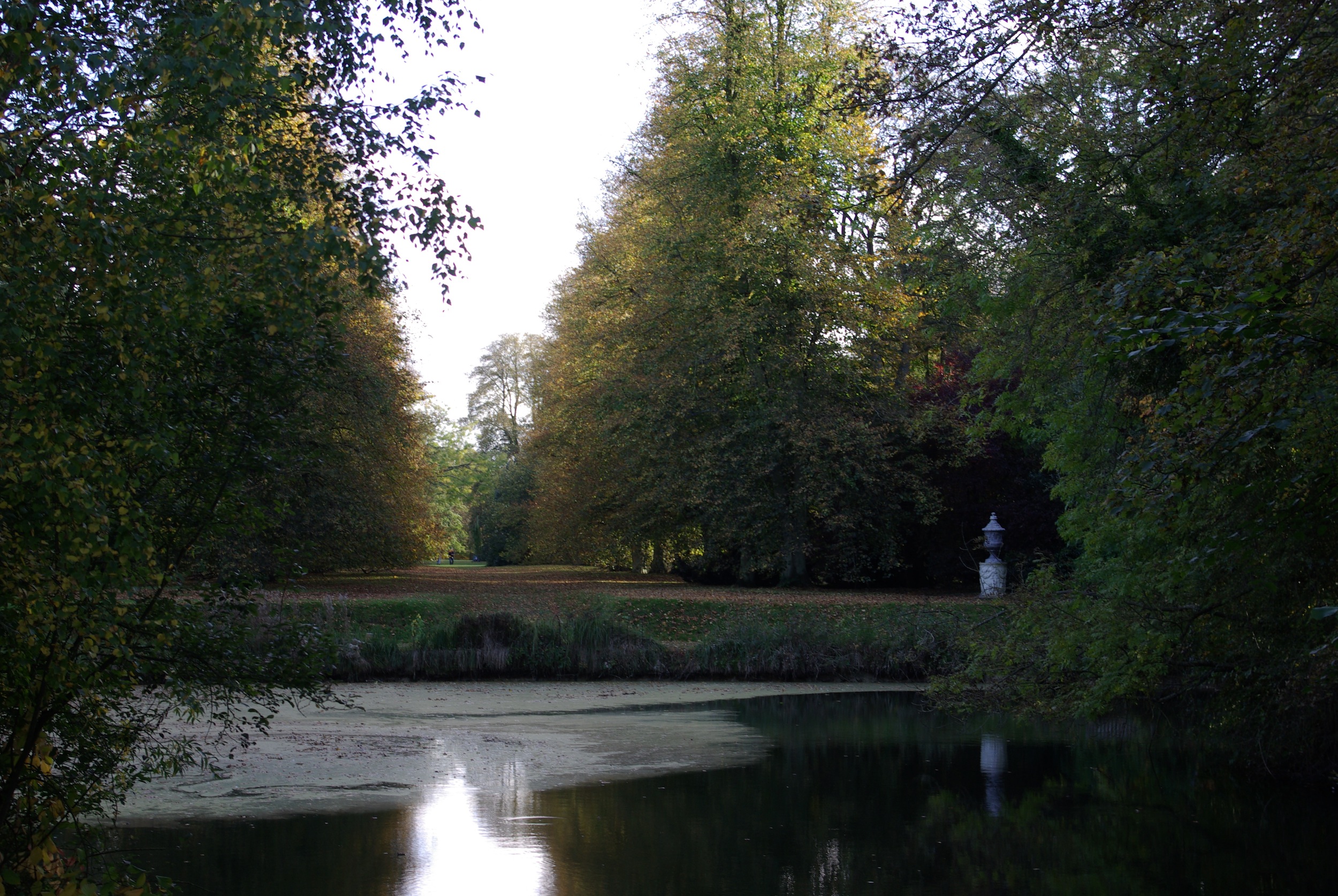
    The photo I have labeled “The Main Tree-lined Avenue” is of a lovely avenue planted to commemorate the coronation of King George VI and Queen Elizabeth in 1937. It is a row of horse chestnuts, which copy a similar garden planted in Windsor Great Park. My children loved grabbing “conkers,” which are the actual horse chestnuts. I still have yet to discover how many made it home in their pockets, but I am sure they will turn up around the house eventually.

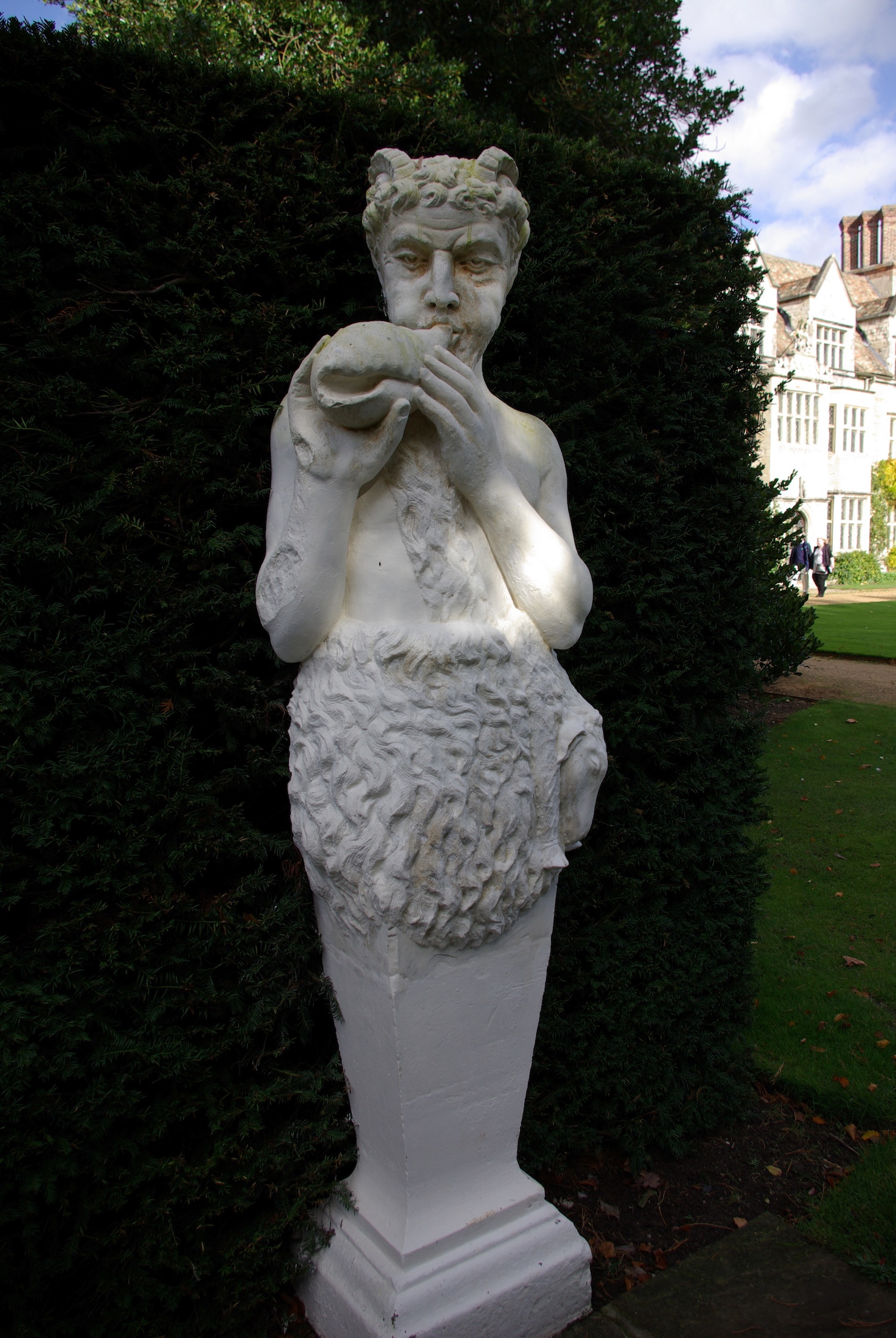
    We loved exploring all of the trails and “avenues” and studying the sculptures. We began trying to guess who many of the sculptures were based on what they were holding or the implements with which they were depicted. Some were not that difficult if you are familiar with Greek or Roman mythology, others gave us quite a run for our money.

    There is even a portion called Hoe Fen Trail. If you remember, I explained a fen in the post about Wicken Fen. This section is different than Wicken Fen, but is still a very natural area of the park and has a lot of activities and areas for children to play. Just beware the stinging nettles! They can be found throughout the park, but they were the most prevalent in this portion of the gardens.

    I definitely think Anglesey Abbey is worth a day and based on photos I’ve seen, one day several times a year to see these amazing gardens in every season!

    Bibliography:
    http://en.wikipedia.org/wiki/Anglesey_Abbey
    http://www.nationaltrust.org.uk/anglesey-abbey/

    Share this:

    • Share
    • Tweet
    Like Loading…
  • An Afternoon in Ramsgate

    January 3rd, 2015

    Anyone who has read Pride and Prejudice has heard of Ramsgate.  It is, of course, the seaside town where Darcy set his 15-year-old sister, Georgiana, up with her own establishment.  The move proves to be a tremendous mistake when he discovers his childhood friend and son of his father’s steward, George Wickham, follows her there and with the help of his sister’s companion, convinces Georgiana to elope.  Darcy arrives just in time to save his sister from a man who was only after her dowry of £30,000.

    Have you ever wondered what Ramsgate looks like.  What have you imagined when you read Darcy’s letter to Elizabeth Bennet explaining Wickham and mentioning Ramsgate.  As someone who has read Pride and Prejudice multiple times, I know I had a picture in my mind of the area, and it was nothing like what I discovered.

    Ramsgate’s history goes back to 100 BCE with the arrival of a group of Belgic people, who were inhabitants of Gaul in those days.  After, there were arrivals and invasions by the Romans and later the Vikings.  Ramsgate’s earliest notation has it called Hraefn’s ate, meaning raven’s cliff gap, although, it later was called Remmesgate, Ramisgate, Ramesgate, and finally Ramsgate.

    In the 14th Century it was known as a fishing village, but in 1483, it was adopted as a ‘limb’ of Sandwich and became a part of the Cinque Ports.  During the early 18th century, Ramsgate went through a great deal of cleaning and renovation followed by a quite a bit of building.  Georgian houses were built around the time Ramsgate became a busy garrison town and during Jane Austen’s time, it became a fashionable seaside resort.  In fact, by 1815, the region was so popular that there were steamboats on the Thames that took people to Margate, Broadstairs, and Ramsgate, which are all located on the same small peninsula.  There was even a train that connected these three towns so people could travel back and forth easily.

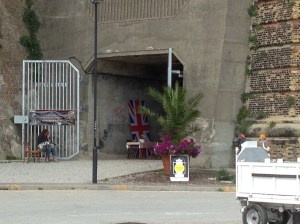
    Restaurant in old train tunnel
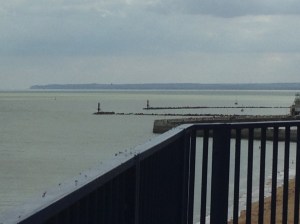
    Deal from the top of the sea wall

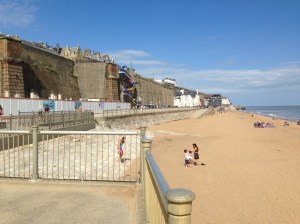
    The first thing you cannot miss when arriving along the beach at Ramsgate is that there is a sea wall–a huge sea wall.  Once you have parked along the seaside road, there are stairs that make the beach directly accessible.  There is a roadway that takes you down to the water level, but there is very little parking and it is no doubt more expensive than parking and taking the stairs down.  Ramsgate is a sand beach, unlike Deal, which is only a 20 minute drive.  It is still a very obvious resort area as the small stretch of beach we were on had two areas with vendors that sold ice cream and had various other beach paraphernalia.  There are no dogs allowed along the sand waterfront during the warmer months as well, which caused us to have to split time along the sand so someone was with our dog.

    Beach view showing Seawall
    Layla waiting with me at the beach

    Driving around Ramsgate is really interesting.  As we drove up one hill, I remember remarking to my husband that I felt as though I were in San Francisco.  Many of the houses are townhouses and attached on both sides like many in San Francisco and there are a few steep hills.  We also found homes that reminded us a bit of the French Quarter with their iron railings.

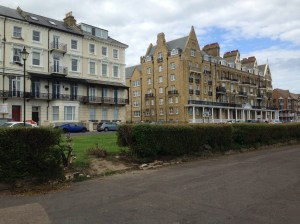
    Buildings along sea wall
    Looking up the street

    I wish we had more time to explore as we had wished.  There is also the Italianate Gardens, which is a large glass greenhouse that was built during the Georgian era, and is supposed to be a must see.  I suppose despite the eye rolls I will undoubtedly receive, I will have to convince my family to return one day to see the gardens.

    I apologize for the quality on some of the photos.  My camera battery died on me within minutes of arriving.  I took these photos with my phone.


    Next up….I don’t know!  Whatever we do this weekend?


    Historical sources:
    http://www.ramsgate-society.org
    ramsgatetown.org
    Watkins, Susan, Jane Austen’s Town and Country Style, Rizzoli (1990)

    Share this:

    • Share
    • Tweet
    Like Loading…
  • Dover and the White Cliffs

    January 3rd, 2015

    The day we toured Dover Castle and saw the cliffs, we had spent the day working our way down about a fifteen minute drive of coast in Kent.  We had toured Deal Castle in the morning, Walmer around lunch time, and our next stop had been Dover Castle.  Now, Dover Castle is high up on a hill and there is a bit of a narrow road through the property to get there, including a traffic light that alternates car travel across a very narrow one lane bridge.  My husband fussed at me because I was always rubbing one tire (or tyre as they spell it here) on the curb. He claimed he did not do it on our drive out, but I distinctly felt a tire rubbing the side!

    According to the English Heritage website, Dover Castle has been protecting the English shores from invasion for over 20 centuries.  Prior to the castle structure that we now tour, the site was home to an Iron Age Hill fort and a Roman lighthouse (I somehow missed this.  Now, I want to go back!).  After the Battle of Hastings, William the Conqueror converted the fort to a ‘Norman earthwork and timber stockaded castle.’   The site was then used continually until 1958.

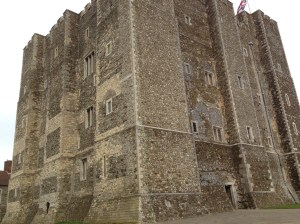
    The castle that now stands was erected by King Henry II and his successors during the 11 and 12th centuries.  Unlike the Tudor castles that we toured, Dover has a ‘Great Tower’ that was a ‘palace for royal ceremony and to house Henry’s travelling court’ and that is exactly what English Heritage gives you.

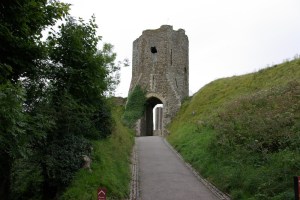
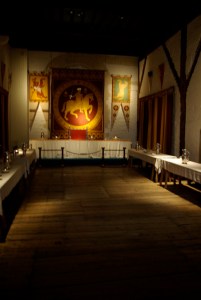
    Entering the front gate, you then walk up through another walled entrance with a drawbridge that protects the Great Tower.  The outbuildings are various museums, a gift shop, and a cafe, but the Great Tower that still stands in the center has been recreated to show visitors what it might have looked like just after completion when the court of Henry II received visitor Count Philip of Flanders, in 1184.  There are actors portraying the parts, holograms in certain rooms (There is one in the larder of men doing inventory), and things are set up to be walked through and explored.  The actors even rope the children into being knights of the realm in a ceremony.

    (Some of the interior pictures were difficult to take without being blurry.  There is not a great deal of light, so I apologize for the quality on a few of the images.)

    First entrance
    The Great Tower
    Recreated room

    We went up the entire tower, which is by winding staircase, so make sure you have been doing your stairmaster!  In fact, the staircases bring you all over and through lots of long corridors, and even all the way to the roof of the Tower where you can enjoy amazing views of Dover, including the port, and the surrounding countryside.

    View from Roof
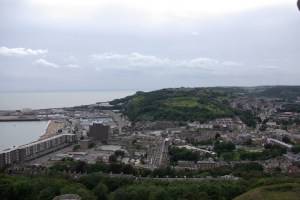
    Roof top view of Dover

    After making our way through the entire Great Tower, we exited out another gate with a drawbridge.  One of the first things we noticed upon exiting this gate was the enormous catapult that was standing outside.  As my family was checking that out, I began noticing the plaques on many of the buildings.  These all tell you the names or uses of the building and when it was built.  It is amazing to see buildings from as far back as the 12th century to as new as the mid-20th century, which shows how long this fortress was used as a defensive point.

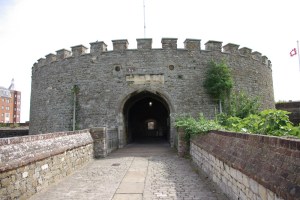
    Drawbridge
    View back to the gate
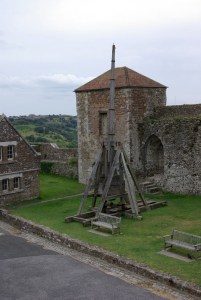
    Catapult!


    There are underground tunnels that take you into the cliffs and an Underground Hospital.   Unfortunately, by the time we walked down to where the Underground Hospital had been, it had closed, so I am sure for safety purposes the remainder of the tunnels had closed as well since it was nearing 5.  I’m not sure about going into the tunnels as I am not huge on tight spaces, but it does sound really interesting.  Dover Castle was an integral part of the battle and evacuation of Dunkirk when the France was being taken over by Germany in 1940, and these tunnels give you an example of what those days were like as well as how the tunnels were used for barracks and other missions.

    Underground Hospital

    Our last stop of the day was the White Cliffs National Trust.  This site consists of trails and lookouts all along the cliffs.  We parked and set off looking for a place to see the white chalk cliffs and take pictures.  Truly, you do not have a long walk from the visitor’s center before you find a nice spot.  There are two trails for this. One takes you down so that you can take pictures with the cliffs behind you and the other takes you above and you can take pictures looking down at the cliffs.  I was a bit nervous because not all of the cliff edges have protective barriers, and I still have one rather young and impetuous child.  We stuck to the upper trail which seemed to have a bit more as far as the barriers while my husband kept him close.

    The views were beautiful.  We could see France, the cliffs, Dover port, and we could also see Dover castle.  Clouds had rolled in by the time we went to the cliffs so France was not as easily discernible in the distance, but if you really look, you can see it.

    White Cliffs of Dover

    The entire day was busy, but everyone had a great time.  I have to say that Dover castle was my favorite of the three castles we toured that day.  If you find you are in the area and must pick one, then tour Dover.  It is easily be an all day event as well.  There is so much to see and do at Dover, and because of time, we only scratched the surface.  I will always recommend packing a lunch too.  There are often places to picnic even if you bring your own blanket, and it is less expensive than eating in the cafe.  I have enjoyed the cafes, but we sometimes pack a lunch, which is much more fun in my opinion.  I also mentioned the stairs inside the Great Tower.  The hills around Dover are steep and high, so they can also be a chore to climb if you are not accustomed to them.  The cliffs were an uphill walk as well.   It was a wake-up to how out of shape I have become, that is for sure!

    Next up….the sandy beach of Ramsgate.

    Share this:

    • Share
    • Tweet
    Like Loading…
  • Deal, Kent

    January 3rd, 2015

    Deal, Kent is a small town on the English Channel.  It lies north-east of Dover and south of the town of Ramsgate (Yes, Pride and Prejudice fans–Ramsgate!).  I will say that the drive from London is beautiful.  Kent is hills and valleys and at times when the brush clears along the side of the motorway, you can see amazing views that stretch for miles.  We traveled in early September, but I would imagine the green in the spring is absolutely stunning.

    Wooded road from the motorway to Deal

    Deal was first mentioned in William the Conqueror’s Domesday Book of 1086, but it has been traced back to as early as 55-54 BCE when Julius Caesar is claimed to have landed on the Deal-Walmer coast.  At one time Deal was a fishing village and then busy military and shipping port (even with its lack of harbour) due to its distance from France.  In fact, standing on the beach, you can see France on a clear day, but now Deal is a seaside resort.

    Deal Beach
    Deal Beach
    View of Homes from the Beach
    View of Homes from the Beach
    Conservation Area from the Beach
    Conservation Area from the Beach

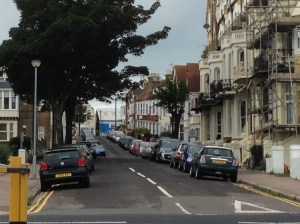
    The oldest portions of town near the town centre where you find Middle Street, which was the first part of the local “Conservation Area” due to the age and history of the buildings. We stayed in a home in the Conservation area and found it an incredibly interesting place just to walk around.  The houses all line exceedingly narrow one lane, yet tw0-way streets with very few garages and gardens.  We brought our dog along for the trip and finding a patch of grass for her was not the easiest chore!  This area runs several streets deep along the waterfront, so from where we stayed we could hear the waves and the gulls.

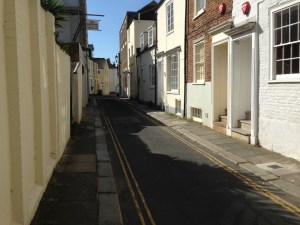
    Middle Street

    The beach is lovely, albeit an uncomfortable place to walk on barefoot.  It is a rocky beach that slopes pretty steeply when the tide is out, so be careful trying to make your way up and down the rocks, but you can still find shells and other treasures if you look carefully among the myriad of stones.  There is also a popular boardwalk down the waterfront that will take you past Deal Castle until the beach no longer runs along the Marine road.

    One of the attractions of Deal is that it boasts having three castles.  Now, when my children think of castles, they have visions of Disney princesses and other such stories, but these are not those types of castles.  These are military forts built by Henry VIII in the event of invasion by France or Spain.  The first castle is Sandown, which is in ruins, and that we did not visit.  The second is Deal Castle, which lies just to the south of town just off of the beach.

    Front of Deal Castle from Road
    Deal Castle from Beach Boardwalk

    Deal Castle was built in the mid-16th century and from overhead is in the shape of a Tudor Rose.  It is said that the stone for the walls came from the dissolution of the monasteries and it is still the original stone and the original building.  There are also preserved cannons and ammunition.  The rooms are mostly labelled so you know what each one was used for, and there is even the original copper door on the room where the gunpowder was stored. If you travel to Deal Castle, beware if it has been raining.  Some of the tunnels are rather dark and moisture does make its way inside, so wellies might be a consideration if you want to make your way through every nook and cranny.

    Cannon
    Shot
    Copper Door for Gunpowder

    The last castle/artillery fort is Walmer Castle, which is still an active home of the Lord Warden of the Cinque Ports.  It is just south of Deal Castle in the small hamlet of Walmer.  It is not as close to the water as Deal Castle, but there is a great view of the English Channel from the upper balcony area.  This Castle was also a favourite place for the Queen Mother.  There are no photos allowed inside because it is still used as a home, but you can tour rooms that once belonged to the Queen Mother as well as the room where Wellington died.  They still have the chair he passed away in on display, which my children found rather gross.

    Entrance to Walmer from the Gardens
    Entrance to Walmer from the Gardens
    View of the walls
    View of the walls
    Within the walls
    Within the walls

    Walmer is best toured for the gardens in my opinion.  They stretch around the castle as well as outward, giving a woodland walking trail, a garden belonging to the Queen and her mother, as well as a green with games for children.  It is a lovely spot for a picnic and simply to enjoy some family time.

    For someone planning to stay for some time, Deal is steeped in history and is fascinating simply for the exceedingly old neighbourhoods and beaches. We spent four days, and I am sure we did not even scratch the surface.


    Next up….Dover Castle and the White Cliffs

    Share this:

    • Share
    • Tweet
    Like Loading…
  • Stourhead

    January 3rd, 2015

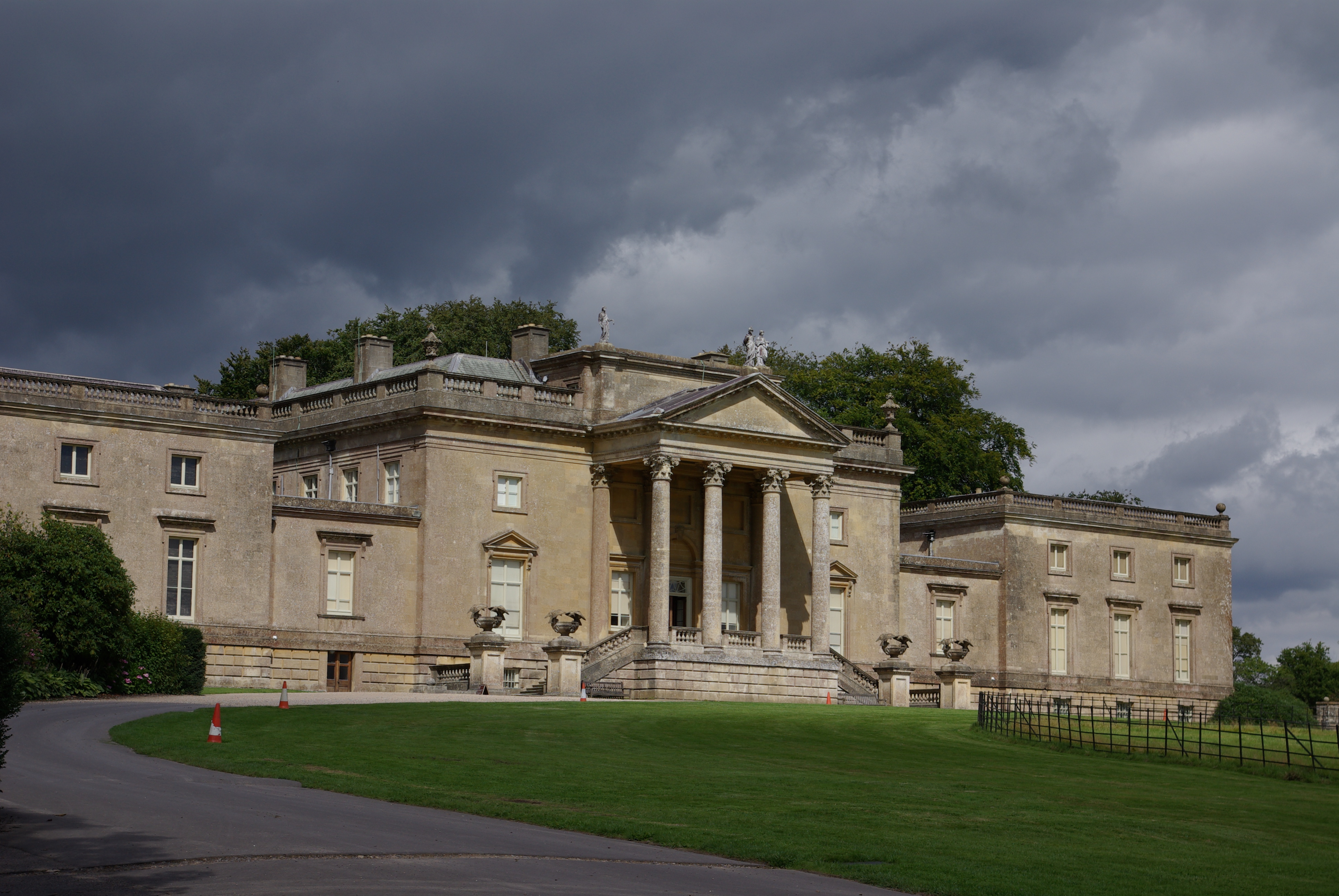
    I know I have quoted this often when referring to Stourhead, but I do mean it.  “If it were merely a fine house richly furnished,” said she, “I should not care about it myself; but the grounds are delightful. They have some of the finest woods in the country.”   Mrs Gardiner would have had the right of it if she were describing Stourhead.  The house is a fine house richly furnished, but the 2,650 acre grounds are what make Stourhead worth the drive.

    The estate itself has a long history even before Stourhead house was built.  The Barons of Stourton resided on this land for more than 500 years.  At the time, there was a manor house, but not anything like the large Palladian home that now sits upon the hill.  In 1714, the land and home was sold to Sir Thomas Meres whose son John Meres sold it to Henry Hoare I, son of prominent British banker Sir Richard Hoare.  This sale occured only three years after Meres bought it from the original owners.

    During this time period, art and architecture were revolting against Baroque and Rococo and looking back to ancient Greece and Rome, which resulted in a popularity to take from the Italian architect Palladio (1508-1580).  Palladio primarily built buildings in Venice, but he was heavily influenced by ancient Greek and Roman architecture, finding particular inspiration in the work of the  Roman architect Vitruvius (born 80-70 BCE – died approx. 15 BCE).  So when Henry Hoare bought the estate, he ripped down the existing manor house and had the Palladian Stourhead built in its place.  He did not live there for long, since he died shortly after its completion.

    His son, Henry Hoare II, then set to work on the gardens of the estate.  He formed a dam that created the lake and had temples positioned around the water to create specific views.  In fact, when you tour the gardens, the guides can tell you in which direction everything is meant to be viewed. I have read that following the path is supposed to evoke a journey “similar to that of Aeneas’ descent into the underworld.  According to the National Trust website, in 1750, a magazine called the gardens “A living work of art.”  I can definitely attest to that.

    When you arrive at Stourhead, parking is not near the house itself.  There is a bit of a walk and some of the flower and kitchen gardens must be passed. The stable block is before you reach the house as well.  The house itself is seated upon a rise in the grounds and when facing it, you can see trails leading to the woods to the right (I have heard the bluebells are beautiful in the spring!).

    As I said earlier, the house is lovely and richly furnished, but I admit to preferring Ickworth and Oxburgh to Stourhead.  It had some interesting features – lovely trim work, stained glass windows in the library, and of course art, but I wasn’t wowed.  I will say for anyone who loves antiques, there is a good bit of Chippendale furniture.

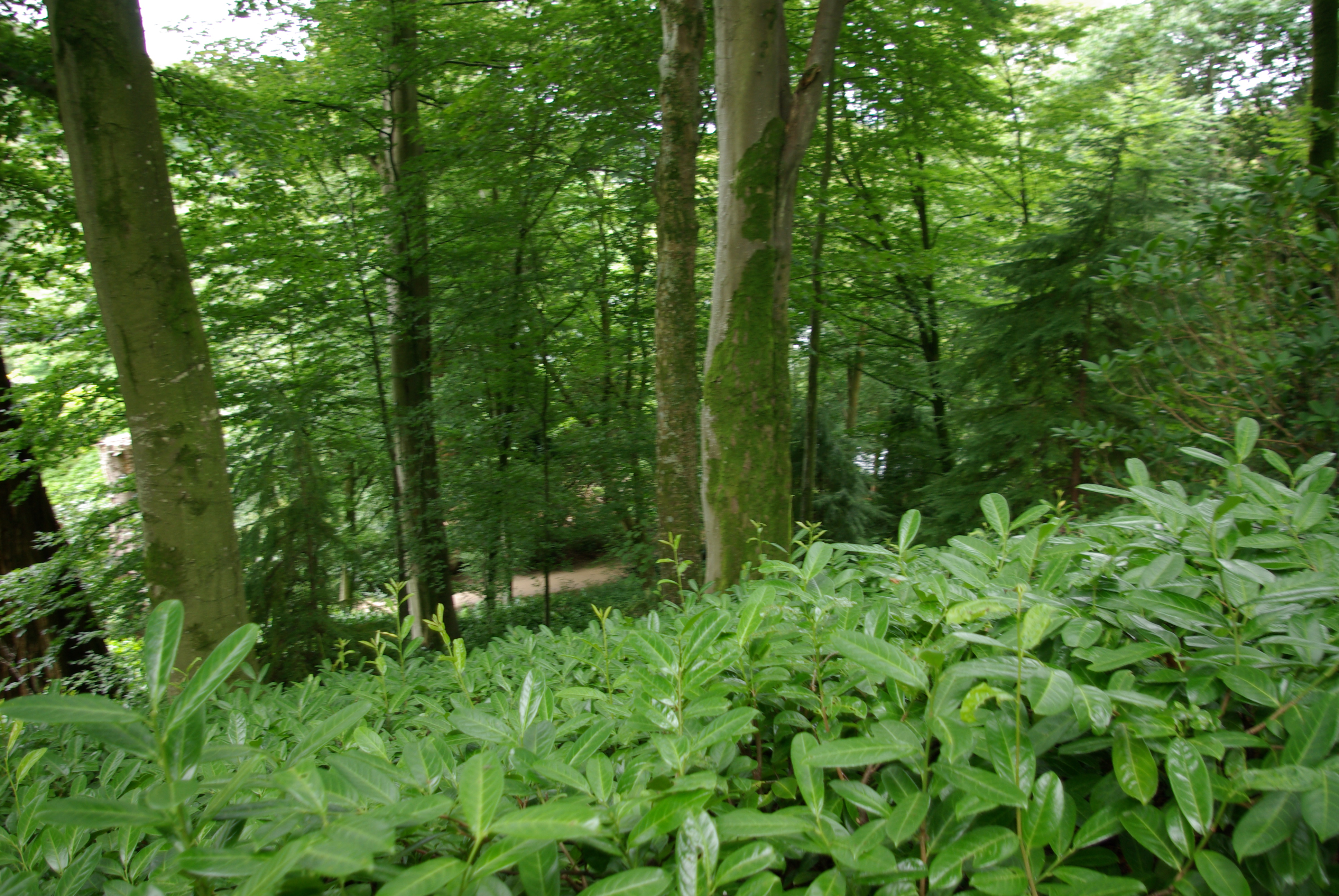
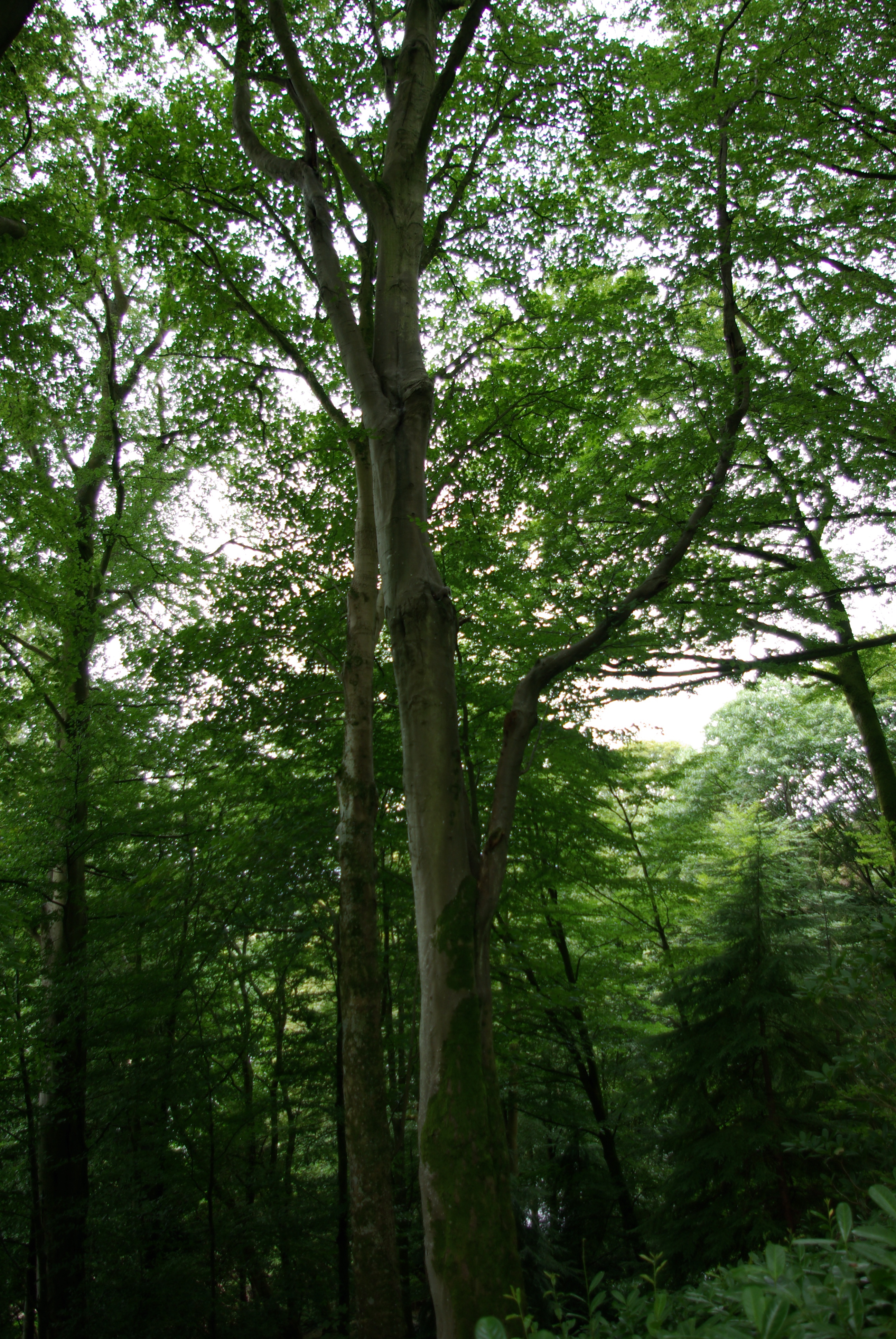
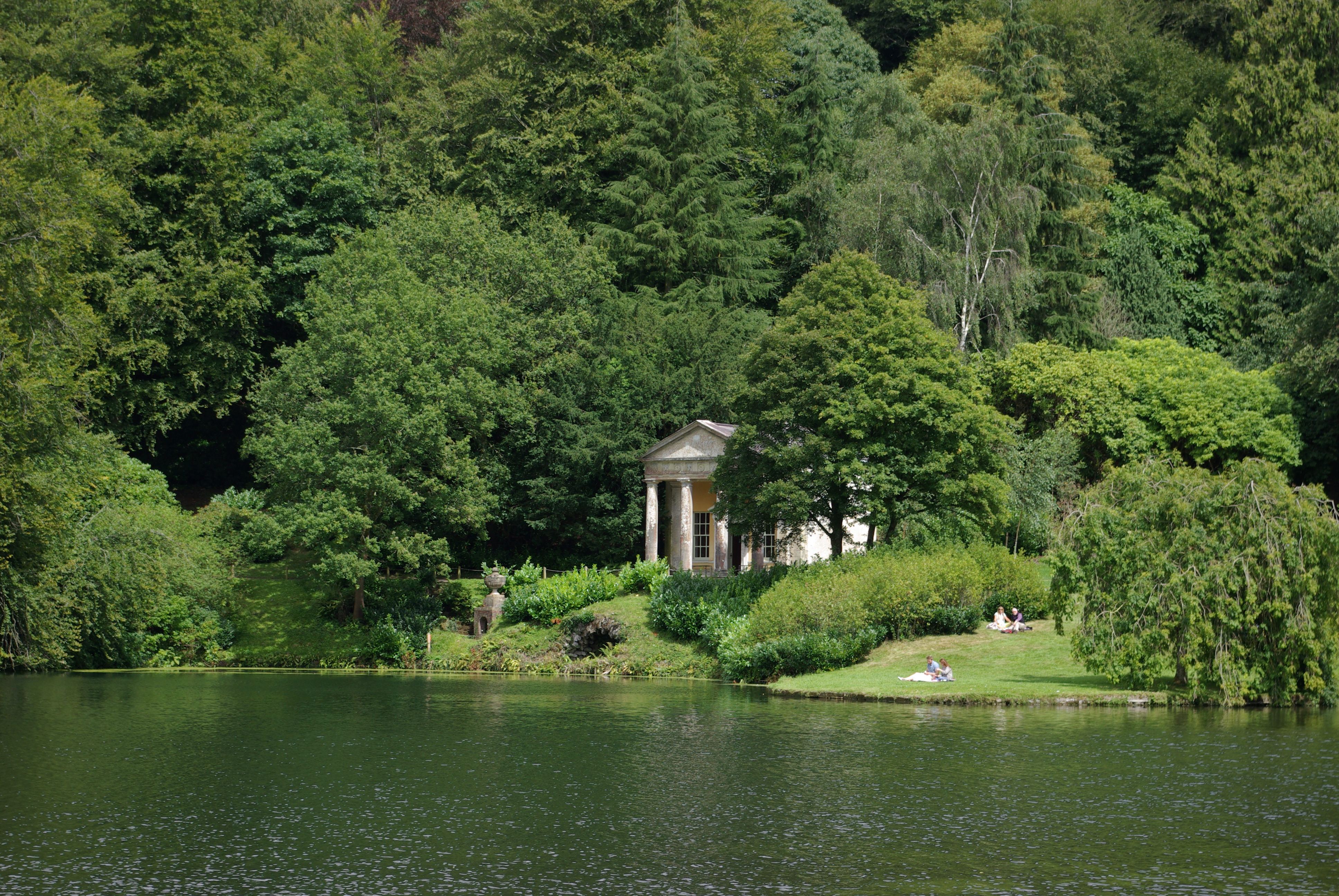
    From the house, we took a trail that begins to the left side of the house and followed it through some amazing woods to the lake.  It is here that you begin to notice the uneven and hilly terrain more.  You travel down quite a bit to reach the lake that you can almost view from one end to the other.  The temples are not always visible at every angle, but when they come into view, they truly add to the landscape.

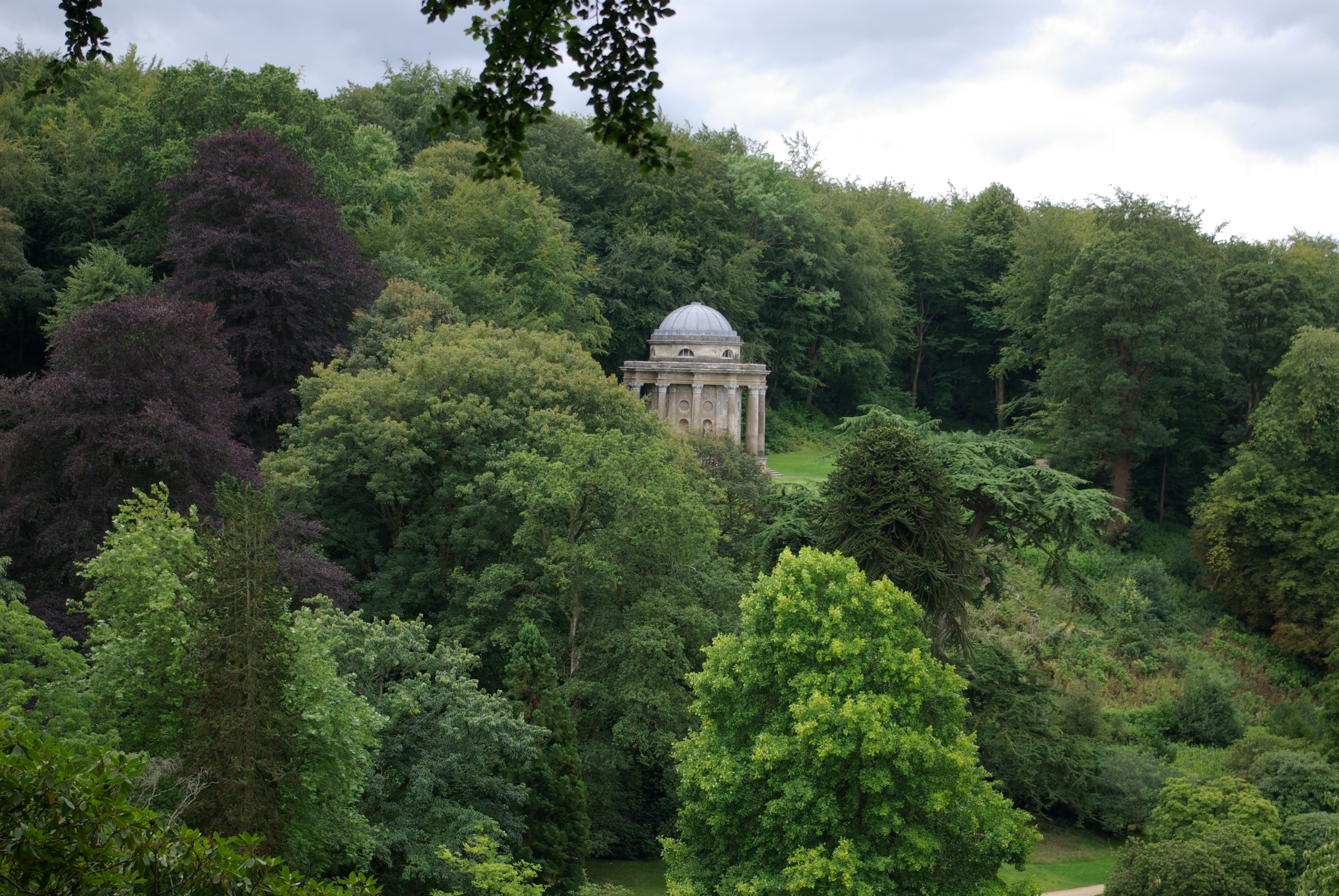
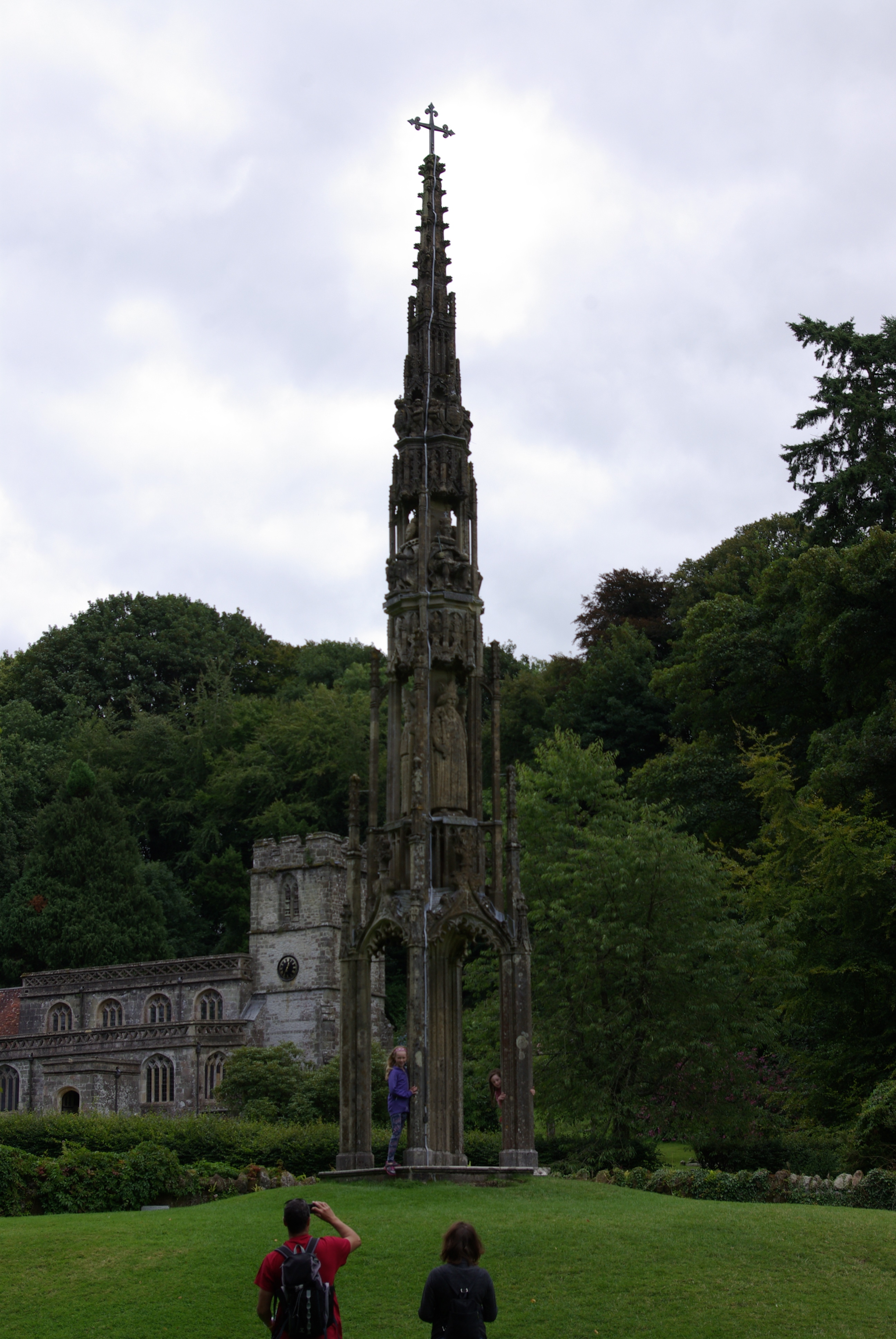
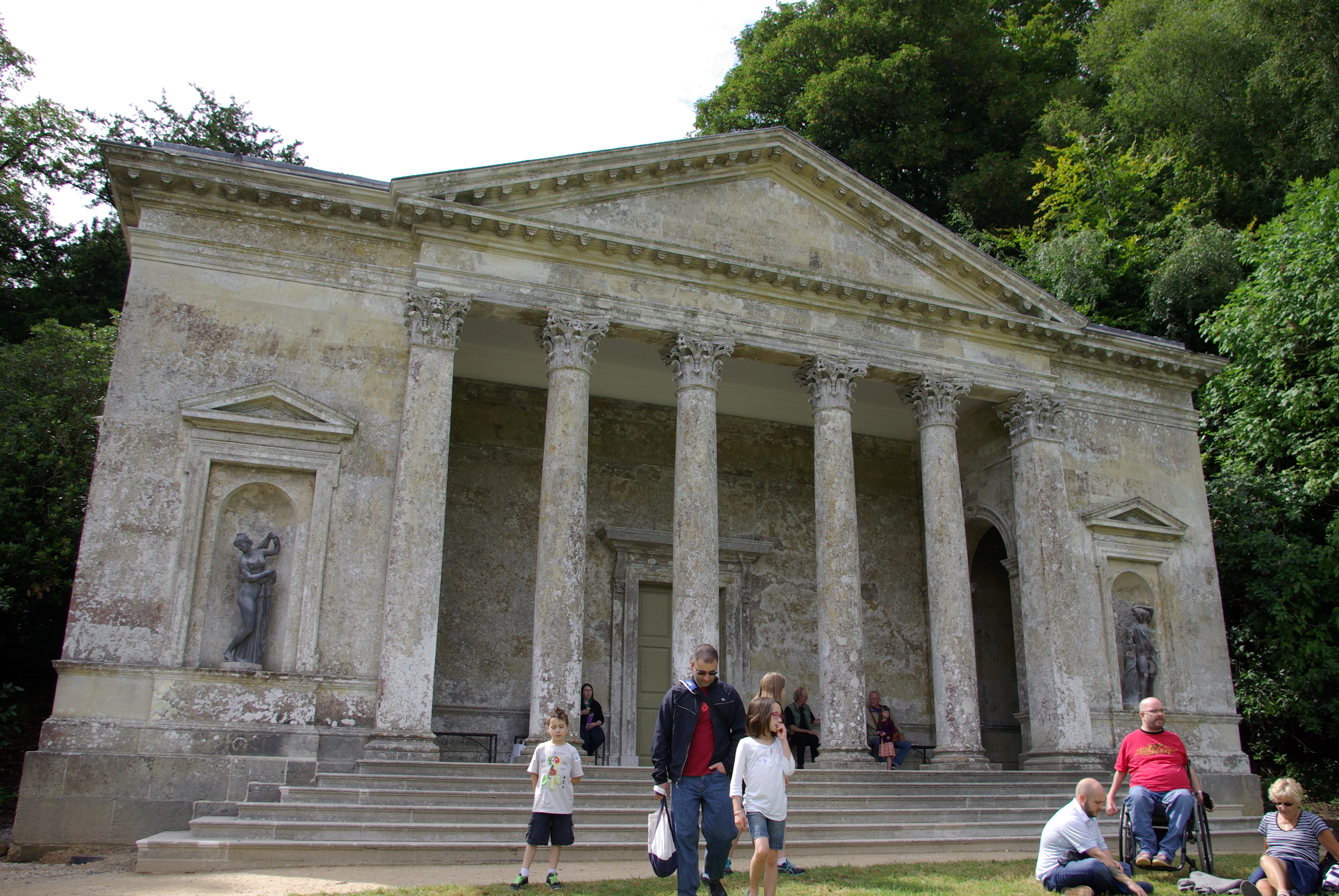
    My daughters are big Percy Jackson fans and wished to see the Temple of Apollo first, so we ended up travelling in the opposite direction Henry Hoare II intended.  We found the trail that circles the lake and began walking, coming to the Temple of Flora first.  It is set close to the water, and it is open so you can go inside as well.  From there, you pass an obelisk called the Bristol High Cross.  The bridge that Keira Knightly ran across in Pride and Prejudice is closed to people touring the grounds, so you must follow the trail.  Unlike the way the movie makes it seem, the Temple of Apollo is not near the lake.  In fact, there is a trail ascending from a rock cave on one side and stone steps on the other side.  It is quite steep but the view is incredible when you reach the top.

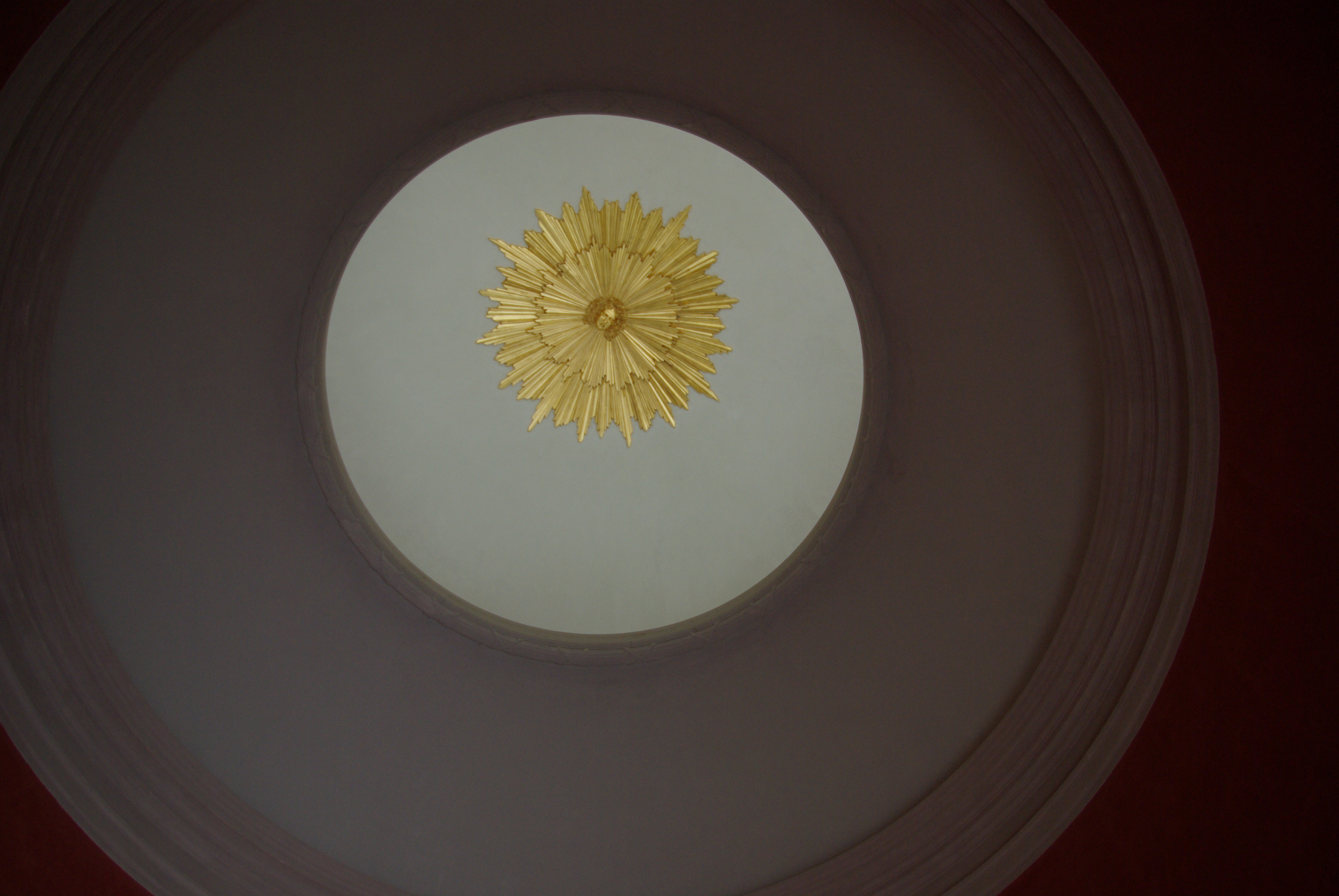
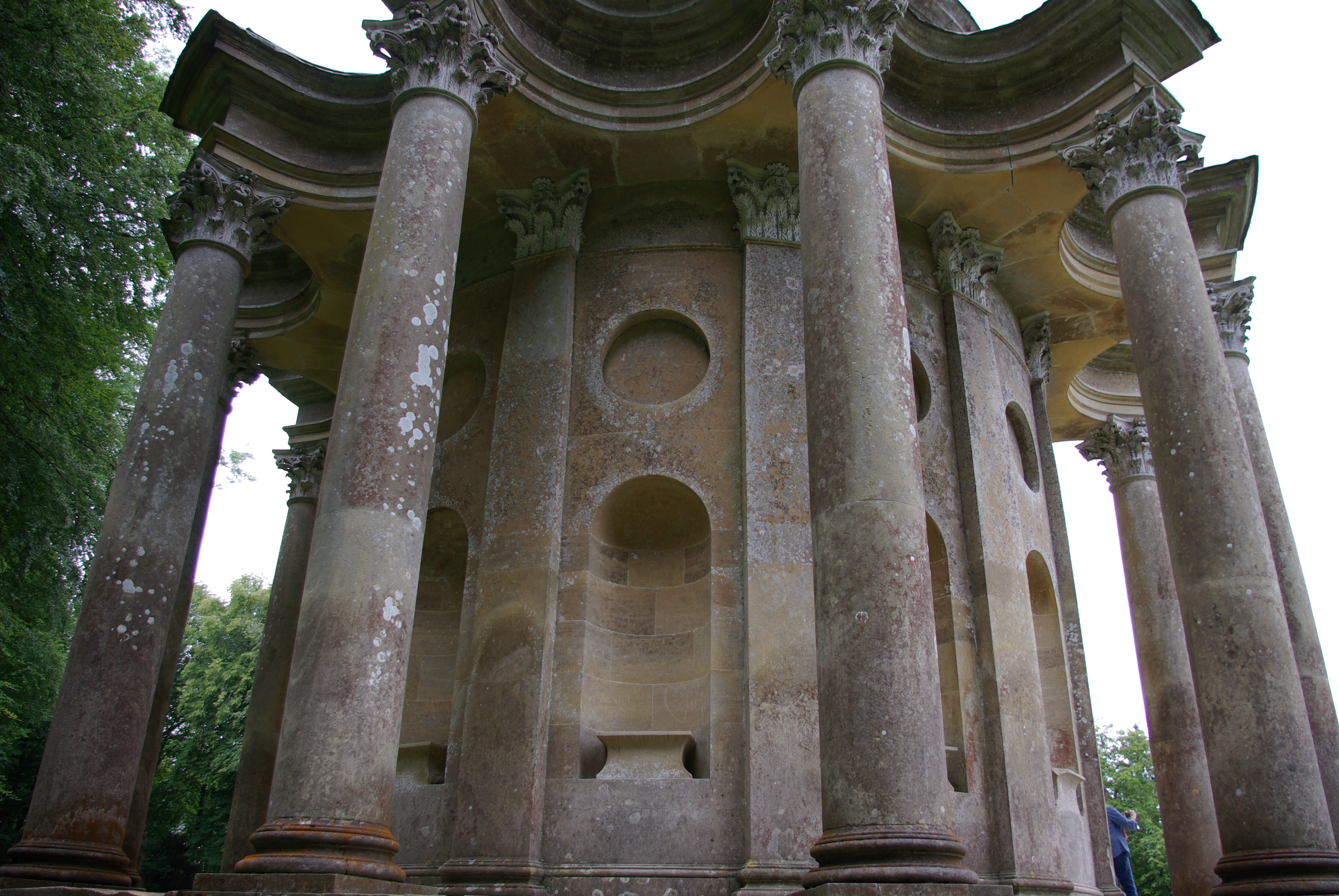
    The temple itself is very interesting with its Corinthian columns and shape, but the inside is fascinating as well.  It is essentially empty with the exception that they might have chairs for when weddings are held as there were the day we visited.  There is a gold face of Apollo in the center of a recessed ceiling and when you stand in the middle and speak, there is a peculiar echo that is really only heard by yourself, the speaker.  You do not have that effect anywhere else in the building but the one spot.  The guide who sits within the temple will even mention it for those who do not know.

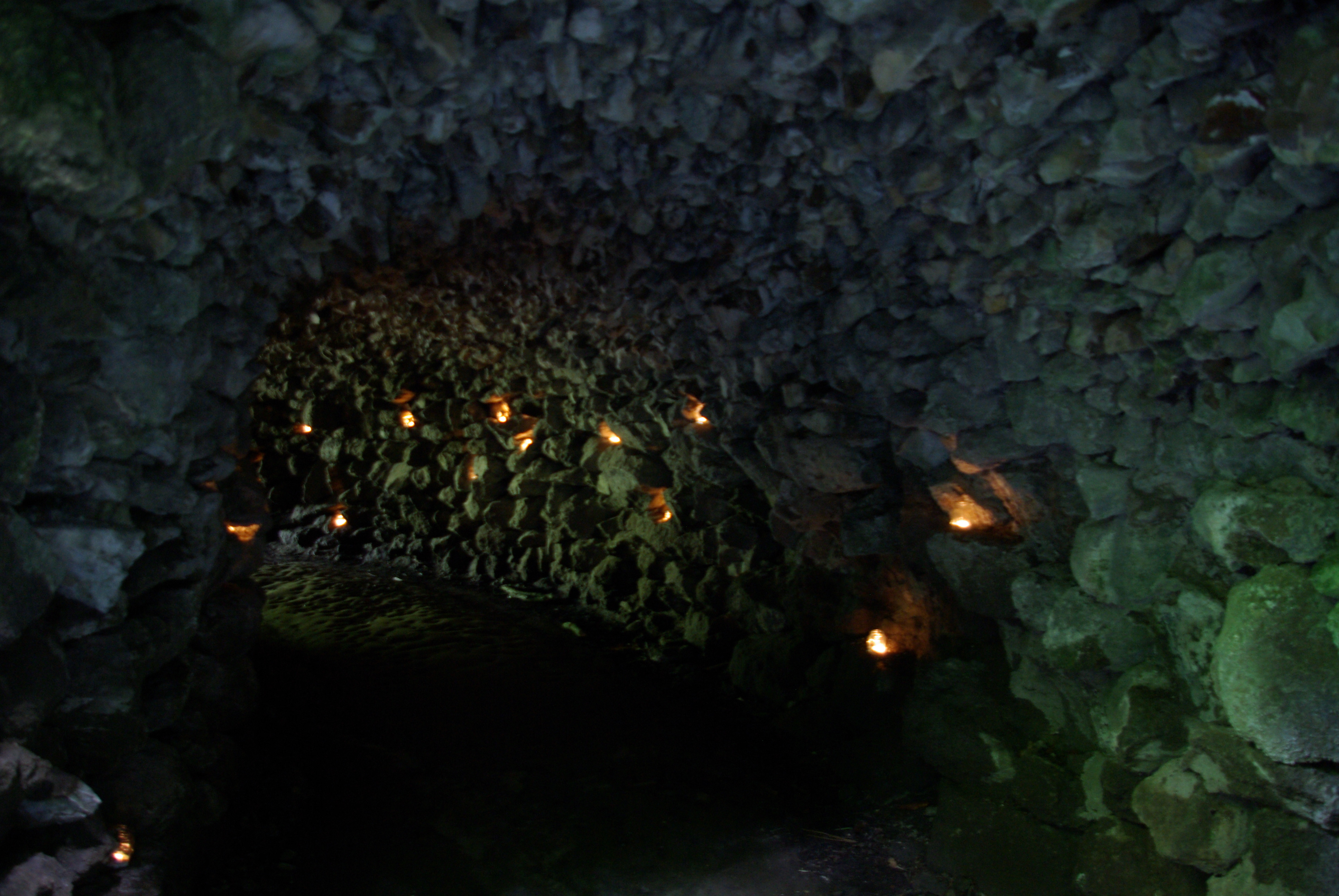
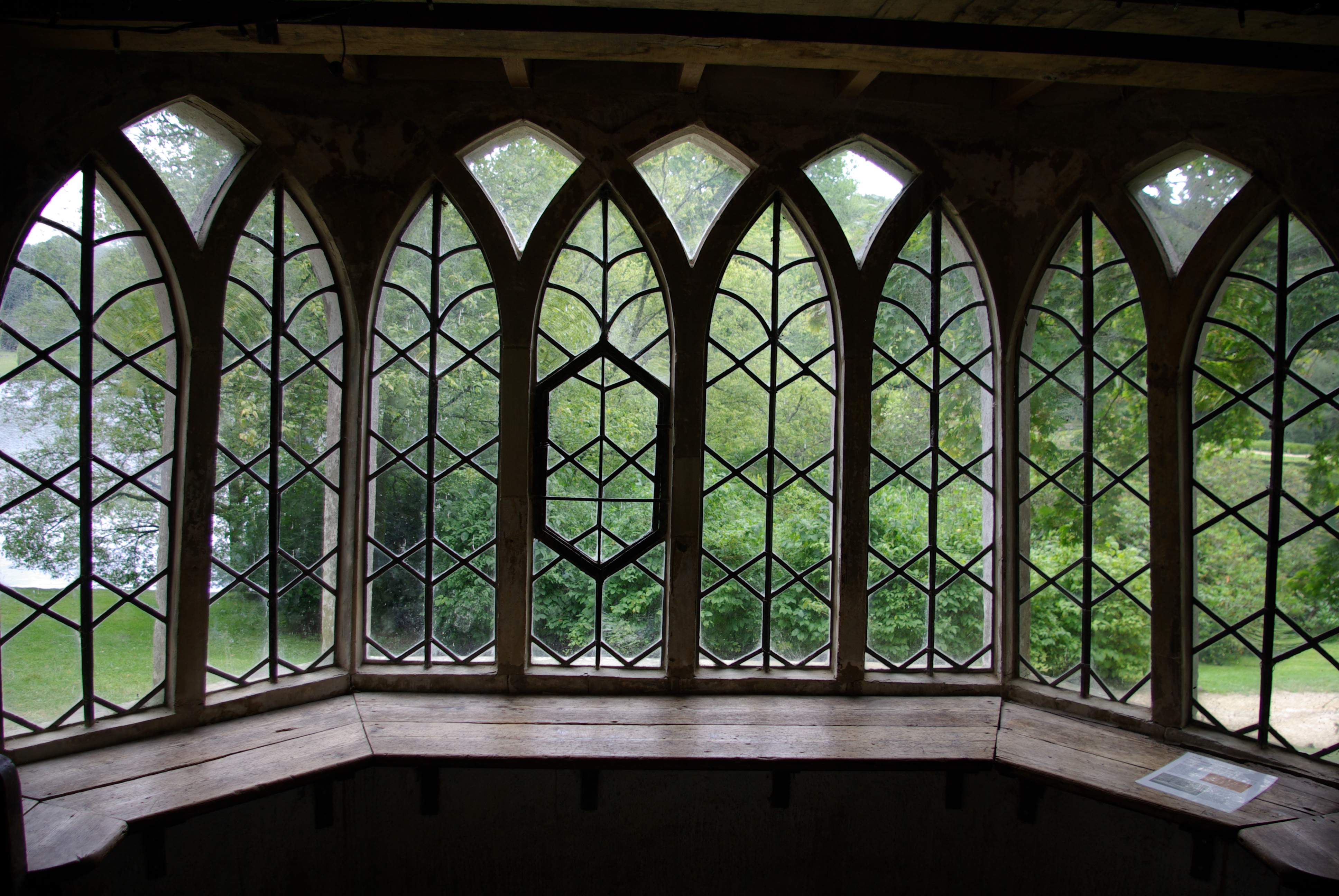
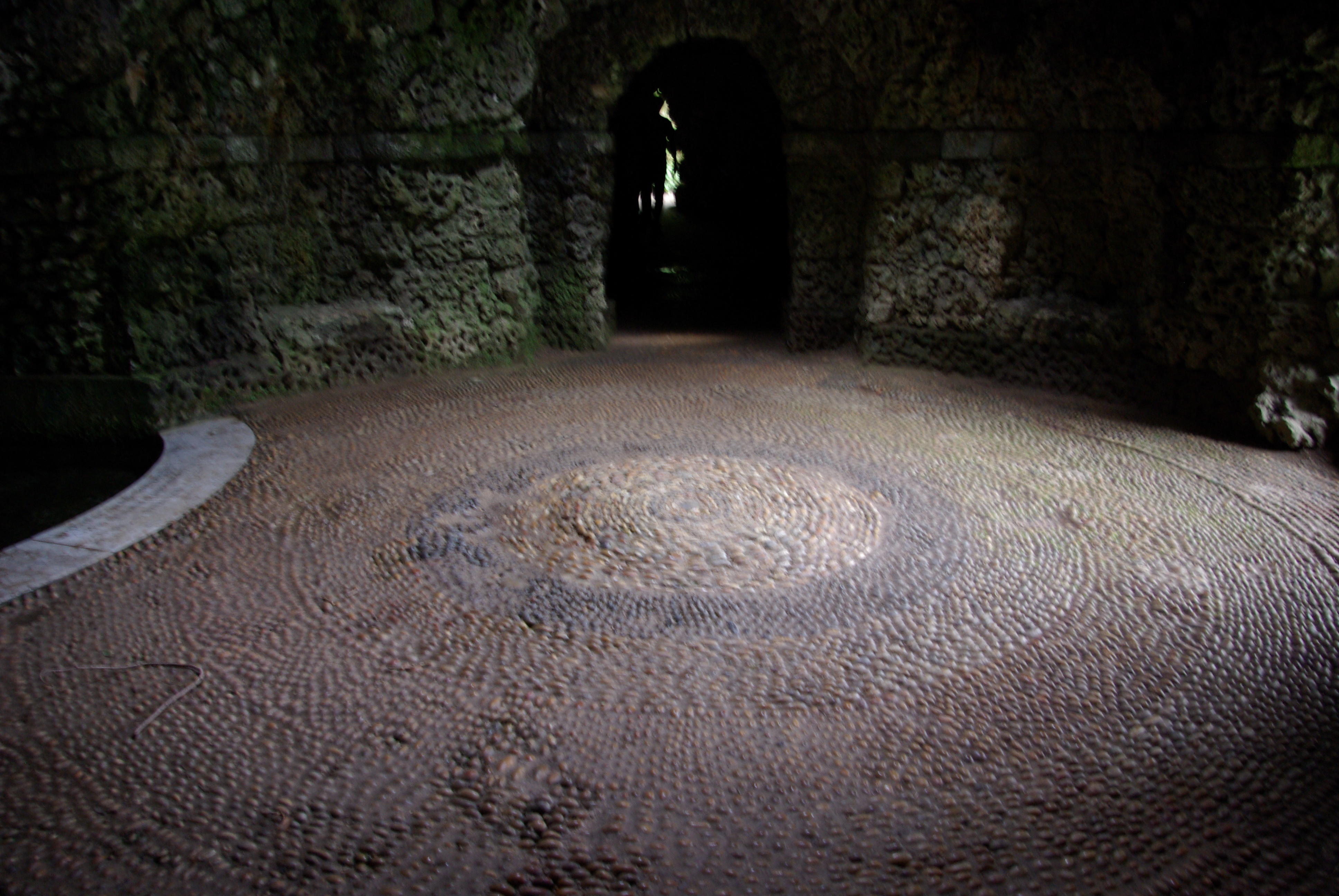
    The last temple is the Pantheon, which is a smaller version of the original from Roman antiquity.  The doors to the temple were locked the day we visited, but the views from the lawn in front were lovely.  There is also a gothic cottage and a grotto to be seen along the path as well.  The grounds all around the lake are beautiful from where you can view the dams and the water wheels to the temples, to the ancient tremendous trees.  I cannot gush more about how amazing the area was.

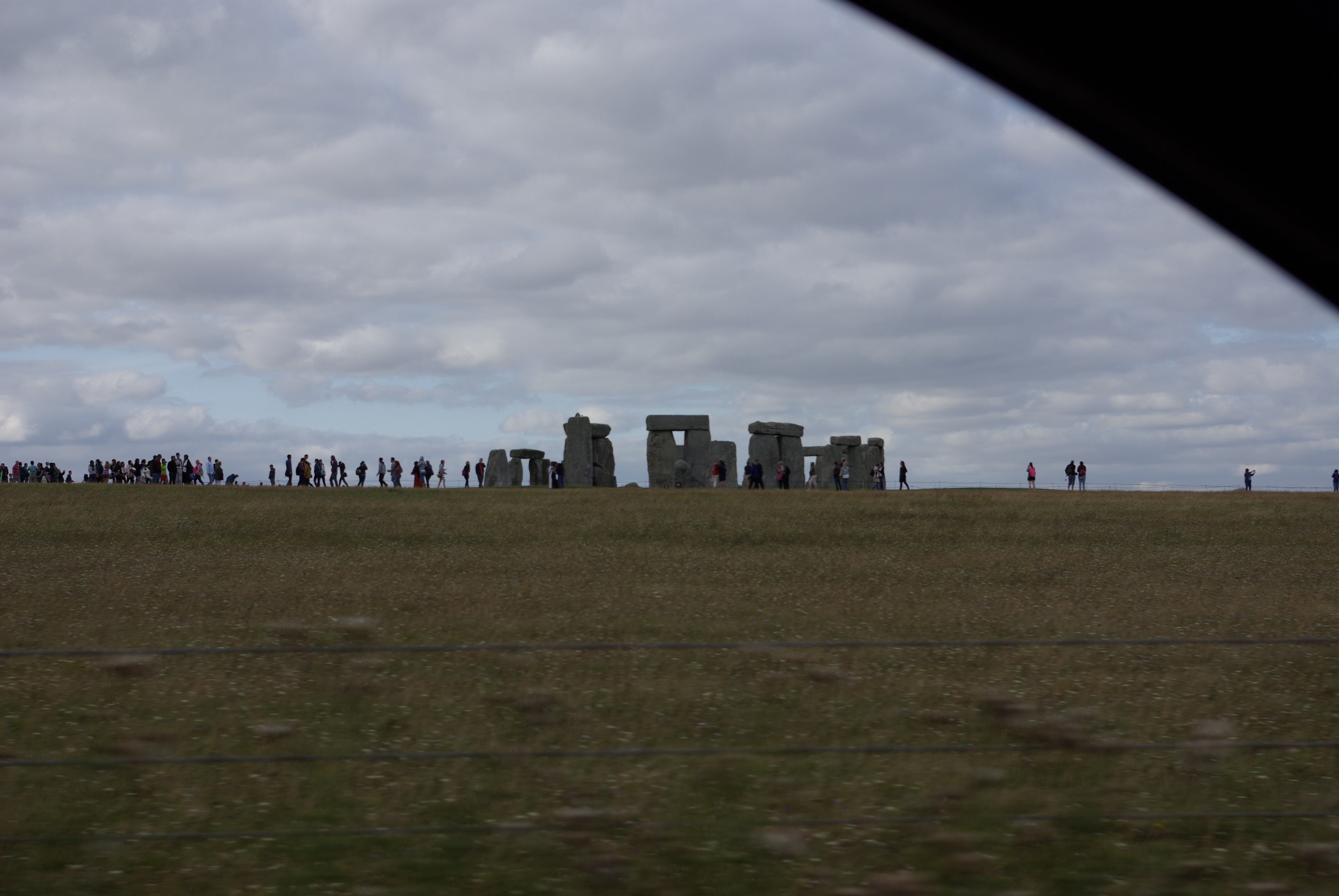
    My only complaint of the day was our travel to Stourhead.  We mapped it at a 3-3.5 hour drive, but it took almost 45 minutes longer because of Stonehenge.  For those who do not know British roads or geography, there is but one major roadway to travel down to Devon and Cornwall, the A303.  (If you look at a map and see roads with B or C in front of them, the letter designation has to do with how much money the government spends on the road.  A roads are the best, while C may be one lane two-way roads with lay-bys for two cars passing in opposite directions.)

    The A303 dwindles down to mostly a two lane road that opens to three periodically to allow drivers to pass, but passing Stonehenge is a major hassle. Yes, for those who do not know, you can see it from the A303.  No, you cannot pull off of the road to view it as there is no shoulder, long weeds and grass, and too much traffic.  I know in the states, we’ll often have signs and small areas for people to pull off and enjoy views.  They do not have those here, SO you wind up travelling behind an enormous line of rubberneckers and tour buses.  I can prove this is true because as soon as Stonehenge is out of site, the road is no longer bumper to bumper. We spent 30 minutes driving 5 miles while waiting to pass Stonehenge.  We tried to map our way around it, but all of the directions GPS gave us to and from Stourhead passed Stonehenge.  I will still look for a way around the next time we travel in that direction!

    Do not let the traffic warning deter you from viewing Stourhead, though.  I just wanted to give a warning to allow any of you to plan for the delay in your travels. In my opinion, the drive and traffic was worth it in the end.

    Next up…Deal (No, I’m not making a deal, but Deal along the Kent coastline!)

    Share this:

    • Share
    • Tweet
    Like Loading…
  • Wicken Fen

    January 3rd, 2015

    In eastern England, there is a swamp region called “The Fens.”  The Fens are the lowest lying region in the United Kingdom with some areas below sea level.  Roman hydraulics and medieval drainage methods have been discovered in this region but the modern draining of the Fens began in the 1630’s, resulting in what is now reclaimed farmland.  This stretched over portions of Suffolk, Norfolk, and Cambridgeshire.  When driving certain roads in this area, the roads are built up from the farmland with large drainage ditches on the sides of the road, some as much as 15 to 20 feet deep.  They have had cars run off of the road and not be found for a few days because of the depth of the water.  In recent years, due to flooding and preservation, some areas have been allowed to revert to their previous state.

    Wicken Fen is the oldest nature reserve that is run by the National Trust and they claim it is England’s most famous Fen.  It is considered one of Europe’s most important wetlands and supports 8500 species of plants and animals.

    Windmill
    History
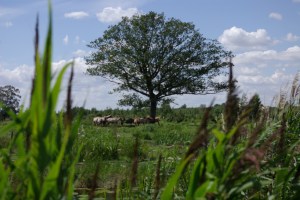
    Fen Cattle

    Anyone interested in Wicken Fen should always bring a pair of Wellies (rain boots).  We learned this the hard way.  Since the weather in the UK is unpredictable, you never know when it will rain and since you’re visiting a swamp, it is likely to be muddy anyway.

    Lode
    Nightshade
    Wild Ponies

    That said, the area is very pretty with a main boardwalk, plenty of trails, and blinds for the avid nature lover.  There is even a boat tour through the “lodes”, which are small rivers that run through the swamp.  Species of plant are labelled as you walk through and even when we went in August there were flowers all along the trails.  There are even wild ponies that wander a portion of the reserve.

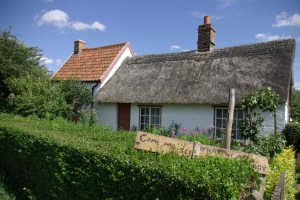
    Fen Cottage
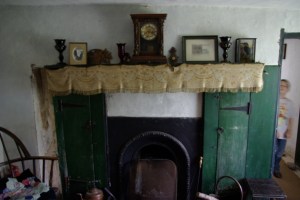
    Fireplace
    Back Garden

    For those history buffs, there is even an old cottage that belonged to people who lived and worked along the fen.  There is even a demonstration of how they made furniture, and they let you try your hand at the contraption that they could carry from place to place that helped them to make the decorative cuts on the legs of tables and chairs.  The women who monitored the cabin and showed us through were wonderful in explaining to my children the different bits about the cabin, including that the children used to sleep in the upstairs which was little more than boards placed in the rafters.  The back flower and vegetable garden were beautiful and teeming with butterflies.

    Butterfly
    Happy Bee

    There is something for everyone to enjoy at Wicken Fen.  The entire family enjoyed the day and for those who don’t bring a picnic to eat along the trails, there is a tea shop by the gift store and a village nearby with pubs.

    Next up…Stourhead!!  To quote Mrs Gardiner, “If it were merely a fine house richly furnished,” said she, “I should not care about it myself; but the grounds are delightful. They have some of the finest woods in the country.”

    Share this:

    • Share
    • Tweet
    Like Loading…
  • Oxburgh Hall and a quick trip to Cambridge

    January 3rd, 2015

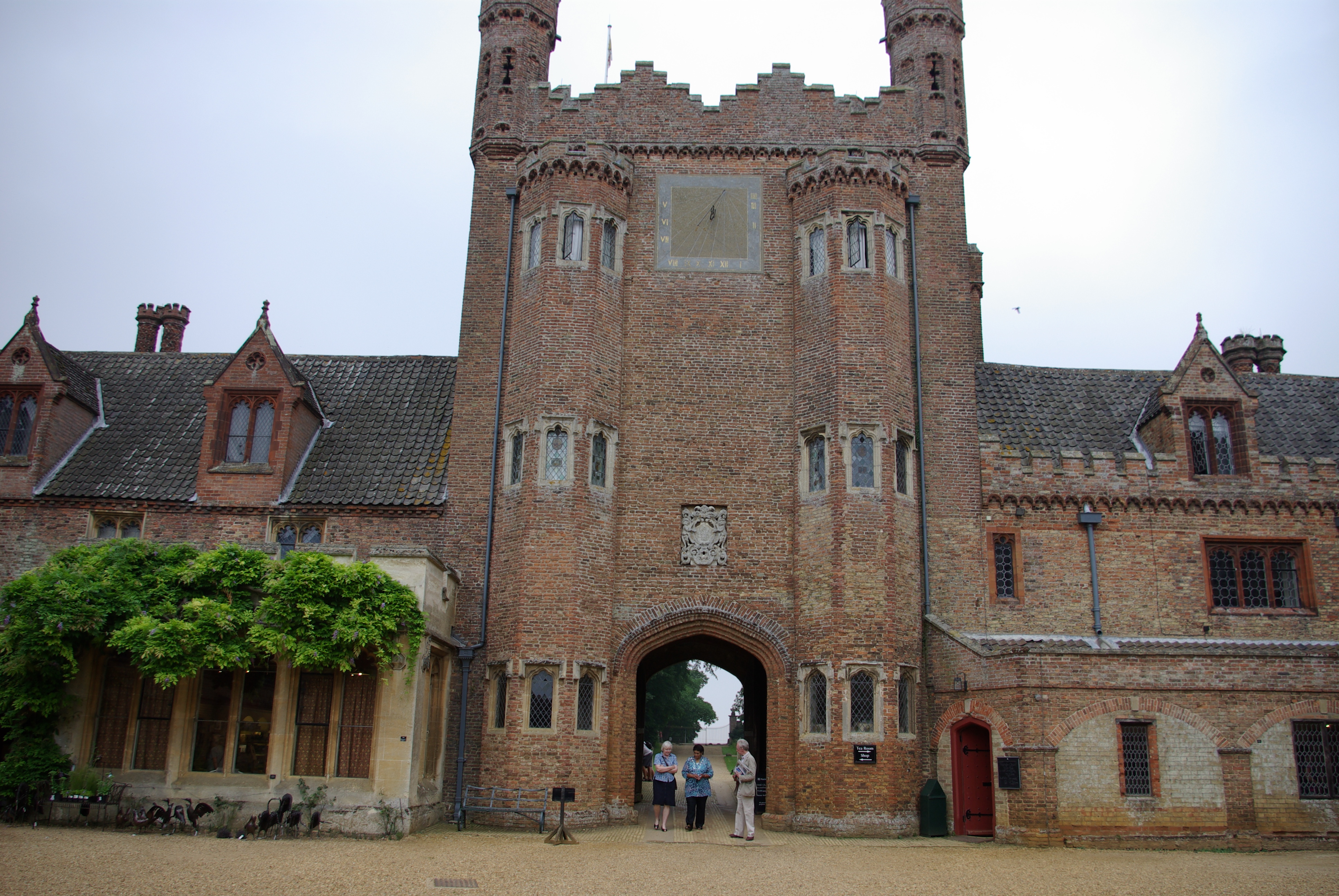
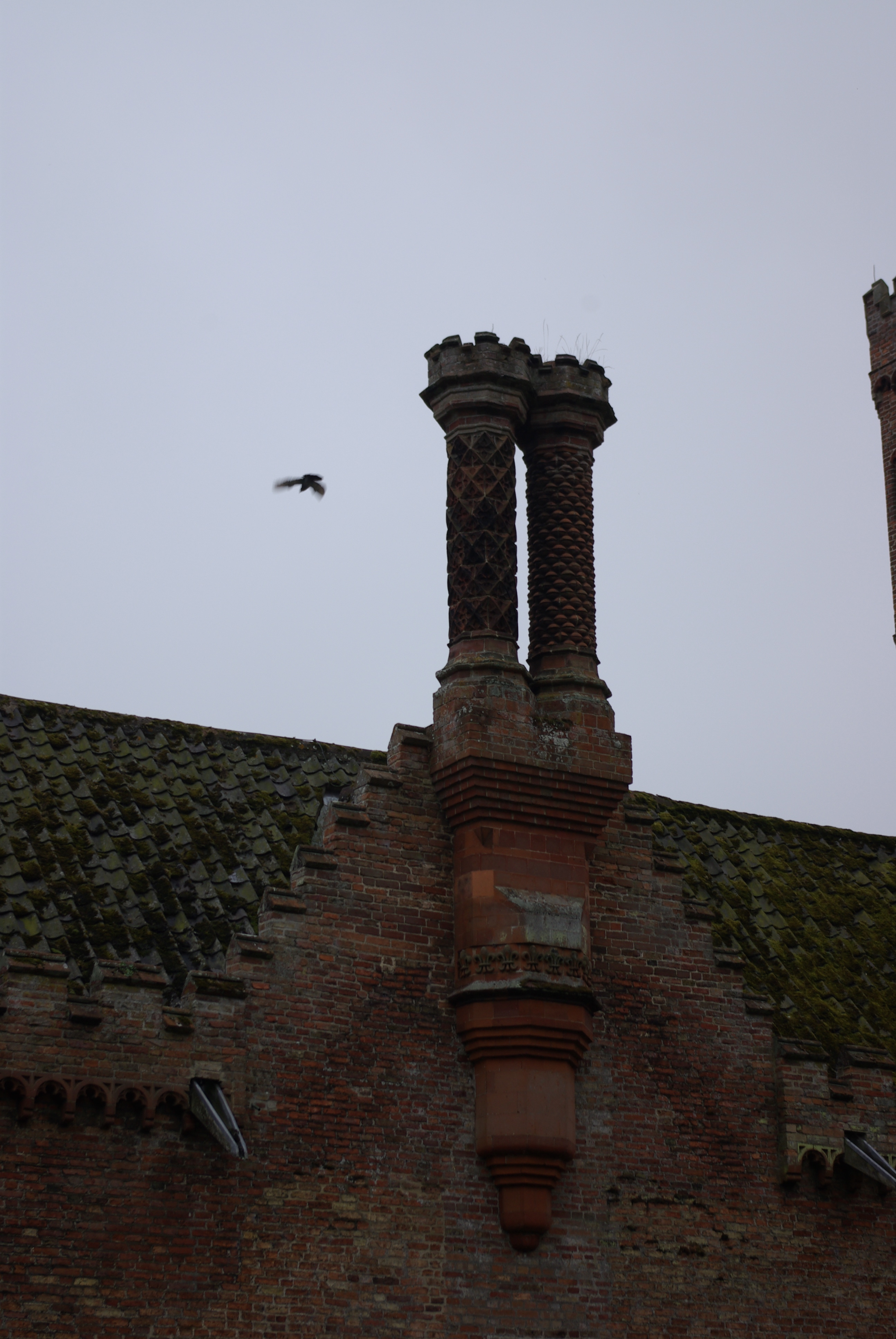
    Oxburgh Hall was built in 1482 by Sir Edmund Bedingfeld and despite its castle-like appearance was home to the Bedingfeld family.  It is a neat bit of Medieval and Tudor architecture with the ornate chimneys and towers.

    It has a moat, which was not for defensive purposes, but was a statement of the family’s affluence at the time the house was built.  The Bedingfelds were indeed affluent and well-connected as Henry VII and his Queen Elizabeth of York stayed in the home.  There are bedrooms dedicated to each, but the National Trust even states that it is unlikely they stayed in those actual rooms.

    On the outside, Oxborough is Tudor architecture on the outside, but much of the inside was redecorated during the Victorian era by the 6th Baronet, Sir Henry Paston-Bedingfeld.

    In 1950, the 9th Baronet, Sir Edmund, was forced to sell Oxburgh Hall and the adjoining land at auction to a property developer who wanted to demolish the house and build 70 houses on the acreage.  The contents of the house were even sold.  At the last minute, three female family members, Sybil, Lady Bedingfeld, Violet Hartcup and Mrs Greathead banded together to save Oxburgh by selling their own homes in order to raise the money to buy the house back from the developer.  They then turned it over to the National Trust.

    Oxburgh Hall is an interesting home.  The downstairs is completely at odds with the upper floors where they have a more medieval decor.  There are costumes that are handmade using the old techniques that are in the upper “King and Queens” rooms as well as beds from that era.

    The beds have to be the shortest beds I have ever seen.  The gentleman who was the guide for the “King’s Room” seemed to enjoy telling us how the people of the 16th century slept sitting up and so there was no need for a longer bed.  Apparently, one didn’t lay on one’s back until they were dead lest the body believe it was dead and the soul escape.

    Another attraction to this home was what they call “The Priest’s hole”.  The Bedingfeld family remained catholic when England persecuted Catholics, so they had a trap door, where the priest could hide.  The trap door was within a cupboard, so someone would cover it after the priest went down.  Guests are allowed to actually go into the hole where you are in a small room (and I use the term room generously).  My three children and I fit, but there wasn’t much room after that.  I was also eager to get out of that cramped space once I was inside.  When you emerge from the “Priest’s Hole,” you receive a sticker that says “I have been in the Priest’s hole at Oxburgh.”

    The grounds at Oxburgh are lovely and the moat only adds to the beauty of the area.  The water for the moat comes from the nearby River Gadder and there are systems that shunt the water where it needs to go.  In fact, the bricks of Oxburgh have been in the water for so long that they require it.  They would crumble if they were allowed to dry.

    While at Oxburgh, be sure to see the tapestries made by Mary Queen of Scots and Bess of Hardwick.  These amazing pieces were what she worked on while in the custody of the Earl of Shrewsbury.

    I apologize for some of the dark shots for the interiors.  The lighting is often dark for photography and you are not allowed to use flash to preserve the artwork and fabrics.  This home was harder to photograph than others that I’ve seen so far.

    There is also an old chapel on the grounds which is lovely and set back in the trees.  It also has an amazing altarpiece.

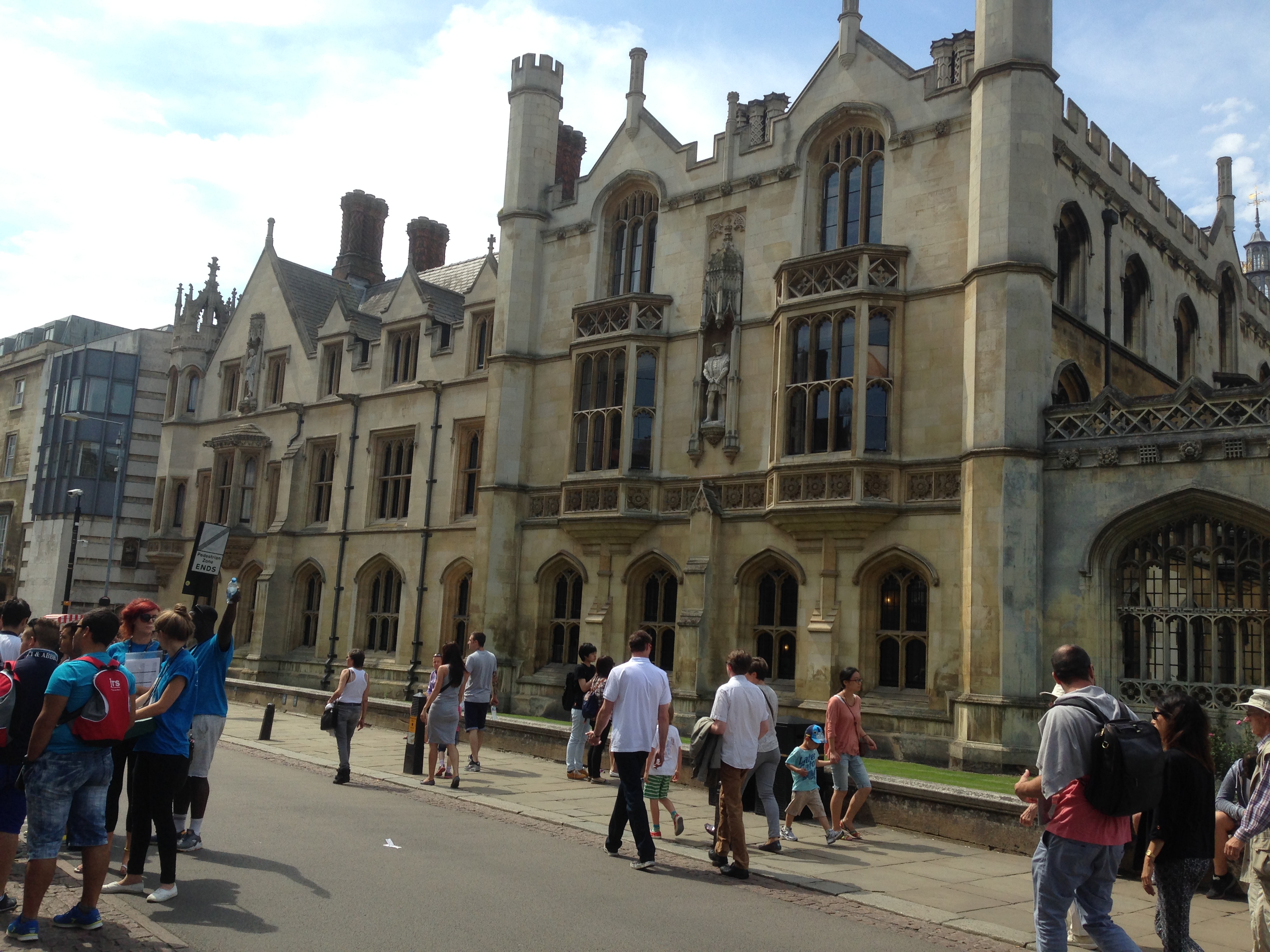
    The weekend after we went to Oxburgh, my hard drive crashed and we took a quick trip to Cambridge to have it repaired.  I only mention the trip because it was my first and I am eager to see the sites there, but just not during the summer!  One of the locals explained that the local colleges have language schools during the summer and the weekend was horribly busy.  I would like to say I’ve been back, but the last time I managed to get to Cambridge, it was raining.

    Oh well!  Eventually!

    Next up…Wicken Fen.  It has nothing to do with Wiccan (despite what my husband thought!)  LOL!

    Share this:

    • Share
    • Tweet
    Like Loading…
  • Ickworth

    January 3rd, 2015

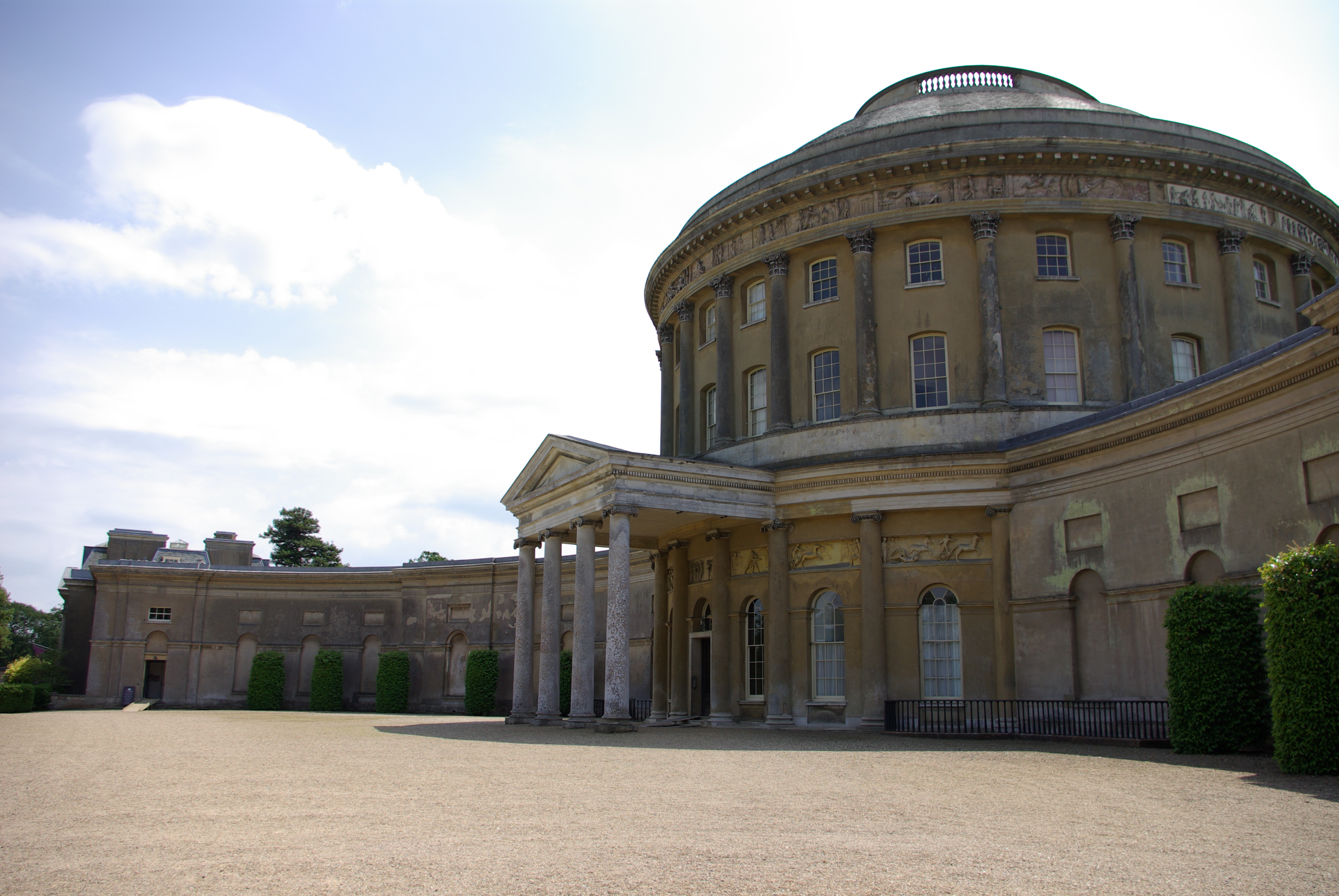
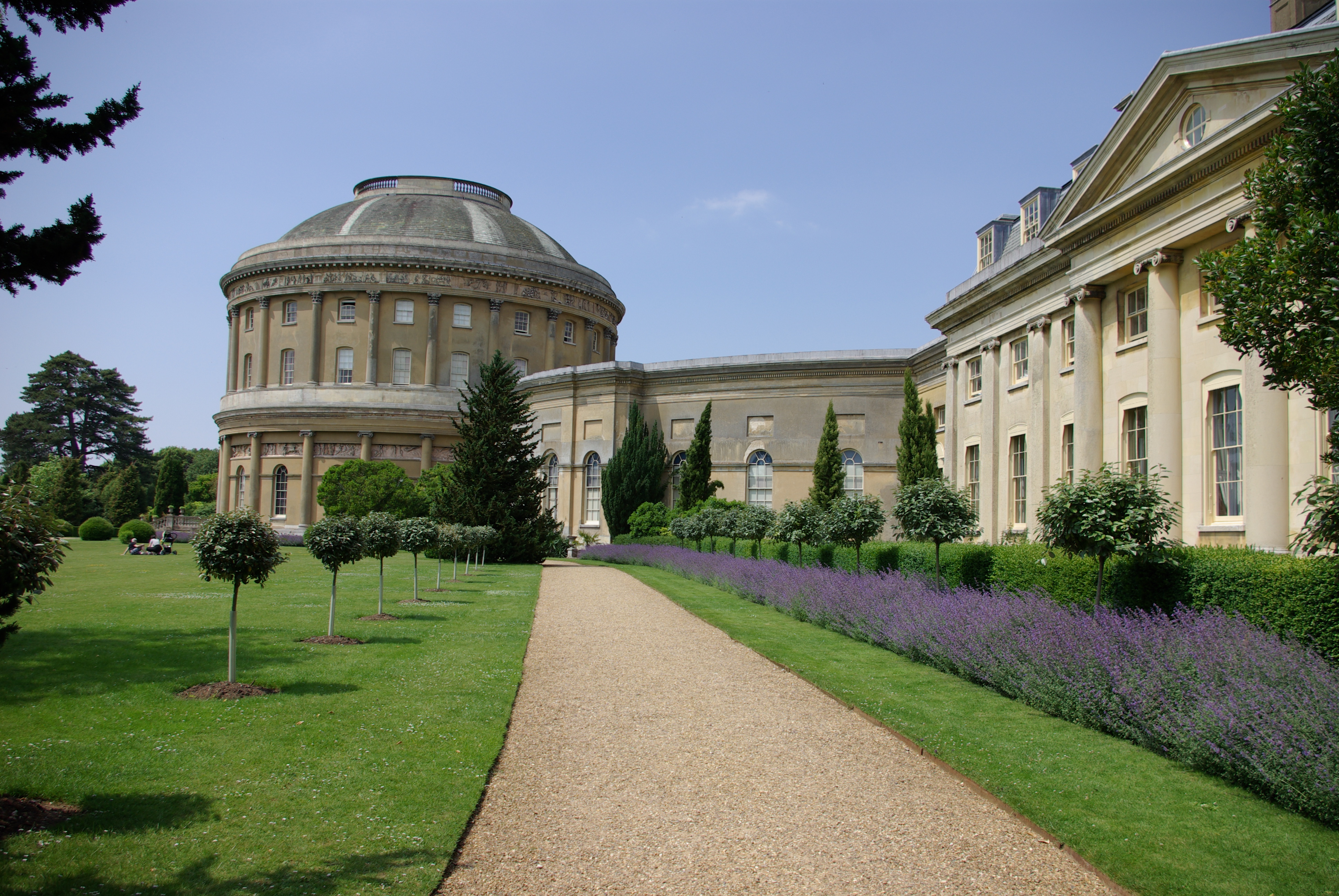
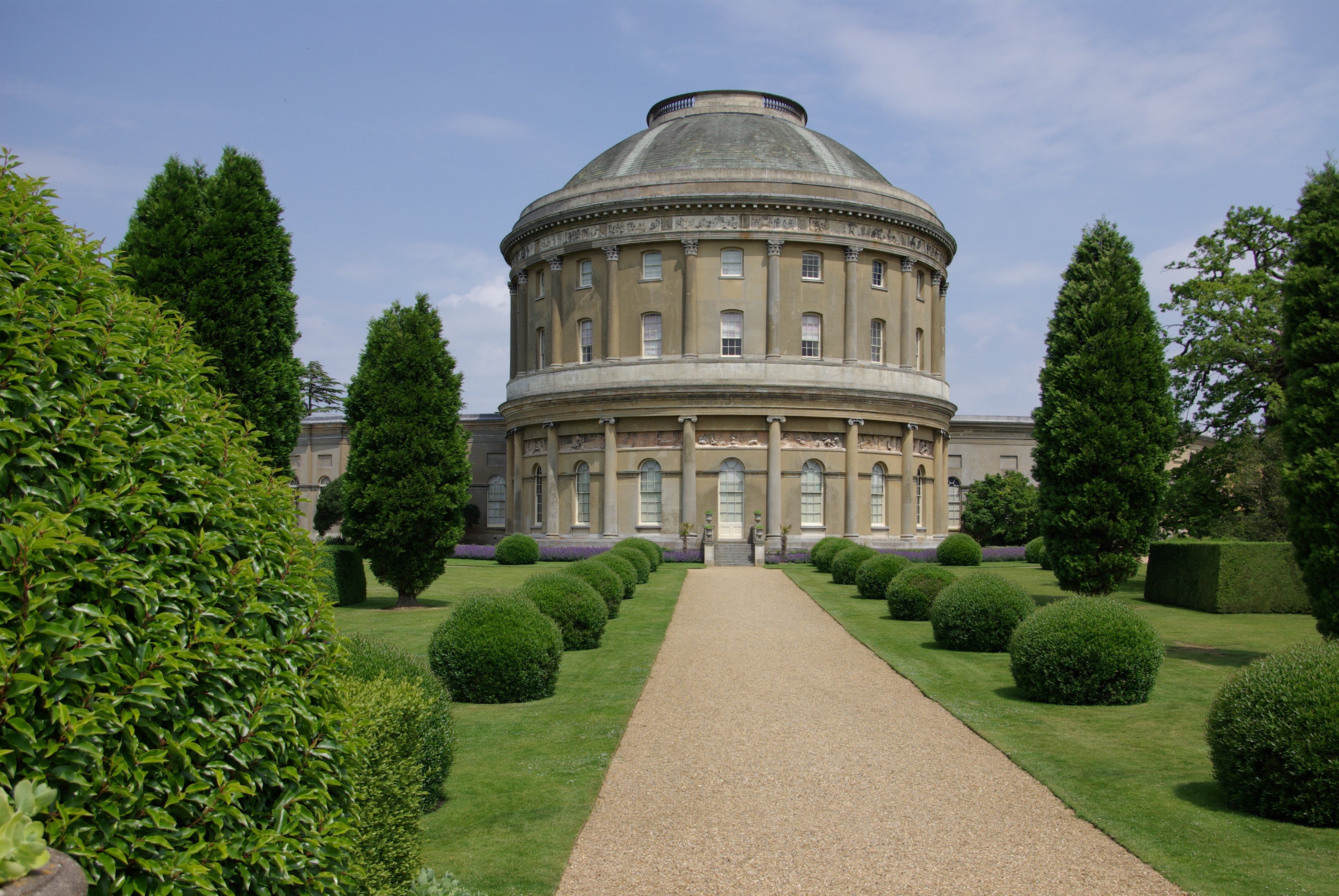
    Ickworth House is an estate near Bury St. Edmunds in the county of Suffolk.  It is not as old as many of the estates in England, but it earns points for size and style.

    The building of Ickworth began in 1795, by the 4th Earl of Bristol, Frederick Augustus Hervey.  Hervey, who was also the Bishop of Derby, was an avid art lover.  He was not only building Ickworth as a home, but mostly as a showcase for the art that he travelled to Italy to collect.  During his travels, he was arrested as a spy and died in 1803, leaving the completion of Ickworth to his son, Frederick William Hervey, 1st Marquess of Bristol (5th Earl).

    I will saying that when you take the guided tour of the main rooms that the guides are very aware of the titles and will refer to them as the 4th Earl and the 1st Marquess.  It is very easy to get turned around with their stories.  Anyway, Frederick William finished the Neoclassical Ickworth in 1829 and proceeded to try to track down the artwork his father had purchased on the continent.  These pieces included this large statue (pictured below) that was commissioned by the 4th Earl and was later seized by the government when he was arrested.  He used significant funds re-purchasing art that his father had purchased years before.

    One thing that is noticed with a bit of the art when you tour is that some really is a treasure and the earl had been hoodwinked with some.  There is one work that is in the library (if I remember correctly) that is very close to a daVinci, but is not.  Any art lover will recognise many names from the plates under the works.  If you check the National Trust website, they boast of works of art by Thomas Gainsborough, William Hogarth, and Sir Joshua Reynolds, but there are two artists that are not mentioned that should be.  One is Angelica Kauffmann.

    Angelica Kauffmann was a Swiss born painter, but found success in London and Rome.  She was one of two women admitted into the Royal Academy (with Mary Moser).  Most of the works I studied by her in school were mythological/allegorical, but her painting at Ickworth is a portrait of one of the daughter’s of the 4th Earl, Elizabeth Christiana Hervey.  Elizabeth for those who saw the movie “The Duchess” was Lady Bess Turner.  Elizabeth’s first marriage was to Irishman John Thomas Foster and her second was to William, the 5th Duke of Devonshire after the death of his wife and her friend Georgiana.

    The second artist I refer to is Elisabeth Vigee-Le Brun.  Vigee-Le Brun was best known painter for the French court and the artist who painted portraits of Marie Antoinette and her children.  However, she fled France during the French revolution with her daughter and worked in Italy, Austria, and Russia.  Frederick Hervey, the 4th Earl of Bristol commissioned her to paint his portrait (1790) and then asked her to paint her self-portrait to hang at Ickworth. According to the National Trust, the portrait is almost an exact replica to the one at the Uffizi and in my opinion, is incredible.  I stood in front of it and stared for a while and then found myself coming back to it.

    For any art lovers who wonder if I looked at the Gainsborough and the Reynolds.  I did, but I did not find them as fascinating as the self-portrait of Vigee-Le Brun.  The William Hogarth was on loan to an exhibit when we visited.

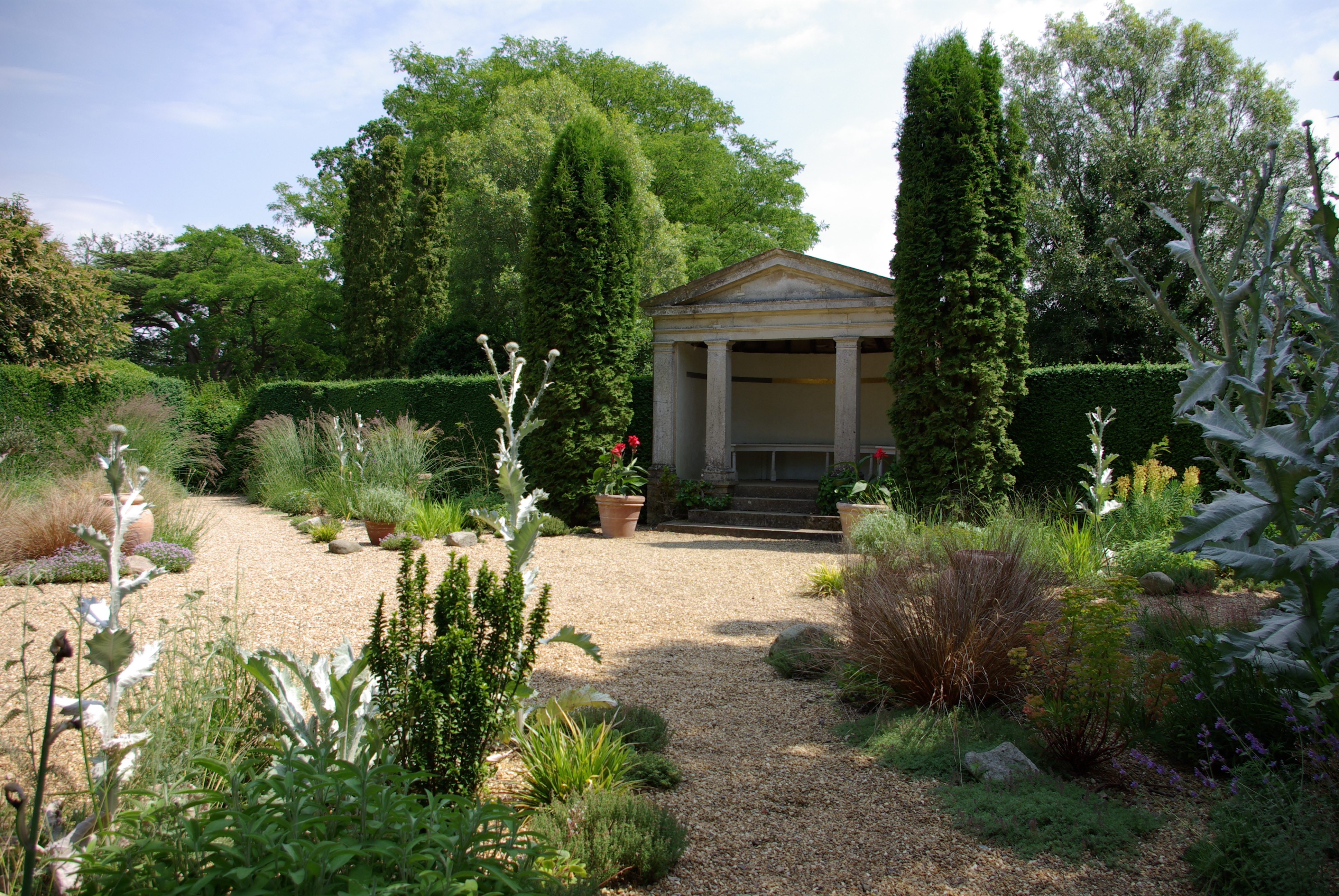
    The grounds of Ickworth are lovely, but I feel that we probably visited at the wrong time of year to do them justice.  My husband and I still enjoyed wandering around, especially the stump garden where the gardeners put the stumps dug up from around the estate.  They become rather sculptural and fascinating when you look at them in that display.

    In the mid-20th century, Ickworth was given over to the National Trust in lieu of death duties.  The family had a 99 year lease on the east wing, but ended up selling it back to the National Trust.  It is now used as a hotel.

    Next up…Oxburgh House

    Share this:

    • Share
    • Tweet
    Like Loading…
←Previous Page
1 … 26 27 28 29 30 31
Next Page→

Blog at WordPress.com.

Loading Comments...
  • Subscribe Subscribed
    L.L. Diamond
    Join 258 other subscribers

    Have a WordPress.com account? Log in now.

  • L.L. Diamond
    View site in Reader
    Manage subscriptionsSign upLog in
    Report this content
    Collapse this bar
%d