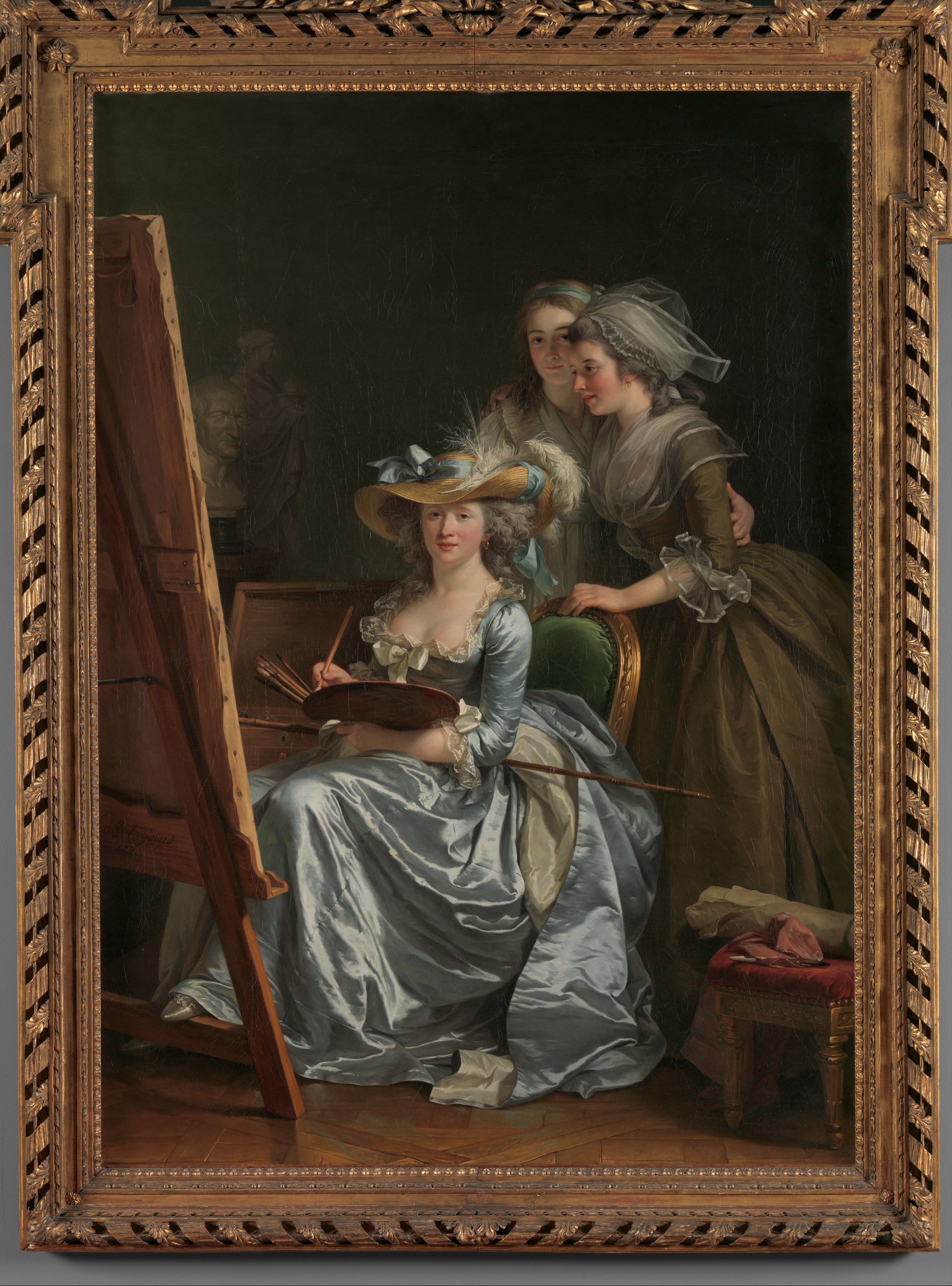
In my Regency novels, I have a lot of fun naming characters, but one of my favourites is naming the modistes for great female artists. I’ve used Lebrun, duParc, and in Particular Intentions and its sequel, Madame Guiard for the portraitist Adélaïde Labille-Guiard.
Adélaïde Labille-Guiard (French, Paris 1749–1803 Paris) Self-Portrait with Two Pupils, Marie Gabrielle Capet (1761–1818) and Marie Marguerite Carreaux de Rosemond (died 1788), 1785 Oil on canvas; 83 x 59 1/2 in. (210.8 x 151.1 cm) The Metropolitan Museum of Art, New York, Gift of Julia A. Berwind, 1953 (53.225.5) http://www.metmuseum.org/Collections/search-the-collections/436840
Adélaïde Labille was born in 1749 and was the daughter of a Paris shopkeeper (Coincidentally, her father owned a fashion boutique 🙂 ). She first studied as a miniaturist before joining the Académie de Saint-Luc or the Paris Guild in 1774, and later studied history paintings and portraits. In 1783, she was admitted to the Académie Royale de Peinture et de Sculpture and was later awarded the title Peintre des Mesdames (painter to the king’s aunts), an apartment at the Louvre, and a government pension of 2,000 lives.
She continued to show at the Salon through the French Revolution, and unlike her contemporary, Elisabeth Vigee-Lebrun, she supported the French Revolution and remained in not only France, but kept to Paris for a long time. However, the new regime closed down the Académie Royale and banned women from joining the groups that succeeded it. She was also ordered to destroy some of her “royalist” works. She then waited out the remainder of the Terror in the countryside with her partner François-André Vincent and her student, Marie Gabrielle Capet.
Despite her exclusion from the French art world, Labille-Guiard continued to show, even though she received little notice after her exclusion from the Académie. Throughout her career Labille-Guiard used her experience and talent to train aspiring female artists and was no doubt a great influence with her talent and her ambition. She died in 1803.
I finally did something touristy! Not a major trip or thing, but I tagged along on a trip to the Norwich Castle recently. I’ve been to the Cathedral (which is spectacular if you’ve never been) for Evensong during the Christmas season, but we just went for the morning and missed out on the castle.
The Norwich Castle is a 900 year old Norman castle originally started as a fortification according to our tour guide, but later the plans changed and it became a Royal Palace. Norwich Castle, today, is still the original structure, but instead of being just the castle, like most of the castles I’ve seen here, it is more a museum and art gallery.
Norwich Castle
Castle Keep
Castle Keep
When you enter the castle the centre-most portion is a cafe and stairwell. On the upper floor, there are exhibits for the Romans and Vikings, an exhibit honouring the Norfolk military, and the castle keep (the original part of the castle built). On the lower floor, there is a national history exhibit, an exhibit of Norfolk artists (including a Gainsborough!) and the Iceni and Boudica. I know I’ve left out bits and pieces, but we weren’t there for the entire day, so I did miss bits.
Greek Pot
Norfolk China
Awesome door from the Cathedral if I remember correctly
Also don’t forget to make it down to the dungeons for that portion of the exhibit as well. We had a guided tour of the castle keep, which added a lot to the experience as well. I understand there are also tours of the dungeons as well.
The castle is not huge and can be toured in a day without rushing. There’s a lot of variety and a good number of artefacts to enjoy and study. There’s so much in Norwich and a mall nearby the castle to enjoy when you are done with the castle. Definitely a fun day out!
Next up… Flatford! I know! I got out more than once!
So you’ve answered the first set of questions and now you are seeking the last set! (If you’ve happened upon this post first, then backtrack to Austen Variations for part one of the Scavenger Hunt! Once you’ve got these down, email them to me at ldiamond531@yahoo.com, and if you have them all correct, I will enter you in the drawing. If you can tell me which book the quote comes from, I will count it as bonus if you miss one of the others 🙂
So here we go on the second part!
6. “I do not know whether it ought to be so, but certainly silly things do cease to be silly if they are done by sensible people in an impudent way.”
7. “A large income is the best recipe for happiness I ever heard of.”
8. “One is never able to complete anything in the way of business, you know, till the carriage is at the door.”
9. “What he told me was merely this: that he congratulated himself on having lately saved a friend from the inconveniences of a most imprudent marriage, but without mentioning names or any other particulars, and I only suspected it to be Bingley from believing him the kind of young man to get into a scrape of that sort, and from knowing them to have been together the whole of last summer.”
10. “The one claim I shall make for my own sex is that we love longest, when all hope is gone.”
Alrighty then! Email me those answers at ldiamond531@yahoo.com (I’m going to run to empty my email!) and tell me if I made it too hard below or at Austen Variations!
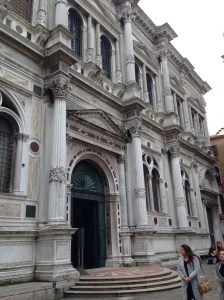
As you follow the signs to the Rialto Bridge and Saint Mark’s Basilica, you’ll definitely pass a small square with the Scuola Grande di San Rocco, the Chiesa (church) of San Rocco, and a da Vinci Museum. Now, I can’t comment on the da Vinci museum other than the understanding we had from the description was that it was a compilation of da Vinci’s inventions that were built and on display. I love da Vinci, but I would prefer to see his actual drawings and paintings, so we skipped the da Vinci museum. I was very intrigued, however, by the Chiesa di San Rocco and the Scuola Grande di San Rocco.
Chiesa di San Rocco
Scuola Grande di San Rocco
San Rocco (or Saint Roch) was the protector against plague, which had devastated Venice in the 15th century. In 1478, a group of wealthy Venice citizens founded the Scuola Grande di San Rocco.
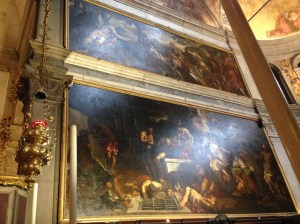
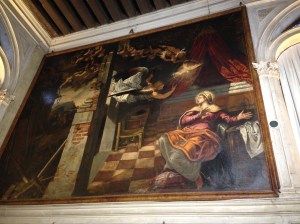
When I was studying for my art degree, I took a class that I loved called Women in Art and Culture, and one of the artists we studied was Marietta Robusti, also called Tintoretto. Both the Church of San Rocco and Scuola Grande di San Rocco have works from Jacopo Robusti or Tintoretto, her father, who was commissioned in 1564 to produce paintings for the interior. I was curious to see the work of the father as I’d never really studied him in depth, and I didn’t regret the visit!
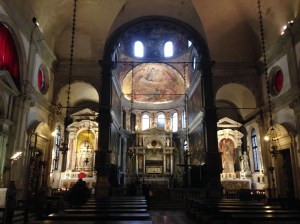
The church is small and has more artists featured than Tintoretto, but the works are all lovely and the church is by no means unadorned. It is beautiful in its paintings and detail, but doesn’t really hold a candle to the Scuola Grande di San Rocco.
Ceiling church
Altar
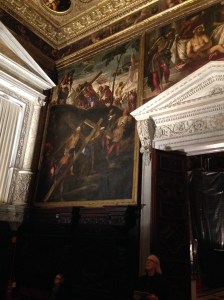
Tintoretto Paintings
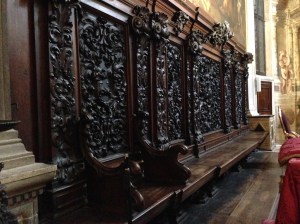
Detail on seating by altar
Altar from the rear
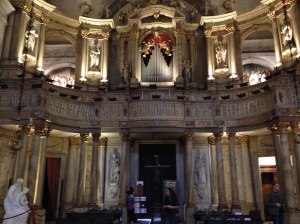
Back of the church
We exited the church and walked across the square. My husband was hesitant due to the admission, but we soon realised children were free, which is always welcomed with five of us–especially as my children aren’t always excited about art museums.
One of the paintings downstairs
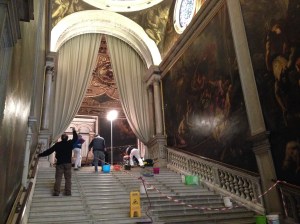
Cleaning the stairs
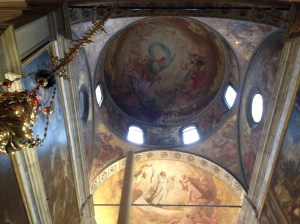
The Dome over the stairs
The downstairs (Salla Terra) is a columned room containing a nave and two aisles nothing but the works of Tintoretto adorning all of the walls, depicting scenes from Mary’s life. It’s a lovely room, but once you’ve looked at all of the paintings, which are gorgeous, you walk up a stone staircase with a domed roof to a room that will take your breath away. I find the downstairs deceptive when you first walk in and it makes the upstairs (Sala Superiore (“Upper Hall”)) all the more grand.
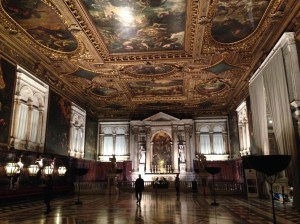
Upstairs
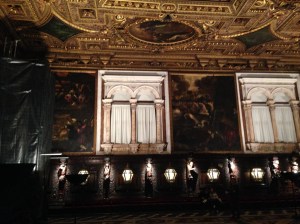
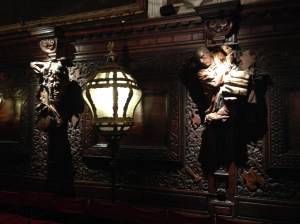
Walls with Sculptures
Tintoretto is on right
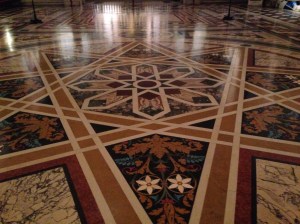
floor
Crucifixion
Walk to Cavalry
The ceiling and walls are covered by Tintoretto’s paintings trimmed in gold and with sculpture adorning the walls beneath it, including a wooden rendering of Tintoretto himself by Giuseppe Angeli and allegorical figures by Francesco Pianta. The ceiling in the Sala Superiore are from the Old Testament and the walls are depictions from the New Testament. There is also a room off to the side which has paintings depicting Christ appearing before Pilot to Calvary, which adorns an entire wall.
Scuola San Rocco was not something we planned, but was my favourite part of the trip. If you go to Venice, you shouldn’t miss it!
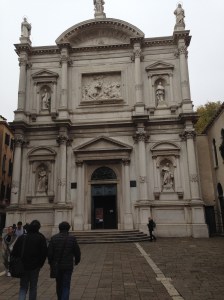
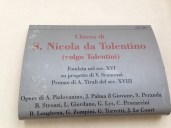
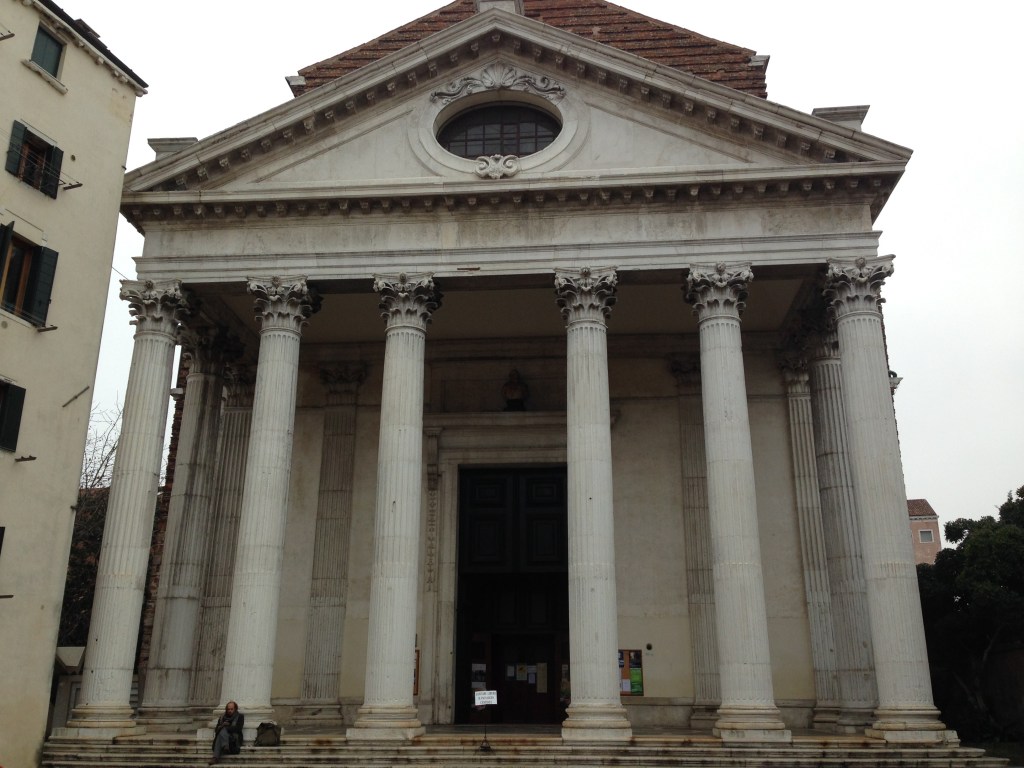
When you cross that first bridge in Venice, La chiesa di San Nicola da Tolentino is at the opposite side of a small square across from the German consulate. The temple facade caught our eye, so we decided to investigate and boy, am I glad we did!
La chiesa di San Nicola da Tolentino translates to The church of St. Nicholas of Tolentino, and has been a Catholic church since the 16th or 17th century (I had to translate the Wiki page on it’s history, so sorry for any issues arising from that!). It was named for an Augustinian friar, who was proclaimed the patron saint of souls in Purgatory by Pope Leo XIII in 1884.
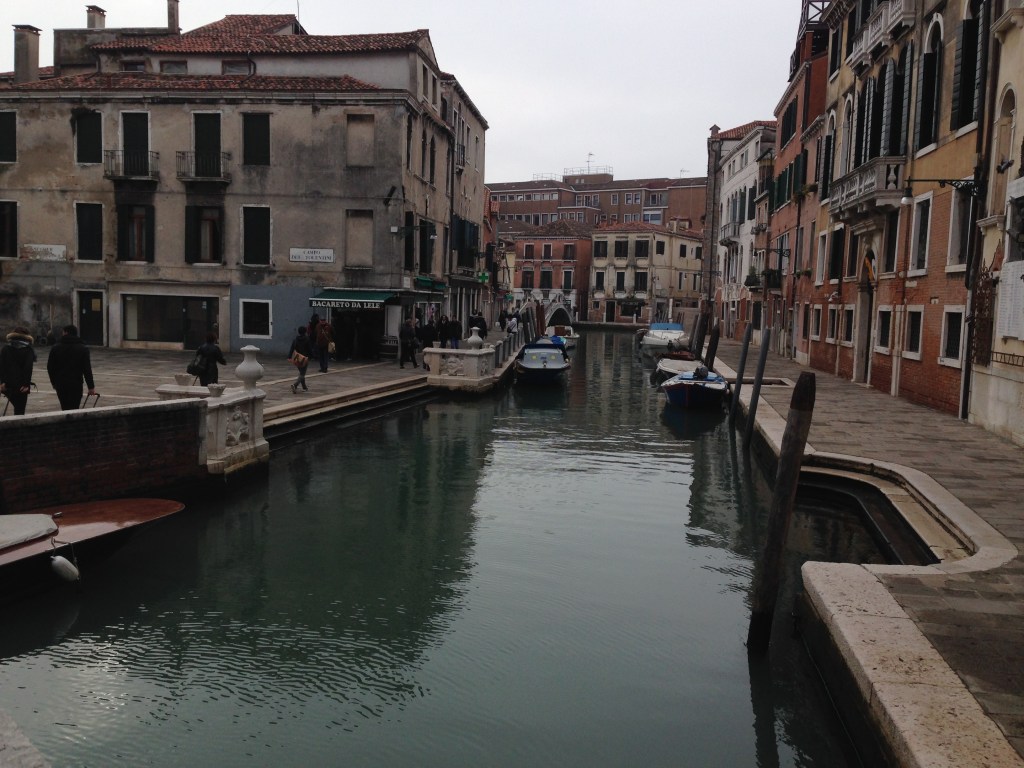
First canal (see the square to the left?)
Facade
The church was erected between 1591 and 1602, and designed and built by Vincenzo Scamozzi. Between 1706 and 1714, Andrea Tirali added the portico, the tympanum, and six Corinthian columns to the exterior, which had been unfinished.
I wish I could’ve taken my own photos inside this beautiful building, but they do not allow it. Thank goodness for Wikimedia Commons, who actually has photos of the stunning insides. I must admit that though the outside is nice, I was not prepared when I entered and caught a glimpse of the interior.
I was playing around, looking for a book to allude to while writing a scene, when I came upon this one. At times, I see something and think, “That would be fun!” and this was one of those times. I do not mention it specifically by name…at least yet, but I couldn’t resist using it.
I knew the name Lady Caroline Lamb. Many who have a fascination with Regency England and literature do, but I knew of her more as the lover of Lord Byron rather than a writer in her own right. Lady Caroline was indeed a writer, though probably considered as scandalous as Byron, she likely also sold as many books as he did.
Glenarvon, the book Georgiana peruses in the story, was first published anonymously in 1816. Now, I say anonymously, but everyone in society knew Lady Lamb was the author. Even Lord Byron commented, “I read Glenarvon too by Caro Lamb….God damn!” Society at the time was well aware of her identity, though it did her no favours.
While Glenarvon is a Gothic tale, the story was actually that of her own affair with Lord Byron in which she included other prominent members of the Ton, under different names of course, and satirised them in the most unflattering terms.
The book was an undisputed success. The entire first run sold out, and further editions were printed, so one cannot say her efforts were for nothing; however, her already poor reputation was ruined and she became ostracised from the Ton.
The strange part is that Lady Caroline did not become a pariah on account of making her love affair public. The fact that she and Byron were lovers was far from a secret. It was in fact quite well-publicised. Rather, it was her unflattering satirisation of several high-ranking members of the Ton–including Lady Jersey, who led to her downfall (In retribution, Lady Jersey cancelled Lady Caroline’s Almack’s vouchers. By the efforts of family members, she did have her vouchers reinstated in 1819, but it did not do much to repair the damage.)
Glenarvon has been in and out of print since the 19th century. It’s last printing was in 1995, and has since been called an early work of feminism, though some consider it “hysterical” and incoherent. As Lady Caroline was known to abuse alcohol and laudanum and have mental instability, incoherent is a distinct possibility.
Lady Caroline Lamb published three other works in her lifetime: Graham Hamilton (1822), Ada Reis (1823), and Penruddock (1823).
For those who are fascinated with legends of King Arthur, Tintagel Castle on the north coast of Cornwall is a must-see. The site has been dated back to the Romano-British period by the discovery of artefacts dating to that time period. It was definitely a settlement during the medieval period and in 1233, Richard, Earl of Cornwall built a castle on the site.
Geoffrey of Monmouth first claimed Tintagel was the site where Arthur was conceived before Richard built the castle. In Historia Regum Brittaniae, Monmouth claimed Merlin disguised Uther of Pendragon to look like Gorlois, the Duke of Cornwall and husband of Igraine, who was Arthur’s mother. The belief of the link to Arthur was reinforced when Tennyson wrote ‘Idylls of the King’ in the Victorian period.
What remains of Tintagel is located on Tintagel island near the village of the same name and is now operated by English Heritage. There is a great deal of walking and stair climbing involved, which is something to keep in mind. We planned our visit for the last day of hour holiday, which turned out to be rainy and cold.
Parking is plentiful when you arrive, and it’s only a short walk to the English Heritage building where you check in for Tintagel. There is a separately operating shuttle that will drive people closer to the actual castle or you can walk it as we did.
When you begin the trek upwards, you start with this dirt path (muddy on rainy days) up to where the outer castle wall was. This part isn’t too steep, and you begin to have some lovely views once you reach the first portion of the ruins.
Tintagel Castle, like many old castles and homes in Britain, have different structures and walls from different time periods.
Tintagel at one time had a portion of the castle on the mainland and a portion of the castle or a bridge brought you over the water to the island. Unfortunately, that bit crumbled into the sea at some point, but a bridge has since been constructed so people can cross from the mainland ruins to those on the island. You can still see what is left of the original stairs in the second picture below.
Stairs down to cross
Bridge crossing
Once you’ve crossed the bridge, you climb up a rocky set of stairs on the side of the island. If it’s wet, I recommend not being in a hurry as some of the steps are steeper than others and if you slip, the rocks would be rather unforgiving.
Tintagel Ruins
Looking back at the path and the excavations
The views and the ruins are definitely worth the hike uphill!
more excavations
View from Tintagel
View from Tintagel
Once you are across there are signs with history just like any English Heritage site as well as plenty of gorgeous views. I did have a fit of nerves watching my fourteen year old, who liked to step near the edge of some of the cliff-like sides. My husband would go with her, but it still made me nervous.
I will say that when you are ready to leave, you have to exit the same way you came in, so back down the crazy length of steps. You can also go down to the beach and go inside “Merlin’s Cave.”
I will say if you’re anywhere near Tintagel, don’t miss it! Legend aside, the different portions and excavations of buildings all built in different centuries if not ages, is fascinating and the views are incredible.
That said, please excuse my finger, which insisted on being in a few of the shots. That is one problem with a rainy day like that–I just won’t bring my nice camera outside. I used my phone and I often get my hands in the way.
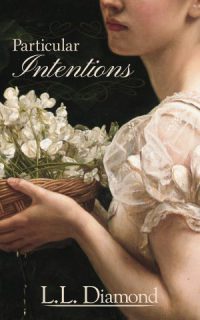
Particular Intentions is released! I can once again breathe a bit easier while I hope that everyone is enjoying my new book. Big hugs and thanks to everyone who has already purchased their copy. Your support is what keeps me doing something I love.
Now, I have the second part of the Netherfield ball from Lydia’s point of view for y’all to read and a giveaway, so don’t read and run! Make sure you comment to enter!
If you missed the first part, you can find it here at Austen Variations.
Her father was mortifying! Why did he suddenly care with whom she danced and socialised? He huffed and crossed her arms over her chest as Kitty moved by on Saunderson’s arm. Why did Kitty get to dance and not her? She had always been more popular with the officer! It was not fair!
“If you had not disregarded my wishes, you would be dancing as your sister is.”
“We were to visit the refreshment table, Papa. Nothing untoward could happen while we drink punch.” She scanned the room. Where was Mama? She would not countenance her father’s restrictions.
“I shall not argue with you. Just know you are here by your own design.”
With a huff, she dropped against the wall behind her. He was so unfair!
“Lydia! Why are you not dancing?”
Her mother! She sprang from the wall and clasped to her mother’s arm. “I was to visit the refreshment table after my dance with Denny, but Papa pulled me away. I was so embarrassed! He would not even let me dance the next!”
Her mother stared at her father, her mouth agape and her eyes bulging. “Mr. Bennet!”
“I must confess I do not believe for one moment you were destined for the refreshment table, and in the future, Lieutenant Denny will not be permitted to dance with my daughters.” He glanced to Mary, sitting in the corner reading a book. “Not that I believe some will care.”
Lydia gave a loud exclamation and flounced back against the wall once more. “He is ruining the ball!”
Mama placed a hand to her arm. “You cannot mean to keep her from partaking in the activity for the entire evening?”
“If she cannot follow my simple instructions, then yes, Mrs. Bennet, I do.”
“But my daughters must find husbands!”
“Lydia will not find a suitor behaving as she does. In fact, I would bet my life she agreed to walk outside with this Lieutenant Denny, which could damage her reputation irrevocably as well as that of her sisters. No, Lydia will do as I say or make herself miserable.”
“But she is out! You cannot return her to the nursery!”
Lydia bit her lip and did her best not to bounce on her toes. Her father always capitulated when her mother used that shrill tone.
“If she does not learn, then I shall do just that. I will not have her create a scandal with one of these rakes in a red uniform.”
“Oh, Mr. Bennet!”
“If Mr. Darcy’s courtship of Lizzy continues as it should, you will have a home after I die. He is an honourable man and would not leave you and my remaining daughters to starve in the hedgerows. Lydia is too young for marriage and I will not see her wed before she is at least seventeen.”
“Oh, Mr. Bennet!” Her mother dabbed at her eyes, but her father merely rolled his eyes and returned his attention to Kitty.
Why would he not listen?
“Mrs. Bennet!” her Aunt Philips loudly whispered from several feet away. “You will never guess what I just heard!”
Her mother’s head darted to Aunt Philips, to Mr. Bennet, and then to Lydia. “My dear girl. Take care to enjoy yourself as much as you can.”
Lydia stomped her foot. “But you must help me! I am so bored!”
Without even so much as a turn back, her mother hastened to Aunt Philips side. Her aunt grasped her mother’s forearm and began to whisper in her ear.
She whimpered and crossed her arms over her chest again. How she wanted to cry!
Kitty bounded up on Saunderson’s arm with a wide smile on her face. The little traitor!
“Miss Lydia,” began Saunderson in an unsure manner. “May I have the next dance?”
Her mouth opened but the voice that reached her ears was not her own.
“I apologise but my daughter is not at liberty to accept invitations to dance at present.”
She made a loud wail of protest, causing a few people nearby to stop and stare. With an abrupt motion, she jerked her chin upwards. They could all hang for what she cared! No one present had to endure her father’s injustice as she had this evening. After all, they could do what they liked.
“But Papa! ‘Tis the supper set!”
“And yet, I am unmoved.”
An officer applied to her father for Kitty’s next set and her sister flounced back to the dance floor on his arm.
“If you will cease your pouting, I shall dance with you.”
She huffed. “I could not stand up with my father! How humiliating!”
With a long sigh, he faced the floor to watch Kitty once more. Perhaps he was as annoyed and bored as she was. Well, if he was, it was his own fault! She was not a child and had no intention of being treated as one!
I can’t remember the last time I had an update! Shame on me!
Things have been crazy and hectic. I’m prepping my oldest to start high school (How do I have a high schooler already!) and another to start middle school. We swapped swim teams, and we’re trying to keep up with a myriad of other after school activities along with my own swim schedule. It’s insane some weeks!
My garden
My garden
Today, we managed to get out in the garden and clean out my planters and pots. A quick trip (and more money than I planned to spend) filled them with flowers, so hopefully, once things fill out a bit, everything will be overflowing with colour. At least I had a brilliant sunny day for it!
Goodies!
I’m also busy prepping for Jane Austen Regency Week. If you’re going on Regency Day, please stop by the Austen Variations table, which will be me this year, for a bag of goodies and to enter a drawing. I’m still hoping to add one or two more little items to the prize, so I don’t have a picture yet of that. I will say that I would love to have the basket. We have contributions from Abigail Reynolds, Maria Grace, and a few Jane Austen goodies I’ve thrown in, as well as two of Jane Odiwe’s amazing note cards. Trust me, you’ll love it!
One or two people out there might be asking “What about your next book?” 😉 Well, I have it written. My plot beta/cold reader has been through it and now the second beta is almost to the half-way point. She is patiently awaiting the next chapters since the holiday has put me a bit behind. I do plan on posting it at AHA and D&L once the betaing is near completion.
I’ve also been talking to an editor to work on this one with me. I sent the first three chapters to her last night, and we’ll see if my fingernails survive the biting until I get them back. 🙂 In the meantime, my brain is going round and round trying to figure out a title (always the worst part!) and a cover. I’m having a dreadful time finding an old portrait I like or a stock photo for that matter. Once the kids are all back in school, I’ll have a bit more time to get that all going 🙂
I hope everyone had a great spring, and you have a great summer as well. I’ll update as soon as I have a cover or a title, or news of a release date.
Oh! And because of Jane Austen Regency Week and my crazy, hectic schedule this month, Ask the Author is taking a break this month. I hope everyone will come back in July, though I don’t have a guest yet.
A huge thank you to everyone who contributed questions and comments for Ask the Author this month!
I’d like to give a special thanks to those repeat offenders out there who have been contributing questions or comments on every interview. Y’all are awesome!
So winner of the e-book of their choice
(from Karen’s amazing books of course)
is….
Glynis!
Glynis chose Undeceived for her prize, and I’m sure she’ll love it!
Congratulations!
Also a huge thank you to Karen
for stopping by and answering your questions!!!
I am swamped for the month of June, so right now, my plan, at the moment, is to skip Ask the Author next month. I’ve thought about trying it a bit differently, but I haven’t been able to talk myself into it yet. In the meantime, if any of y’all are going to Jane Austen Regency Week, I look forward to seeing you there!