
Karen has answered your questions, and there were a lot of them.
Thanks so much to everyone who contributed!
Due to the number of questions, a few questions that were similar or the same were combined so we wouldn’t be publishing a book today 🙂 I hope no one minds!
Anywho,
Enough of hearing from me, let’s get on to Karen’s answers!
Which is your favorite Jane Austen novel and why?
(Debbie Fortin)
I love them all, even have a soft spot for Mansfield Park (although it took a group read to keep me focused on it). But Pride & Prejudice and Persuasion flip-flop as my 2 favorites: Persuasion for the elegance of the novel, and P&P for the characters, especially the charming Elizabeth Bennet!
What is your favourite P&P film? (you could maybe say two and why)
(anadarcy)
I’d have to say P&P 95 is my favorite overall for its fidelity to the book, for Colin Firth (yummy!), and all the minor characters: Mr. Collins, Charlotte, Mrs. Bennet, Lydia. Mary Bennet cracks me up. I also think Jennifer Ehle did a great job of portraying a character that we all think we own a little piece of.
I do think Joe Wright’s version is beautiful to look at, and I LOVE the soundtrack. I like Matthew Macfadyen and Keira Knightley, but they don’t particularly exude Darcy and Elizabeth to me. I’ve watched that version many times though, and I like it too.
Who is your favorite Jane Austen hero? Why?
(Joy Dawn King and Debbie Fortin)
Oh man, I’m not sure I can choose! Let’s see…nope, I can’t choose on this one‑sorry!
I’m sort of a Captain Wentworth gal—I respect him for being a self-made man, and he’s a risk-taker, which I admire too. If you think about it, he not only went off to do the captain-thing, but he took a risk on Anne when he was young and maybe a bit impulsive (her being so far above him in social stature.)
But Mr. Knightley is so gentlemanly—kind to people, classy and elegant, yet he speaks his mind when he needs to (I’m thinking of the Mrs. Elton set down.) And Mr. Tilney has a great sense of humor. I’m not too enthralled with Edward Ferrars or Edmund Bertram though.
As for Mr. Darcy? Hmmm…I think of Darcy as deep and mysterious (which is why we all want to know what makes him tick.) I can see Darcy being rather challenging as a husband—a man who’s used to telling people what to do and having them actually listen to him, a man with strong opinions. And you know at some point that pride of his is going to rear its ugly head again. It’s not gone forever. (Oooh, plot bunny…)
Who is your favorite Jane Austen villain and why
(Debbie Fortin)
Henry Crawford – I think he has the most potential to “go towards the light”. A stronger personality than Fanny’s might have brought that out in him.
Who is your favorite Austen heroine and why?
(Debbie Fortin)
Elizabeth Bennet – it has to be her, because she’s what most women want to be: attractive and charming and witty, with a side of humility and strength. She’s a bit of an underdog who is always being compared to her older sister, which makes her easy to relate to. And she comes out on top in the end, sitting pretty as the Mistress of Pemberley.
Which Jane Austen female would your family and friends say you are most like?
(Joy Dawn King)
Sadly, I am an Elinor in real life. I have always been and will always be the practical, observant, hold-your-tongue, older-sister type. I think that’s one of the reasons I’m a writer, because when I write a story, I can say what I want. In some ways, that’s a role that was thrust upon me because of events and people in my life, but then, the same could be said for Elinor herself. Would Elinor be Elinor if there had been no Marianne? No neglectful half-brother? No precarious financial situation forcing her to grow up quickly? (Oooh…plot bunny.)
Elinor has some great qualities, including her loyalty and her wisdom, which I think I share with her to some degree, so it’s not, you know, a BAD thing to be an Elinor.
But she doesn’t come across as very exciting, and I think that’s how I come across as well.
Are you in love with Mr. Darcy? Do you have your own Mr. Darcy?
(Joy Dawn King)
Yes, I am in love with Mr. Darcy, and Mr. Tilney, and Mr. Knightley…
I do not have a real-life Mr. Darcy of my own. I do, however, have a Captain Wentworth (although he wasn’t ever an actual captain) who I’ve been married to for 30 years next month, and he’s pretty awesome.
What is your opinion of Mary Bennet?
(anadarcy)
I said above that the Mary in P&P 95 cracks me up. That’s true in the book as well, but part of me feels sorry for Mary—middle-child syndrome, preachy, dull thing that she is. I think she is the only woman in P&P that would have been happy and fulfilled being Mrs. Collins. She never gets the chance, and that’s kind of sad.
What do think about Mrs Louise Hurst? Would you ever consider writing a book giving her a more important role?
(anadarcy)
Honestly, I’ve never thought too much about Mrs. Hurst. She seems to function solely as Caroline’s snark buddy in the original, without the depth of a character such as Charlotte. But you never know—she could have this fascinating story tucked behind her.
What first got you into writing and what made you decide on writing JAFF books or did it just come naturally?
(Amanda Frank)
I wrote as an emotional outlet off and on for years and dreamed of being an author someday, but I was always so BUSY. And I had absolutely no training as a writer, except for non-fiction writing I learned for school. So being an author was a dream I’d really given up by the time I turned 30. As far as JAFF goes, I read it voraciously for 2 or 3 years before I ever tried posting anything. I had a lot of encouragement from authors and readers at A Happy Assembly. Because of my lack of formal writing education, I felt very insecure about writing fiction, and the supportive online environment was a safe way to explore those interests. Meryton Press asked me in 2010 about publishing 1932, and it all just sort of bloomed from there.
How do you organize your time to have free and, most importantly, quiet time to write? I usually resort to working during the night so I don’t get interrupted…
(tgruy)
I tell you, Teri, I truly don’t know. I’m always struggling to find this quiet time and don’t have any good answers. I tend to write in fits and starts, but I think that’s more a function of the obligations to work and family than of my own inclination. I will say that until the end of 2012, my work schedule was such that I usually had one work day each week where I was alone at my house, in the quiet, and that was the time frame when I was the most productive, writing-wise. I wrote the bulk of 1932 when I was home because of bad snow and ice storms. Find Wonder in All Things I wrote for NaNoWriMo, mostly in the evenings. At the Edge of the Sea, Northanger Revisited 2015, and Undeceived were written when I could carve out chunks of time: weekends, summer breaks (I work at a school and have more free time in summer), other vacations/snow days, evenings, early in the mornings before the others got up, etc.
I have a feeling though that I’m on the cusp of some big changes in my routine. I will go from having a very full house, to a very empty nest in the next few months, and entering what Gail McEwen (my editor for FWiAT and AtEotS) calls “Phase Three” http://gailmcewen.merytonpress.com/2014/03/30/phase-three/
So, ask me again in a year and the answer might be very different!
Do you have a special time of day and place to write?
(Debbie Fortin)
Mornings are my most productive writing times. I will sometimes get up even at 4 am to write for 2 or 3 hours before my family gets up. But I’ll make anything work if I have to!
As far as places to write, I have a chair in my bedroom where I do a lot of my writing (on the laptop), but I also like to write in my living room—lots of natural light, few distractions, surrounded by books and pictures.
When writing do you need quiet or do you listen to music, and if so what kind?
(Debbie Fortin)
I can do some editing with music on—instrumental New Age stuff is my favorite for that—but when formulating new material, I really need quiet. I use music a lot when writing a story (I wrote a guest post about this during the Undececeived blog tour at My Love For Jane Austen blog http://forloveofausten.blogspot.com/2016/02/undeceived-blog-tour-guest-post.html )
But the music is more to anchor myself to the story, rather than as a background while writing.
Do you keep notepad and pen by your nightstand when a plot bunny or conversation pops in your head and wakes you up?
(Carole in Canada)
I do, and I jot things down, but they rarely pan out as good story material.
Do you dream about your stories as you write them?
(Joy Dawn King)
Before Undeceived, I would have told you no, but that story took hold of me in a different way than the others. I did dream about Undeceived—the danger, the plot points, the love scenes.
It seems every book affects me a little bit differently.
What do you do to relieve stress or writer’s block?
(Carole in Canada)
When your muse decides to be uncooperative what do you do to get her cooperation again (walking, cleaning, listen to music, etc)?
(Debbie Fortin)
For stress and for writer’s block, I tend to go for walks. It helps me clear out the cobwebs. I also swim when it’s warm enough. I listen to music, sing along to distract myself, or read. Familiar, beloved books are like a lullaby to me. My kids will tell you they know I’m angry or stressed because I’m cleaning!
I have sometimes been able to write myself through a writer’s block—just get something on the page so I have something to fix later. That tends to unstick my brain a bit. I also talk to my ideal reader—she knows who she is —and that helps me too. My own worst writer’s block was after FWiAT. I didn’t think I had anything left to write about. But then I saw Billy Ray Davenport in my head and I just had to tell his story.
Leslie and I are constantly working to improve our ability to write in third person multiple, deep point of view, a difficult writing style that’s super reader-friendly. Deep POV puts the reader into the protagonist’s head but allows multiple characters’ narratives. I’d loved books using this POV yet had no idea how to emulate their style until you championed it and suggested “Rivet Your Readers with Deep Point of View” by Jill Elizabeth Nelson. You also indicated that this technique is something you’re constantly improving upon. Can you comment on the considerations required to write in deep POV? What do you see as key issues/discipline for an author who wants to incorporate it into her/his novels? If you’ve read books that came close but failed, what would your advice be?
(Suzan Lauder)
For me, the two biggest struggles are using “see/saw” and “thought/felt” in my sentences, and eliminating the “prepositional-tells”, prepositional phrases used to describe emotions or one right after another (Gail McEwen really helped me note this in my own writing.) I think these POV challenges are somewhat exacerbated when adapting Austen because of the 19th Century prose style and the omniscient narrator she used. I think for some readers, that’s part of the charm of Austen – that formality – so for some Austenesque stories, the narrative distance could work nicely, e.g., epistolary stories.
The easiest way for me to write deep POV is to imagine experiencing the story as a movie in which I can pause the action and look around, rewind and resume, so I don’t miss anything. In my head, I actually stop as the character and take in the surroundings.
I sometimes struggle to remember that as a reader, a constant barrage of deep POV can be exhausting; in other words, it is possible to overdo it, because it speeds the pacing up so much. There has to be balance, a moment for the reader to ‘rest’ before surging into the next piece of action or the next scene. But then, I can’t stray too far from deep POV or it sounds like I’m writing two different books. The ultimate goal is that, when I go back over my manuscript, I want it to ‘sing’ to me. I wish I could explain it better than that, but it’s a slippery concept.
What do you like most about writing? Editing?
(Christina Boyd)
I know it sounds cliché, but what I like most about writing is hearing from readers. Not just whether or not they liked the book (although a happy reader is always a good thing), but what resonated with them, what memory the story brought to mind, what made them smile, laugh, cry, whatever. It’s that experience of sharing thoughts and ideas with other people that makes writing worthwhile to me. Writing comes to LIFE when it’s shared.
I’m one of those odd ducks who likes to edit. I love tweaking word choice and rearranging sentences and figuring out how to keep a reader in the story. Sure, the copy editing part is kind of dull (commas, ugh!) but I love the stage of content editing.
I have memories of a trip to West Germany the spring before the cold war ended, and being constantly buzzed by US military aircraft. In addition, my father did business in Russia in the late 1970s and early 1980s. “Undeceived” took me to a place nearby what I know, but beyond it, into a world my father spoke of suspecting, but he had always seemed paranoid to me, so I blew it off! As far as I know, he had no direct knowledge of the world of “Undeceived.” Where did you find the information that inspired specific events, and how did you select some of the places in the novel?(Suzan Lauder)
I’ve been dying to know how you researched Undeceived. Did you watch movies and read books of the time? I feel like you really captured the 1980’s without it being kitschy or obvious.
(Beau North)
I’ll answer these two together. I’ll admit, when I began researching Undeceived I knew very little about espionage in general, or spy novels in particular. I’d read a few stories, but I’m not even all that well versed in the genre (so much for write what you know!)
(I have a Pinterest board with some of my sources on it, and I posted a couple of pictures of my notes there as well. https://www.pinterest.com/karenmc1932/undeceived-spy-moviestvbooks/ )
I started by reading a book called A Short Course in the Secret War by Christopher Felix, pen name for an American ex-intelligence officer, and sort of a classic in the non-fiction spy book arena. It was published in the early 1960’s so a lot of the information wasn’t applicable, but I was amazed at how the oldie-but-goodie trade craft techniques could still be useful. This was also where I got the Hungary setting idea, as this man was stationed there. I took copious notes in a spiral notebook: new terminology, ideas, dialog snippets that occurred to me, concepts I thought I could use.
Then, I tackled Molehunt by David Wise, which is about James Angleton and his failed search for a mole inside the CIA. This search destroyed the careers of some CIA officers who were judged later to be innocent, and this was interesting to me. One of the officers was sent to Trinidad, so that’s where that setting comes from.
At this point, I started watching some movies and TV: “Spy Game” with Robert Redford and Brad Pitt, “The Lives of Others”, a German film (this led to Undeceived ‘s theater setting in East Germany), some of “The Americans” episodes, “The Assets” which is about the investigation of Aldrich Ames, and of course, I re-watched “No Way Out”. I researched the CIA a lot on the internet (still waiting for Homeland Security to show up at my door!), and I googled and read online articles about the settings I chose, different hand guns, and the Bay of Pigs incident. Used GoogleMaps to plan escape routes and gauge distances. I found some documentary gold on You Tube about life in East Germany, and read some books on body trauma and writing violence.
I read a spy novel or two, or pieces of them; I tried not to delve too much into fiction at that point, and I read the books with an eye toward style and structure rather than letting myself go into the story too deeply.
Meanwhile, I kept taking notes and began to envision events in my story that could be analogous to general events in the Pride and Prejudice story arc. At one point, I had Post-Its with plot points all over my wall!
Scrivener helped me organize the chapters, and then I just kept plugging away until I had something reasonable to send to Michele at Meryton Press for review.
It was a gamble: a quasi-modern era Austenesque story, and a genre jump to boot. But I thought it was an interesting place to take P&P, so I wanted to write it.
Which is your favorite era to set your stories in?
(Joy Dawn King)
Whichever one I’m working on at the moment 😉 Seriously, I love them all, but there’s a soft, mushy place in my heart for the 1930’s—probably why I chose that era first.
You have already taken P&P & Persuasion to periods & places very different from the original – and Undeceived is such a globe trotting adventure in many ways – taking in several far flung countries. Is there a time period or place that you think is ripe for an Austen retelling that you haven’t covered before and if so, what is it?
(Jenetta James)
I don’t know—I think any era where there are class differences to be overcome is ripe for a P&P tale. There are probably many times in history and places in the world that I’m not even aware of, because I’m ignorant about a lot of world history from places like India, China, Russia, etc. I thought “Bride & Prejudice” was genius because to me, the Indian culture was a relative novelty.
Right now, the early 20th Century American West is calling to me, but I’ve got some other things to finish before I let myself go there!
Any plans to write a full length Regency JAFF?
(JaneV)
I get asked this question quite frequently, and the unequivocal answer is…maybe. It would be a big learning curve in my case, although it’s been suggested to me that reading Regency prepares you more than you think for writing Regency. If I did write a Regency JAFF, it would have to be a story idea that really spoke to me, not just Regency for its own sake.
Do you like Persuasion? and would you like to write a variation?
(anadarcy)
LOVE Persuasion! Love it. Mature Jane Austen + writing about second chances + hope and happiness = amazing literature. It always makes me happy to hear of other Persuasion fans out there. I loved that book so much, I wrote a modern variation, Find Wonder in All Things, published by Meryton Press in 2012.
If Lydia Bennet decided she was going to move in with you, what would be the first thing you would tell her?
(Joy Dawn King)
“Sshhh!”
If 1932 was picked up for production as a movie, who would you want to star as your Darcy and Lizzy?
(Joy Dawn King)
Originally I had Gregory Peck and Donna Reed in my head, but since they aren’t with us any longer…
I actually sought some help on this one. Some of the suggestions were older actors, which might be okay, given that people tended to look older then. Of the suggested ones who were around the right age, Henry Cavill and Emilia Clarke were good choices, as were Aidan Turner and Jessica De Gouw. I’d always imagined Aidan Turner as Poldark or Fili, but clean-shaven and with short hair? Yeah, I can see him as Darcy.
If Undeceived was picked up for production as a movie, who would you want to star as your Darcy and Lizzy and which star would you like as Wickham?
(Carole in Canada)
Originally I had Jim Caviezel and Rachel Weitz in my head, but they are past the age of the characters now. I haven’t been able to find the perfect Darcy, but Scott Eastwood is close—and he’s 30. For Lizzy, I think Emma Watson. Believe it or not, she’s 26, but I think she could pull off the brainy ingénue who turns to nerves of steel type. That intensity would be needed for Lizzy. And for Wickham? Ian Somerhalder.
If you had the opportunity to go back to Regency England, what three things would you want to take with you?
(Joy Dawn King)
- A book of English history from 1800 to 1900
- Toilet Paper
- Antibiotics
If you had the opportunity to ask Jane Austen one question, what would it be?
(Joy Dawn King)
When Captain Wentworth ran into Anne again after 8 years, was he still in love with her, or did he fall in love with her a second time?
What is your most cherished writing memory when you look back on your career?
(Joy Dawn King)
This is a really hard question! Firsts were always treasured: First posted story, first published story, first book fair, etc. The first time I posted a love scene I said that was more nerve-wracking than actually doing the deed for the first time. When people started commenting on my posted stories, those are great memories. I was probably the most excited when I won the Gold IPPY award for Find Wonder in All Things. I actually knew what it meant in a way I didn’t yet grasp when 1932 won the bronze medal the year before.
I love talking about writing, so the presentation I gave to my local JASNA chapter (shout out to Greater Louisville!) was a lot of fun. And getting to meet other authors and readers at events like the Decatur Book Festival are highlights too.
As you know KAREN, I am such a big fan of your books! They are always a pleasure to read and reread! You are so detail-oriented and you have a way with writing that snappy dialogue that I love!!
So, my questions are completely selfish… What are you going to write next and are you going to pursue a story based on “Emma?”
(justjane1813)
You had three excellent novels published back-to-back, each very different from the last. A hiatus included a short story in “Sun Kissed: Effusions of Summer” before Meryton Press released “Undeceived.” There’s an early 70s Emma Coming Attraction at AHA. Does that have potential to be your next novel? Is there a time-line you can share for your next publication?
(Suzan Lauder)
What’s your next project?
(Christina Boyd)
I’ll answer these 3 as a group too. First of all, thank you for your interest! I never have exact plans for what comes next, because I’ve learned things rarely turn out the way I plan. I do have a novel-length Emma adaptation close to completion. It takes place during the mid-1970s in my neck of the woods, the horse country of Kentucky. Emma is a college student who’s come home to care for her father. George Knightley is a Berkley educated lawyer, man-about-town, and serial monogamist who’s known Emma all her life. And the rest of the Highbury gang is there: Miss Taylor is Emma’s aunt, Frank Churchill her high school beau, Jane Fairfax is an actress in New York, Harriet Smith—whose name is Mary Jo Smith is from Beckley West Virginia—even Mrs. and Miss Bates are included. I’d planned to start posting it at A Happy Assembly about the time that Undeceived was released, but the story wasn’t ready—and still isn’t, but I hope to begin posting it this summer.
I’ve also got a women’s fiction piece about half-written that I’d like to finish. Other than that, I’m not too sure what I’d like to tackle next. I’ll just have to wait and see. This writing thing—it’s always an adventure with who knows what around the next corner!
Thanks so much for the invitation to Ask the Author! Some great questions were asked, and it was a lot of fun!
Don’t forget to check out Karen’s new book
Undeceived
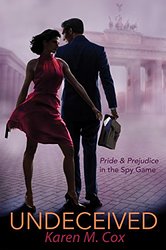
Don’t forget, Karen has offered an e-book of
one of her great novels as a giveaway!
That’s right, you can choose between 1932, Find Wonder in All Things,
At the Edge of the Sea, and, of course, Undeceived!
The giveaway is international!
Just leave a comment for a chance at the giveaway!!!
Rules for the giveaway –
If you asked a question, you have 1 chance in the drawing.
If you comment now, you get 1 chance in the drawing.
If you left a question and leave a comment, you get 2 chances in the drawing!
Please join in and leave a comment. Authors love hearing from you!
**Last day for comments for the giveaway is Wednesday 18 May**
Please leave those questions below!


