Skip to content
  • About Me
  • My Books
  • Short Stories
  • The Expat’s TravelΒ Guide
  • Ask the AuthorΒ 2014
  • Ask the AuthorΒ 2015
  • Privacy Policy

L.L. Diamond

  • Scuola Grande di San Rocco

    December 28th, 2016

    As you follow the signs to the Rialto Bridge and Saint Mark’s Basilica, you’ll definitely pass a small square with the Scuola Grande di San Rocco, the Chiesa (church) of San Rocco, and a da Vinci Museum. Now, I can’t comment on the da Vinci museum other than the understanding we had from the description was that it was a compilation of da Vinci’s inventions that were built and on display. I love da Vinci, but I would prefer to see his actual drawings and paintings, so we skipped the da Vinci museum. I was very intrigued, however, by the Chiesa di San Rocco and the Scuola Grande di San Rocco.
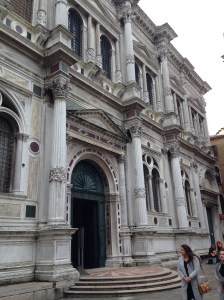
    Chiesa di San Rocco
    Scuola Grande di San Rocco

    San Rocco (or Saint Roch) was the protector against plague, which had devastated Venice in the 15th century. In 1478, a group of wealthy Venice citizens founded the ScuolaΒ Grande di San Rocco.

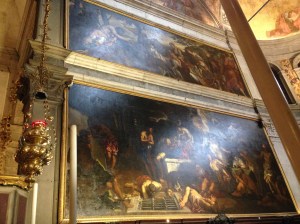
    When I was studying for my art degree, I took a class that I loved called Women in Art and Culture, and one of the artists we studied was Marietta Robusti, also called Tintoretto. Both the Church of San Rocco and Scuola Grande di San Rocco have works from Jacopo Robusti or Tintoretto, her father, who was commissioned in 1564 to produce paintings for the interior. I was curious to see the work of the father as I’d never really studied him in depth, and I didn’t regret the visit!

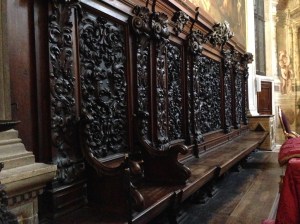
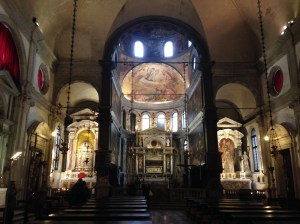
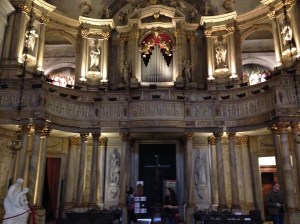
    The church is small and has more artists featured than Tintoretto, but the works are all lovely and the church is by no means unadorned. It is beautiful in its paintings and detail, but doesn’t really hold a candle to the Scuola Grande di San Rocco.
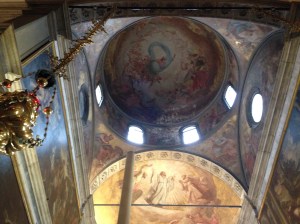
    Ceiling church
    Altar
    Tintoretto Paintings
    Detail on seating by altar
    Altar from the rear
    Back of the church

    We exited the church and walked across the square. My husband was hesitant due to the admission, but we soon realised children were free, which is always welcomed with five of us–especially as my children aren’t always excited about art museums.
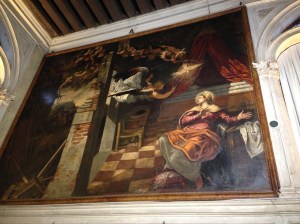
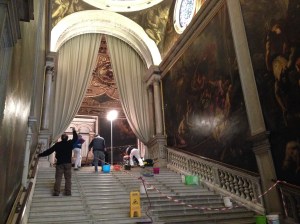
    One of the paintings downstairs
    Cleaning the stairs
    The Dome over the stairs

    The downstairs (Salla Terra) is a columned room containing a nave and two aisles nothing but the works of Tintoretto adorning all of the walls, depicting scenes from Mary’s life. It’s a lovely room, but once you’ve looked at all of the paintings, which are gorgeous, you walk up a stone staircase with a domed roof to a room that will take your breath away. I find the downstairs deceptive when you first walk in and it makes the upstairs (Sala Superiore (“Upper Hall”)) all the more grand.
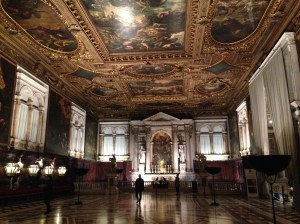
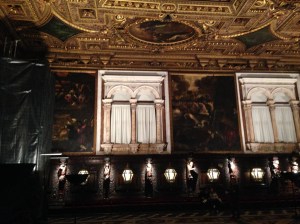
    Upstairs
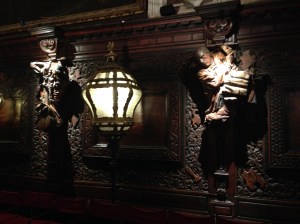
    Walls with Sculptures
    Tintoretto is on right
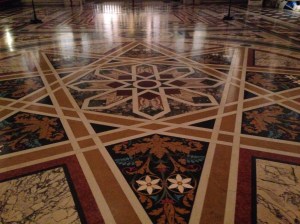
    floor
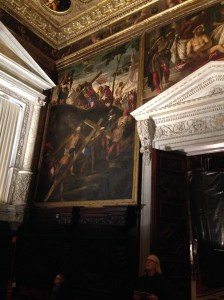
    Crucifixion
    Walk to Cavalry

    The ceiling and walls are covered by Tintoretto’s paintings trimmed in gold and with sculpture adorning the walls beneath it, including a wooden rendering of Tintoretto himself by Giuseppe Angeli and allegorical figures by Francesco Pianta. The ceiling in the Sala Superiore are from the Old Testament and the walls are depictions from the New Testament. There is also a room off to the side which has paintings depicting Christ appearing before Pilot to Calvary, which adorns an entire wall.

    ScuolaΒ San Rocco was not something we planned, but was my favourite part of the trip. If you go to Venice, you shouldn’t miss it!


    Next: Saint Marks Basilica and the rest of Venice
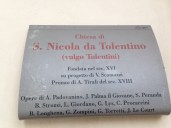


    Sources:
    https://en.wikipedia.org/wiki/Scuola_Grande_di_San_Rocco
    https://www.lonelyplanet.com/italy/venice/attractions/scuola-grande-di-san-rocco/a/poi-sig/400371/360029

    Share this:

    • Share
    • Tweet
    Like Loading…
  • La chiesa di San Nicola da Tolentino (Venezia)

    December 13th, 2016
    img_2798
    Nameplate on exterior

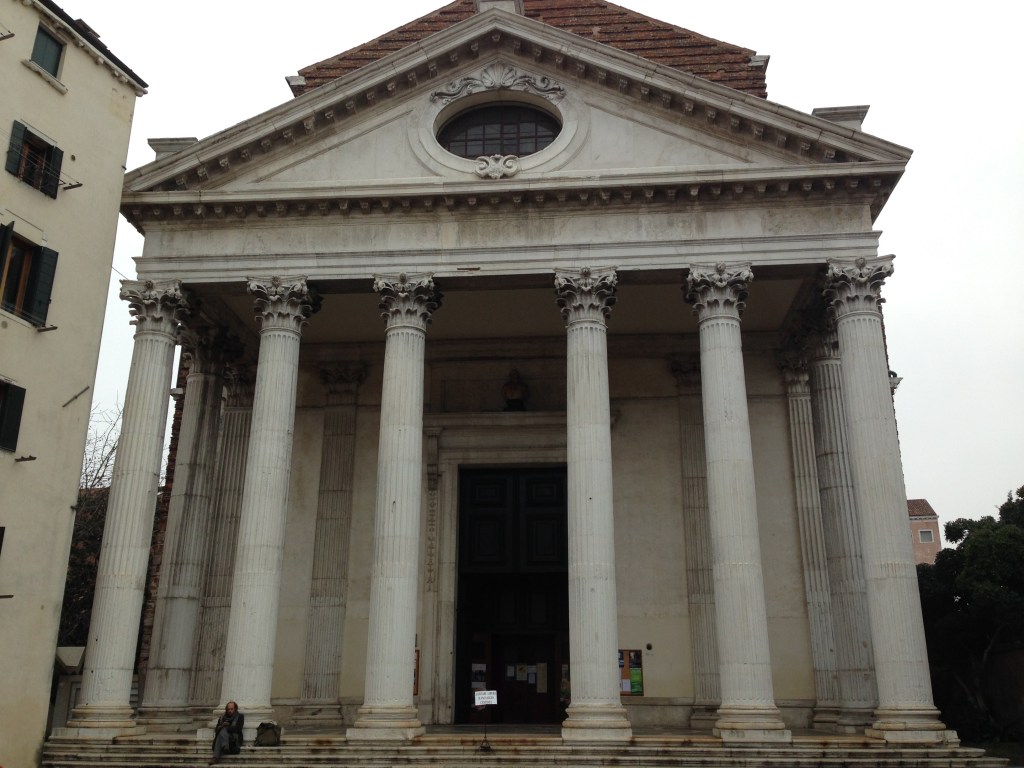
    When you cross that first bridge in Venice, La chiesa di San Nicola da Tolentino is at the opposite side of a small square across from the German consulate. The temple facade caught our eye, so we decided to investigate and boy, am I glad we did!

    La chiesa di San Nicola da Tolentino translates toΒ The church of St. Nicholas of Tolentino, and has been a Catholic church since the 16th or 17th century (I had to translate the Wiki page on it’s history, so sorry for any issues arising from that!). It was named for an Augustinian friar, who was proclaimed the patron saint of souls in Purgatory by Pope Leo XIII in 1884.

    First canal (see the square to the left?)
    Facade

    The church was erected between 1591 and 1602, and designed and built by Vincenzo Scamozzi. Between 1706 and 1714, Andrea Tirali added the portico, the tympanum, and six Corinthian columns to the exterior, which had been unfinished.

    I wish I could’ve taken my own photos inside this beautiful building, but they do not allow it. Thank goodness for Wikimedia Commons, who actually has photos of the stunning insides. I must admit that though the outside is nice, I was not prepared when I entered and caught a glimpse of the interior.

    Interior – Full length
    Dome
    Altar


    Next stop in Venice: Scuole Grande di San Rocco


    Photo credits:
    Chiesa di San Nicola da TolentinoΒ in Venice. General view of the interior of the church. Photo byΒ Didier Descouens.
    Chiesa di San Nicola da TolentinoΒ inΒ Venice. CeilingΒ : “Glory of St. Gaetano” ofΒ Mattia BortoloniΒ Photo byΒ Didier Descouens.
    Chiesa di San Nicola da TolentinoΒ in Venice. The maine altarΒ alla romanaΒ polychrome marble, with a large tabernacle in the shape of small allegory temple of the Holy Sepulcher directed byΒ Baldassarre Longhena. The two worshipers angels and six angels caryatids byΒ Josse de Corte.Β Photo byΒ Didier Descouens.
    References:
    https://en.wikipedia.org/wiki/Nicholas_of_Tolentino
    https://it.wikipedia.org/wiki/Chiesa_di_San_Nicola_da_Tolentino_%28Venezia%29

    Share this:

    • Share
    • Tweet
    Like Loading…
  • Venice

    December 5th, 2016
    img_2866
    My son’s head at the Rialto Bridge

    Can you believe it? We finally took a trip out of the U.K.! Not that I don’t love it here or that there is a lack of things to do or places to see, but we’ve been putting off a holiday that requires us crossing a body of water and we finally managed it.Β Thanksgiving holiday was a bit different when in Italy, but I’m certainly not complaining!

    There two are airports you can travel into when travelling to Venice: Marco Polo and Treviso. We booked our tickets into Treviso, which is a bit farther away (only about 30 minutes), but not inconvenient by any means. It is also A. Canova airport, so for this art lover, that was a plus since Antonio Canova is one of my favourite sculptors.

    Due to a commitment we had about an hour from Venice, we rented a car. I was advised to use a major company and not one of the smaller outfits you find online by someone who had gone before us. Great advice as the smaller local companies seem good at the outset, but then have smaller charges which appear once you’re there–at least that was how it was explained to me. πŸ™‚

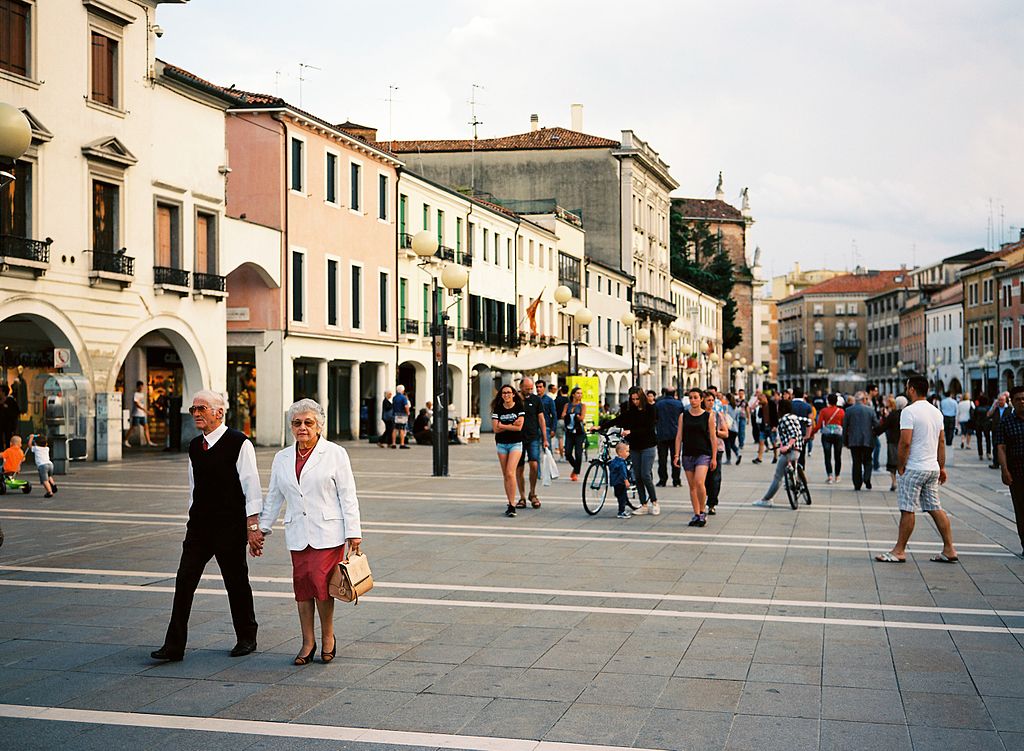
    Mestre Town Centre
    Mestre Town Centre

    Since we did have to drive an hour away, we did not stay in the middle of Venice, but instead stayed in Mestre. Mestre is the mainland portion of Venice and very populated. It has its own town centre of sorts as well as several supermarkets and restaurants. In fact, trying to find parking in the centre of Mestre on a Sunday evening for dinner is insane!
    We opted to rent a flat for a few days. With a larger family, we have to pay for two hotel rooms when we travel or find a flat/apartment. In this case, the apartment was significantly less expensive and we were very happy with where we stayed.

    742px-tramvia-sandona
    Tram

    Transport into Venice from Mestre is, in fact, extremely easy. From the flat, the tram was less than a five-minute walk and our temporary landlord showed us where to purchase tickets so the tram was less expensive. We were between the centre of Mestre and Venice, so a trip from our location took between 5-10 minutes and was fairly easy, though the tram did get rather crowded, so be prepared to stand if you are on one of the later stops. If you purchase tickets in advance, they act like a declining balance when you scan them on scanners on each car of the tram.

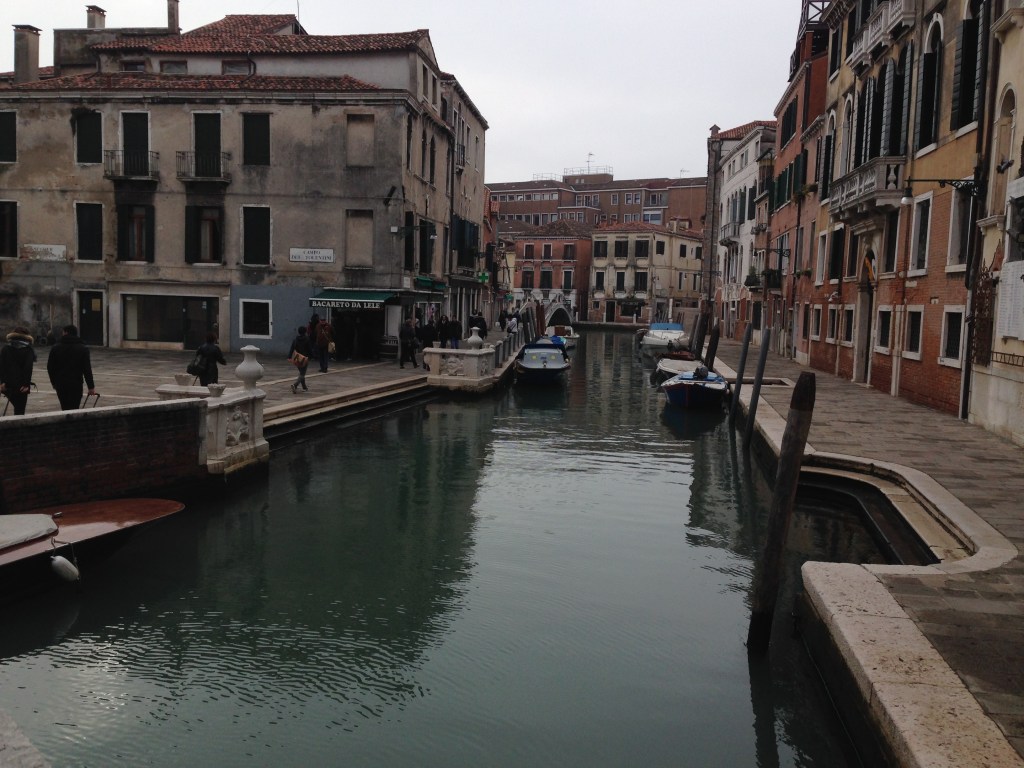
    The tram brings you just over the water and to the edge of Venice. From there, you can follow the signs to the Rialto Bridge and St. Marks Basilica (San Marco), or you can wander. We did a bit of both and had a great time. Restaurants, bakeries, and shops line each and every walkway. Carnival masks and Murano glass (made on an island near Venice) colour many of the windows. It was always fun to go through a line of souvenir shops and boutiques to find a hardware store or something similar. Just that reminder that while it’s a touristy place, people do still live there.

    One word of warning on souvenirs. It didn’t occur to me when we went, but some of the touristy shops are more legitimate than others. My daughters especially enjoyed the Carnival masks, but while there are a lot of shops that carry masks made in Italy or handmade, some carry ones made in China. Fortunately, the larger more expensive ones we purchased for ourselves and a gift, were both handmade, but one or two of the smaller were made in China. We were a bit disappointed when we arrived home and found that sticker on the inside. I’ve heard that can happen with Murano glass as well, but we only purchased one piece as a gift, and it was well-marked as “Made in Italy.”

    Alsoimg_2893 be warned that public restrooms/toilets are not a common thing to find in Venice. I knew they cost money to use, so we all made a point of visiting the ones in the restaurants prior to exploring again; however, we did have to track down the one we could find at one point during our visit. I never dreamed it would cost €1.50!

    The restaurants each had something different to recommend them. Some servers knew more English than others, but we did look up a few phrases before we went. Most importantly was “sensa glutine.” One server even looked at us and said, “Or you could say gluten-free.” Hey! We did try! Between what little French and Spanish I knew combined with Google translate, we did muddle through. My husband laughed at me when I told the lady at Starbucks “grazie” when she handed me my coffee upon our return to England. Four days of Italian had created a habit!

    img_2801I will say that I rarely take photos of food, but I did on this trip. Just about everything I ate and saw in windows that I couldn’t eat were photographed. It was rather funny and not surprising that I gained four pounds over those few days. Imagine what I would’ve gained if I had free rein on the bread and pastries! Yikes!

    Now, I know I usually give a low down on everything we do while we travel, and I will; but for this post, I wanted to give overall impressions, advice, etc. Next post will start what we saw while there. πŸ™‚ I’m going to have to hunt down photos of some since they don’t allow photos in some of the churches 😦


    Photo Attributions:
    Tram:Β Gabriele Foltran, Wikimedia Commons
    Piazza Ferretto:Β William.kimmerle, Wikimedia Commons

    Share this:

    • Share
    • Tweet
    Like Loading…
  • Glenarvon

    November 18th, 2016

    I was playing around, looking for a book to allude to while writing a scene, when I came upon this one. At times, I see something and think, “That would be fun!” and this was one of those times. I do not mention it specifically by name…at least yet, but I couldn’t resist using it.

    I knew the name Lady Caroline Lamb. Many who have a fascination with Regency England and literature do, but I knew of her more as the lover of Lord Byron rather than a writer in her own right. Lady Caroline was indeed a writer, though probably considered as scandalous as Byron, she likely also sold as many books as he did.

    Glenarvon, the book Georgiana peruses in the story,Β was first published anonymously in 1816. Now, I say anonymously, but everyone in society knew Lady Lamb was the author. Even Lord Byron commented,Β “I read Glenarvon too by Caro Lamb….God damn!” Society at the time was well aware of her identity, though it did her no favours.

    While Glenarvon is a Gothic tale, the story was actually that of her own affair with Lord Byron in which she included other prominent members of the Ton, under different names of course, and satirised them in the most unflattering terms.

    The book was an undisputed success. The entire first run sold out, and further editions were printed, so one cannot say her efforts were for nothing; however, her already poor reputation was ruined and she became ostracised from the Ton.

    The strange part is that Lady Caroline did not become a pariah on account of making her love affair public. The fact that she and Byron were lovers was far from a secret. It was in fact quite well-publicised. Rather, it was her unflattering satirisation of several high-ranking members of the Ton–including Lady Jersey, who led to her downfall (In retribution, Lady Jersey cancelled Lady Caroline’s Almack’s vouchers.Β By the efforts of family members, she did have her vouchers reinstated in 1819, but it did not do much to repair the damage.)

    Glenarvon has been in and out of print since the 19th century. It’s last printing was in 1995, and has since been called an early work of feminism, though some consider it “hysterical” and incoherent. As Lady Caroline was known to abuse alcohol and laudanum and have mental instability, incoherent is a distinct possibility.

    Lady Caroline Lamb published three other works in her lifetime:Β Graham HamiltonΒ (1822),Β Ada ReisΒ (1823), andΒ PenruddockΒ (1823).

    Sources:
    https://en.wikipedia.org/wiki/Lady_Caroline_Lamb
    https://en.wikipedia.org/wiki/Glenarvon
    http://www.sjsu.edu/faculty/douglass/caro/works_glenarvon.html

    Share this:

    • Share
    • Tweet
    Like Loading…
  • A Review of Love and Friendship

    November 7th, 2016

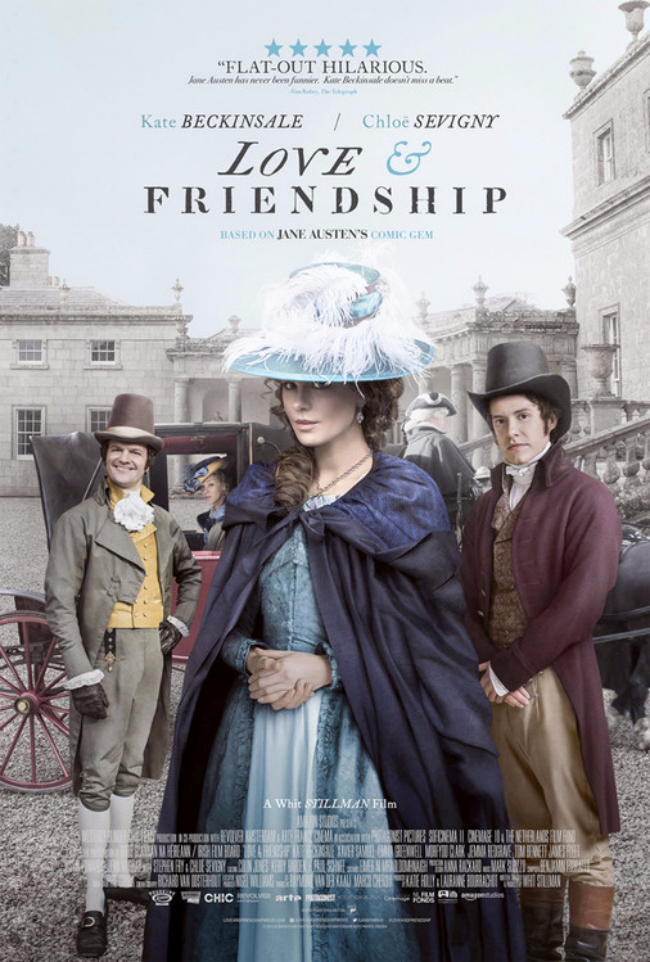
    posterTo be honest, I don’t know how to give a specific rating for this movie. I keep thinking of Robin Williams in Dead Poets Society saying, “How do you rate poetry?” I’m not saying this movie is poetry, but it’s just something I can’t assign a specific number of stars.

    That said, I liked Love and Friendship, though I’m not going to claim it was a flawless masterpiece. I had bits I liked and bits I didn’t. As a Janeite, little things sometimes bug me, and it would seem like a trifling with this movie, but there were a few little things.

    I’d watched the hubbub when Love and Friendship hit theatres and watched the trailers, eagerly awaiting its release on DVD. My husband added us to the waiting list at the library when we had word they would have it. We were Β the first to check out the copy.

    Now, one of the first criticisms I heard of Love and Friendship from others was the costuming. I read someone complaining that the characters were wearing Georgian gowns rather than Regency. Most historian’s or Janeites, have a time period in which they associate one of Jane Austen’s works. Lady Susan is believed to have been written in 1794, and I would imagine the artists and fashion designers were attempting a late 18th century look rather than the look we associate with Regency, which began in 1811. Fashion plates from 1794 do feature the more Regency-looking empire waistline gowns, but there are Robes a la Anglaise dated to this time period as well. I suppose, they wanted a consistent look to the movie rather than some wearing more modern gowns versus the older styles. Overall, the costuming was lovely, and to be honest, I didn’t have an issue with it.

    My only criticism before watching the movie was the title. The movie Love and Friendship is taken from Jane Austen’s epistolary (in letters) novel Lady Susan, who is Kate Beckinsale’s character in the film. What bugged me about the title change is that another of Jane Austen’s juvenilia is called Love and Friendship, and bears no characters in common and no similarity other than it also being in epistolary form. Try to look up Jane Austen’s actual story online these days, and you get a plethora of posts about the movie rather than the book. Grrr! πŸ™‚

    Regardless of my gripe with the title, I still really itched to see this movie, and I did enjoy it. I thought Kate Beckinsale was delightful as Lady Susan and I really loved Chloe Sevigny as her great friend and American (gasp!), Alicia Johnson. The two of them played brilliantly off the other and the quips about Mr. Johnson (Stephen Fry) sending her back to the wilds of Connecticut or having a more severe case of gout next time were really amusing.

    However (Oh, come on! There had to be a however!), I found the flow to be choppy. Scenes were started and sometimes they felt like they were cut too soon, or the one-liner was delivered so the scene was over. My husband even commented about half-way into the movie that it seemed to be nothing but a series of one-liners.

    I will also say that my husband, who is not a Jane Austen fan, but agreed to watch this for me (Who am I kidding! More to watch Kate Beckinsale!) became quite confused as to some of the characters. I don’t think he really grasped who Lord Manwaring was at the beginning which caused him to ask questions when the Manwaring’s names were brought up later in the film.

    For those who are Jane Austen fans, I would say go and watch it to decide for yourself. I would never say watching it was a waste of time. I enjoyed it. But I won’t go running out to buy my own copy. As much as I love Jane Austen, I think I will wait and see if a version I like better is released.


    Have you watched Love and Friendship? If so, I’d love to hear your thoughts!


    Share this:

    • Share
    • Tweet
    Like Loading…
  • Bath — Again!

    November 1st, 2016

    IMG_2299I know, I gush about Bath on here, but I always have such a great time when I go. I first travelled to Bath last year for the Jane Austen Festival, and then for a family holiday in March. This year, I returned for the festival and to have a girls’ weekend with some friends.

    img_2746
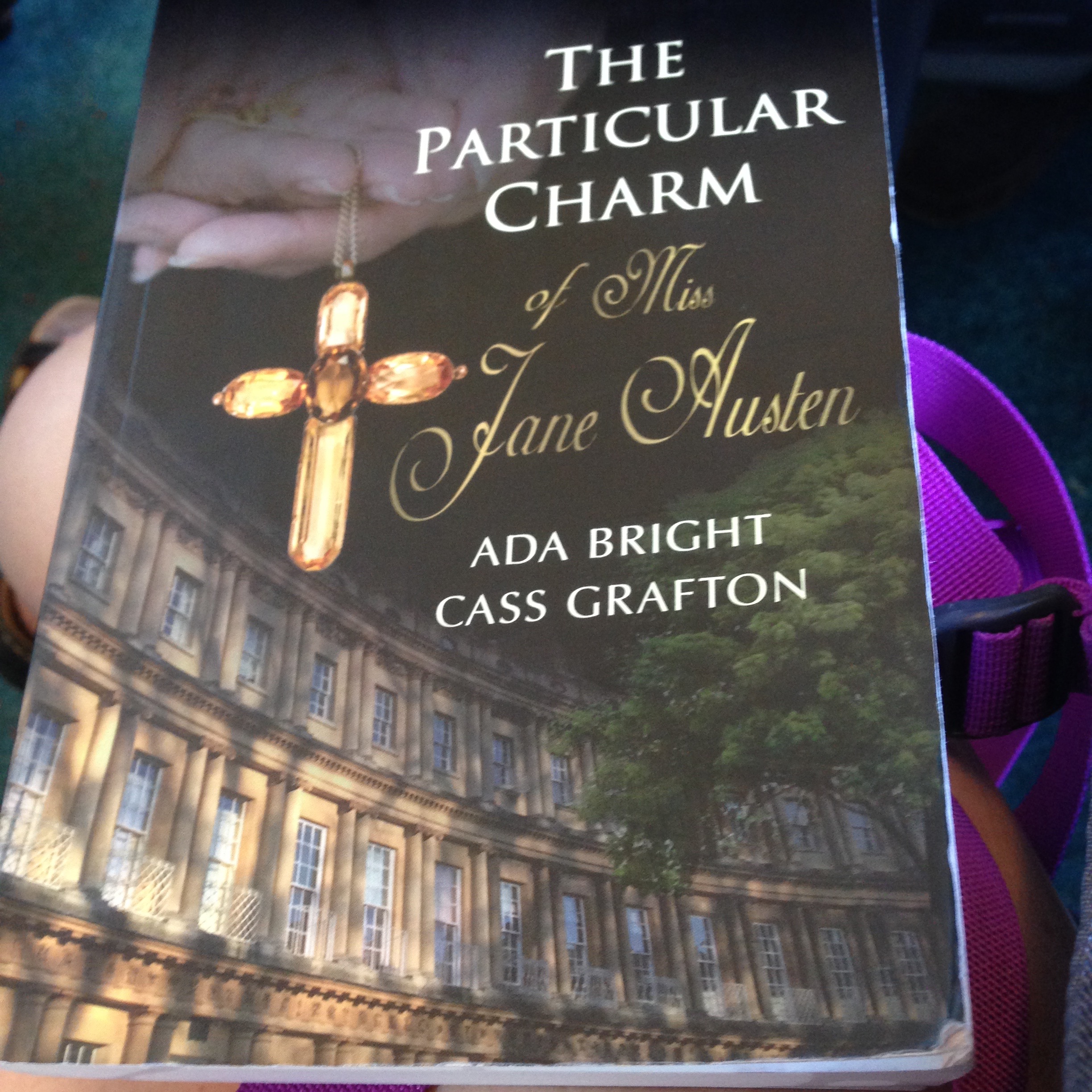
    If you haven’t read it, don’t miss out!

    As has become my habit, I took the train, which I adore doing. I generally prefer to travel England by train than car, but the method has become how I always go to Bath–it’s become a bit special for that trip. I’m not always a big reader on the train, but I brought along Cass Grafton and Ada Bright’s new book, The Particular Charm of Miss Jane Austen, which kept me entertained as I zipped through the English countryside.

    It was no coincidence that my roomie for the weekend (I travelled in on Friday and departed on Monday), was none other than Cass Grafton herself. We first met at Jane Austen Regency Week last year and became fast friends. I’m not a huge fan of staying alone when I travel, and she came to my rescue with a great flat in my favourite part of town. One day, I do want to stay at 4 Sydney Place, but I will never complain about Great Pultney Street!

    14322329_644465625720189_1279158204968452842_nMost of my time this trip was spent visiting with Cass and doing a bit of shopping, but we did meet up with a few friends along the way as well. I had a great time at dinner Friday night when Cass and I met up with fellow JAFF author Alexa Adams. Nothing like wine and great conversation to spend an evening! We were staying close to one another, so we even walked back to that part of town, taking a quick stop for a selfie in front of the Abbey.

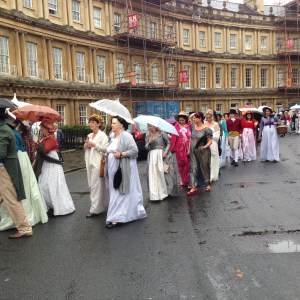
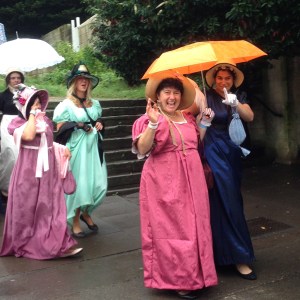
    Saturday was a bit dreary, but we walked up to the Assembly Rooms to watch the promenade and see everyone in their best Regency finery. I always like to bring home special items for my children, so I did a little shopping before I met Cass and an old friend of hers for lunch.

    Promenade as it passed the Circus
    Joana Starnes and Mira!

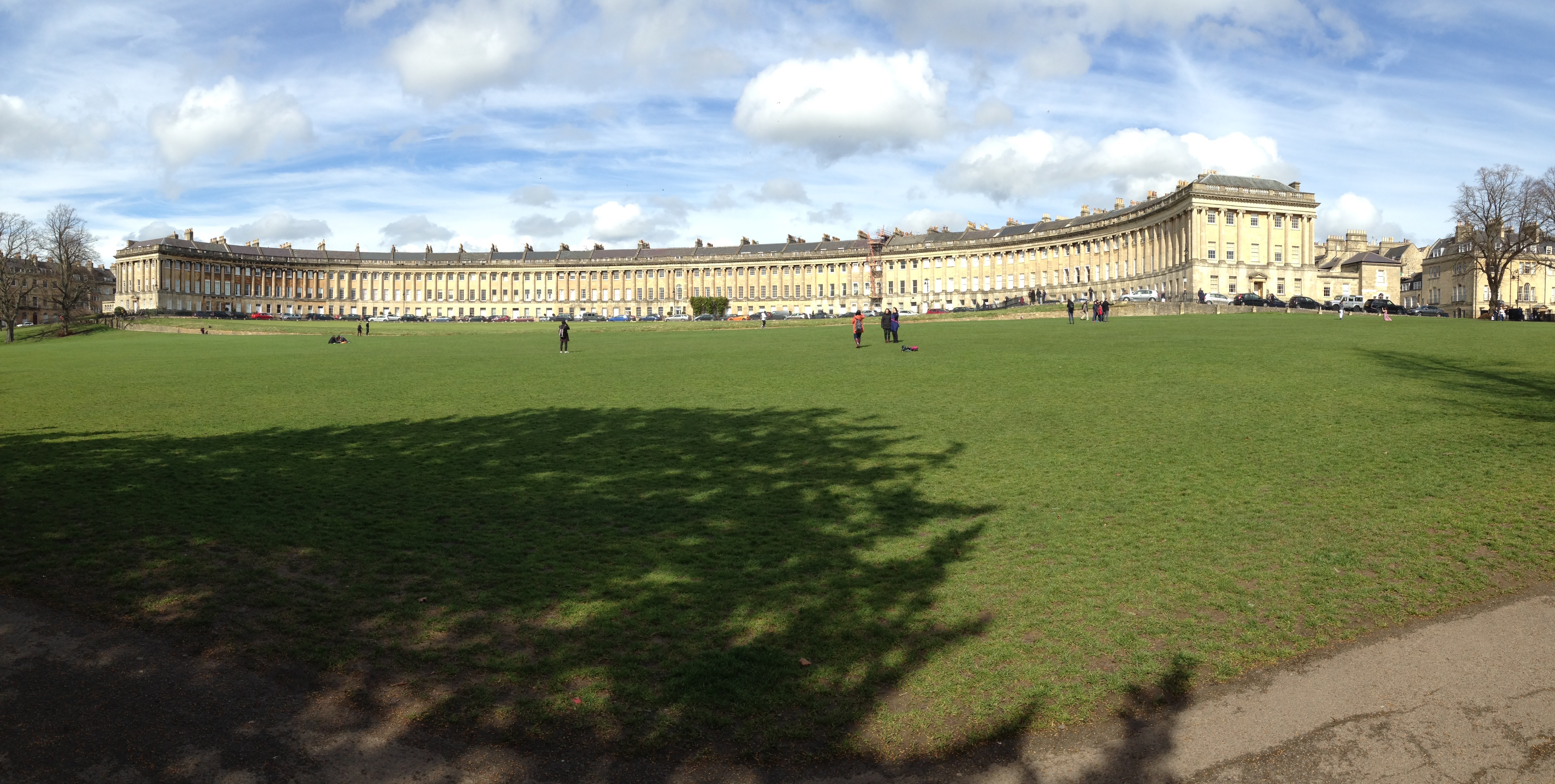
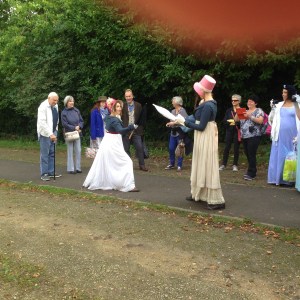
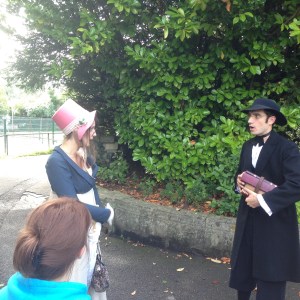
    I spent the afternoon on a comedy walk of Bath. Natural Theatre Company does a play called Austen Undone that is performed as the characters take you on a walk through Bath with the Gravel Walk and Royal Crescent being a part of the tour. The performers were excellent and even engaged the spectators so we were a part of the fun. I certainly recommend Austen Undone to anyone who is in Bath for the festival. I laughed so hard and when Alexa Adams and I happened upon the vicar after the performance, he remained in character and held a conversation with us when we wished him luck. It was a great time!

    Please forgive my finger!
    The funny, bumbling vicar!


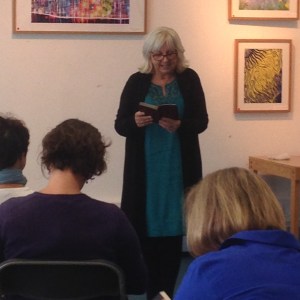
    Sunday, we walked down to the public library for a reading of Sense and Sensibility. Jane Odiwe read the second chapter, and she did a brilliant job of capturing the tone and the humour of Austen’s work.

    Jane Odiwe reads S&S
    Me and Jane… Odiwe that is. πŸ™‚

    Jane, Cass, and I talked over glasses of wine and dinner. We had a marvellous time and I truly enjoyed the afternoon.

    My trips to Bath are always over so quickly, and this one was no different. Before I knew it, I was finishing The Particular Charm of Jane Austen on the train home. I had hoped to stop in Platform 9 3/4 at Kings Cross before I left London, but I didn’t even have time if I wanted a ride home from the train station!


    Up next… Honestly, I have no idea!

    Share this:

    • Share
    • Tweet
    Like Loading…
  • Tintagel

    October 22nd, 2016

    For those who are fascinated with legends of King Arthur, Tintagel Castle on the north coast of Cornwall is a must-see. The site has been dated back to the Romano-British period by the discovery of artefacts dating to that time period.Β It was definitely a settlement during the medieval period and in 1233, Richard, Earl of Cornwall built a castle on the site.

    Geoffrey of Monmouth first claimed Tintagel was the site where Arthur was conceived before Richard built the castle. In Historia Regum Brittaniae, Monmouth claimed Merlin disguised Uther of Pendragon to look like Gorlois, the Duke of Cornwall and husband of Igraine, who was Arthur’s mother. The belief of the link to Arthur was reinforced when Tennyson wrote ‘Idylls of the King’ in the Victorian period.

    What remains of Tintagel is located on Tintagel island near the village of the same name and is now operated by English Heritage. There is a great deal of walking and stair climbing involved, which is something to keep in mind. We planned our visit for the last day of hour holiday, which turned out to be rainy and cold.

    Parking is plentiful when you arrive, and it’s only a short walk to the English Heritage building where you check in for Tintagel. There is a separately operating shuttle that will drive people closer to the actual castle or you can walk it as we did.

    img_2602When you begin the trek upwards, you start with this dirt path (muddy on rainy days) up to where the outer castle wall was. This part isn’t too steep, and you begin to have some lovely views once you reach the first portion of the ruins.

    Tintagel Castle, like many old castles and homes in Britain, have different structures and walls from different time periods.

    Tintagel at one time had a portion of the castle on the mainland and a portion of the castle or a bridge brought you over the water to the island. Unfortunately, that bit crumbled into the sea at some point, but a bridge has since been constructed so people can cross from the mainland ruins to those on the island. You can still see what is left of the original stairs in the second picture below.

    Stairs down to cross
    Bridge crossing

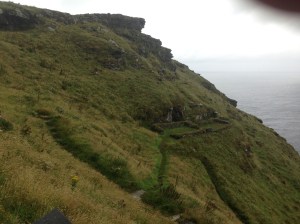
    Once you’ve crossed the bridge, you climb up a rocky set of stairs on the side of the island. If it’s wet, I recommend not being in a hurry as some of the steps are steeper than others and if you slip, the rocks would be rather unforgiving.

    Tintagel Ruins
    Looking back at the path and the excavations

    The views and the ruins are definitely worth the hike uphill!

    more excavations
    View from Tintagel
    View from Tintagel

    Once you are across there are signs with history just like any English Heritage site as well as plenty of gorgeous views. I did have a fit of nerves watching my fourteen year old, who liked to step near the edge of some of the cliff-like sides. My husband would go with her, but it still made me nervous.

    I will say that when you are ready to leave, you have to exit the same way you came in, so back down the crazy length of steps. You can also go down to the beach and go inside “Merlin’s Cave.”

    I will say if you’re anywhere near Tintagel, don’t miss it! Legend aside, the different portions and excavations of buildings all built in different centuries if not ages, is fascinating and the views are incredible.

    That said, please excuse my finger, which insisted on being in a few of the shots. That is one problem with a rainy day like that–I just won’t bring my nice camera outside. I used my phone and I often get my hands in the way.
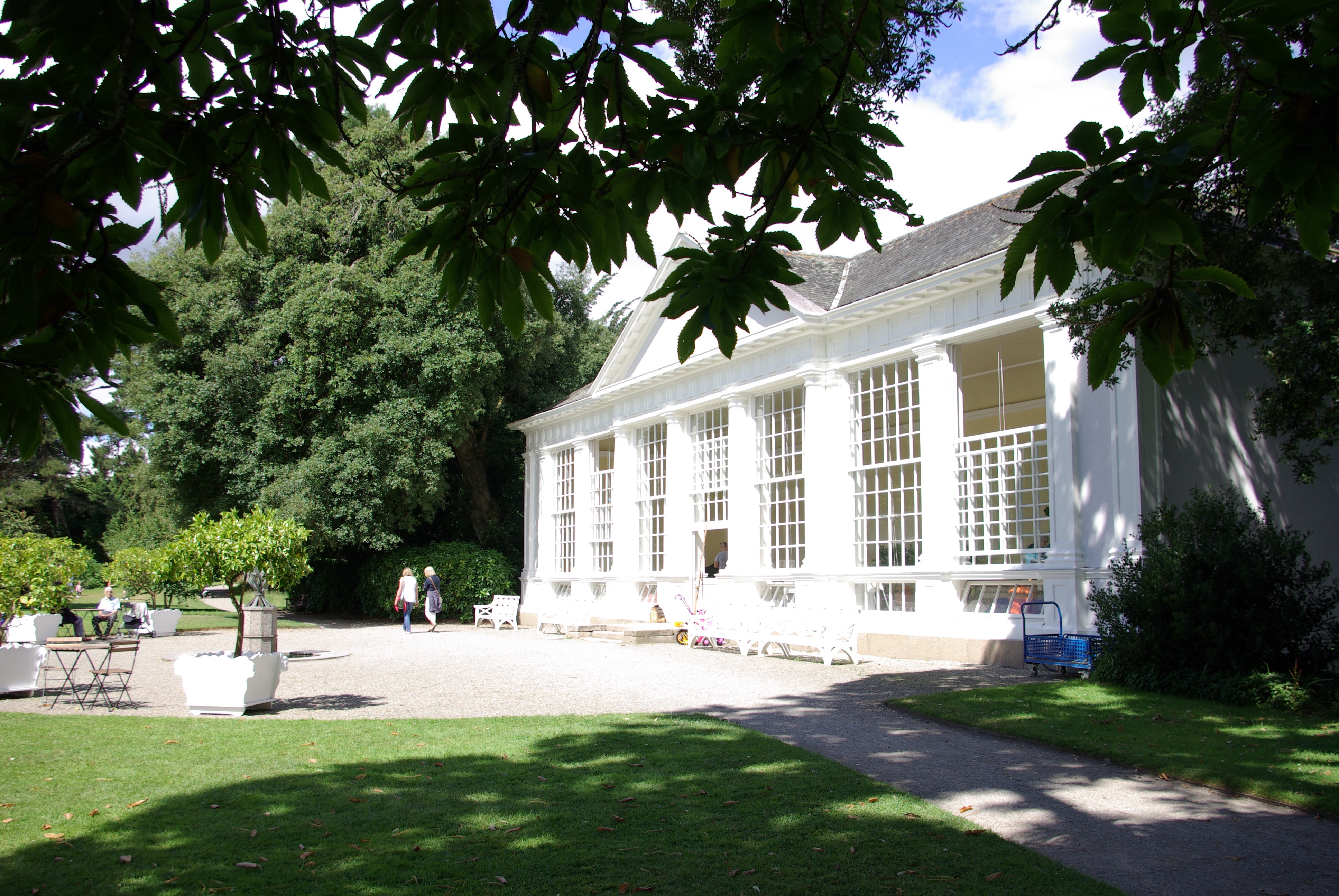
     

    Coming up next…Jane Austen Festival, Bath!!!!


    Share this:

    • Share
    • Tweet
    Like Loading…
  • Update: Yes, I am still in the land of the living…so far.

    October 17th, 2016

    How is it October already!!!Β I know, October is more than half-over and I feel as though I started running and suddenly stopped to discover a month had passed. It seems yesterday as I took my almost daily drive to swimming, I would watch the hedgerows along the stretch of road slowly turn from brown to green. As I passed them this weekend and started into town, I was struck by the yellow and brown of the leaves as they fell in the wind and drizzly rain. Autumn has certainly arrived.

    I have a lot planned for the next month or so. Here’s just the highlights. πŸ™‚

    I fully plan to continue Expat’s Travel Guide with my post on Tintagel. It’s partially written and just waiting. I’ll hopefully finish that this week and get it posted. Tintagel was the last place we visited on our trip to Devon and Cornwall, so after, comes my September trip to Bath for the Jane Austen Festival. I may have to split that one into more than one post since my roomie for the weekend, Cassandra Grafton, and I solemnly swore to be up to no good that weekend. I believe we exceeded our expectations on the matter πŸ˜‰

    Coming up this month and into November (November?! Meep!), I have the Halloween Day post at Austen Variations. I am planning another instalment of the 50 Shades of Jane…? silliness I’ve been writing this year, so I hope you’ll stop by for a read.

    On November 11, I’m posting an excerpt from Particular Intentions at Austen Variations for Netherfield in November. If you haven’t read Particular Intentions and would like a preview beyond what is offered on Amazon, come on by for a look-see.

    One November 15, I have a guest post at A Covent Garden Gilflurt’s Guide to Life. I have several ideas, but I desperately need to choose one and soon for this!

    As for writing not of the blog variety, I’m playing around with a sequel to Particular Intentions from Georgiana’s point of view. It is a bit slow going at the moment, but I have five chapters completed. I have a feeling if I can get past this ball, it might start flowing a bit faster… I hope!


    Share this:

    • Share
    • Tweet
    Like Loading…
  • Berry Pomeroy

    September 19th, 2016
    imgp9164
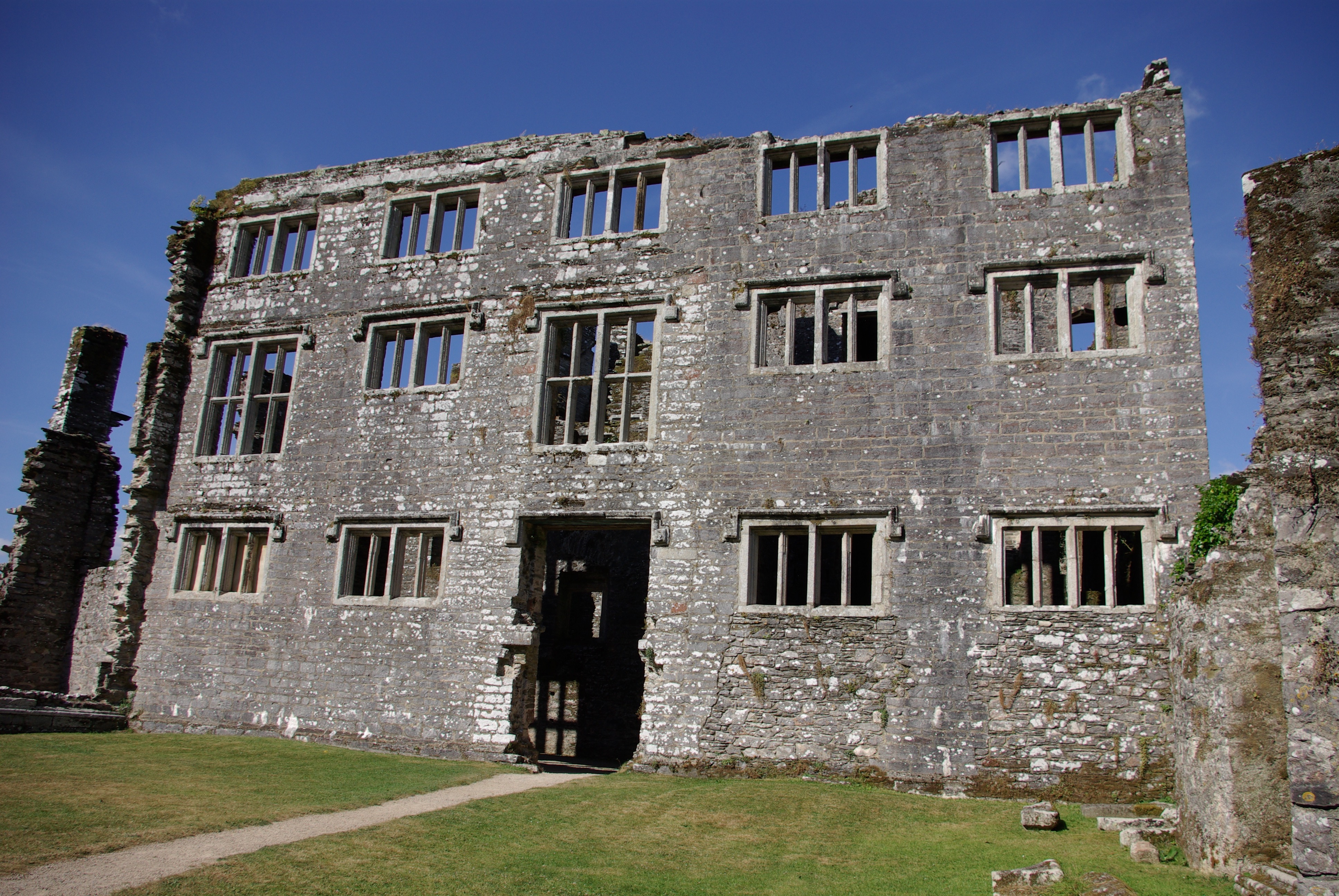
    Berry Pomeroy Castle

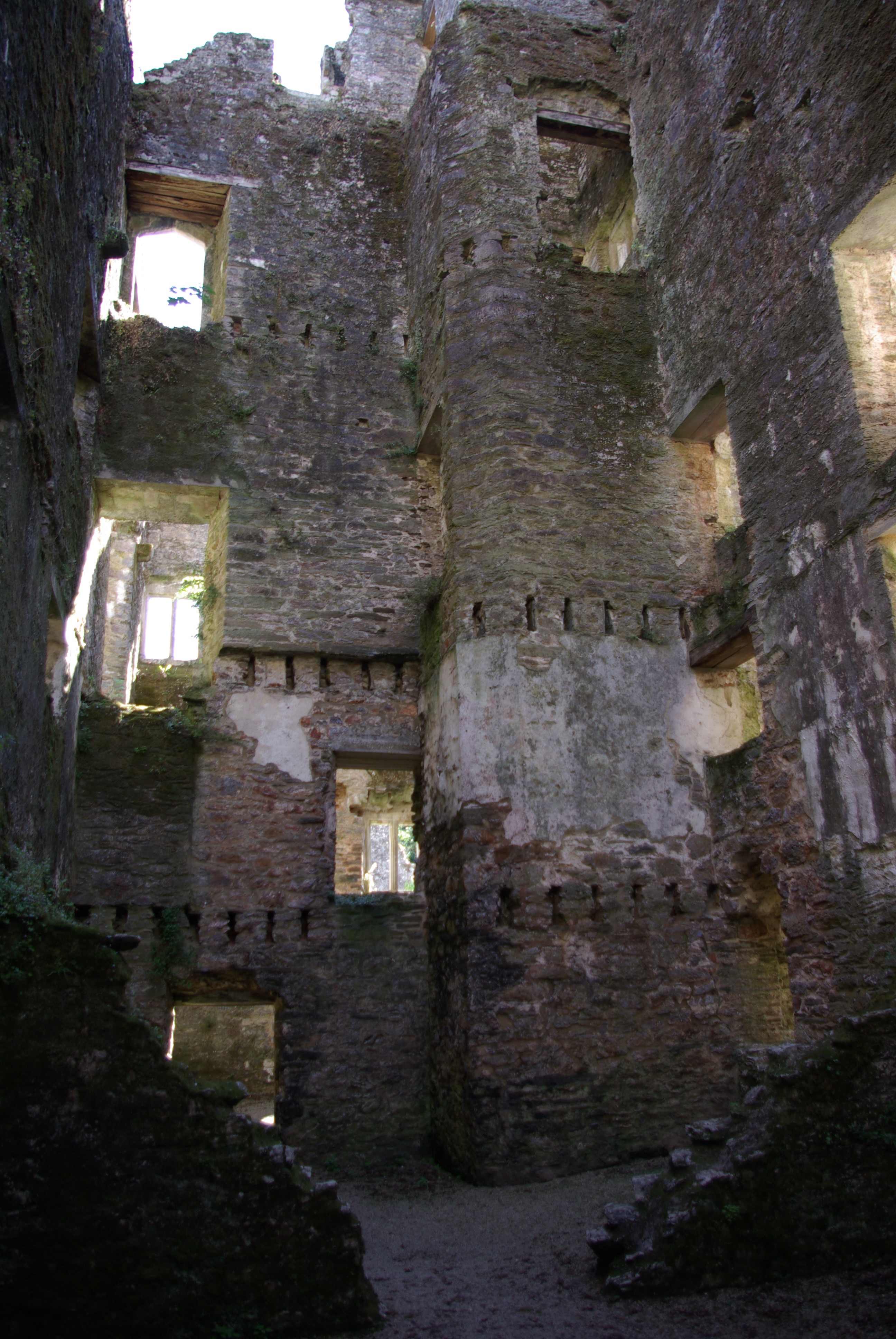
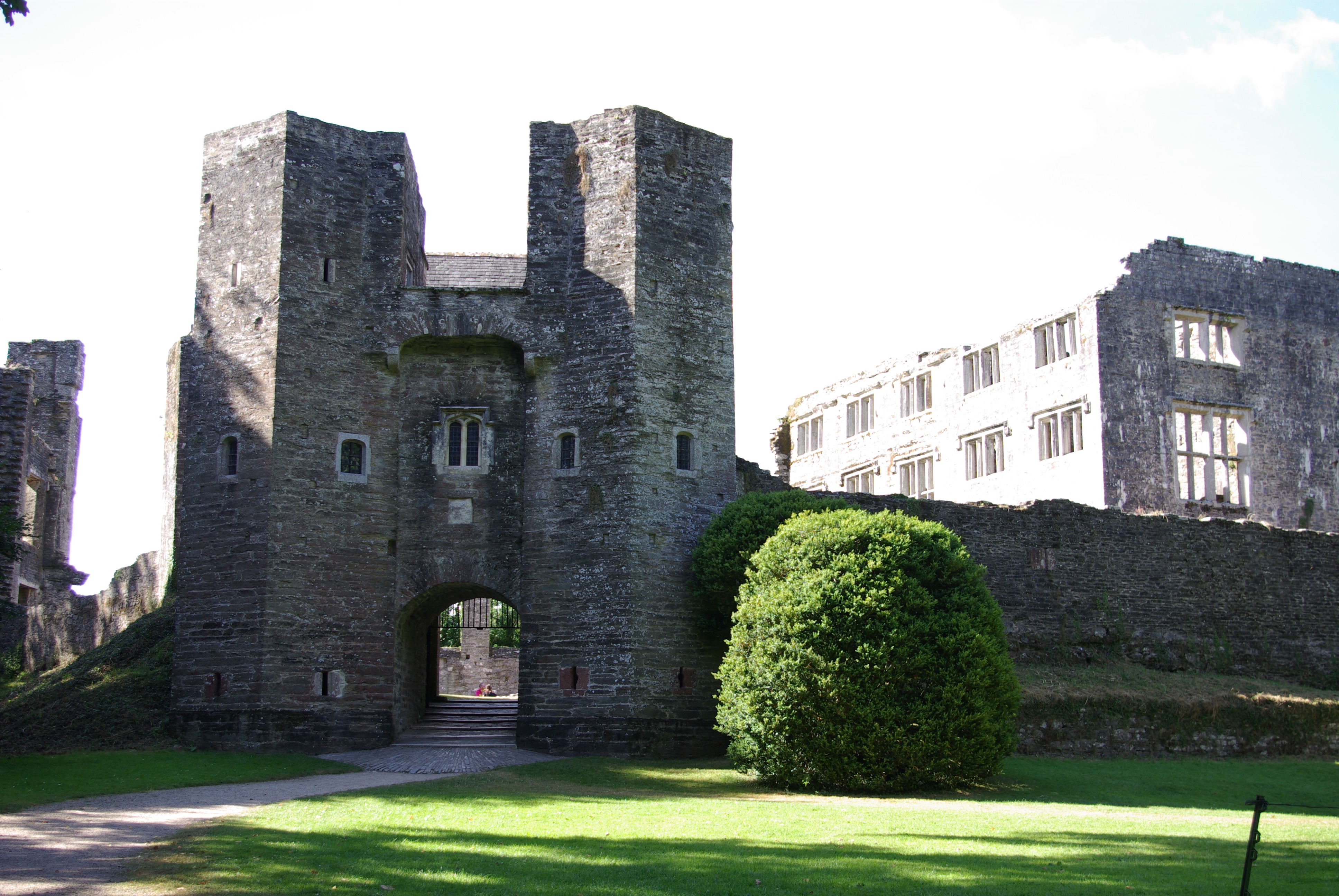
    Tucked away just outside a village of the same name in Devon is Berry Pomeroy Castle. This castle is quite unique in many ways. The land was first awarded to Ralph de Pomeroy by William the Conqueror as a reward for his loyalty during the Norman invasion and the Battle of Hastings. Some sources claim the construction of the castle began in the late 15th century and some the late 14th. English Heritage, who now owns and runs the site, claims 15th. The Pomeroys fell into debt and the land and the castle were sold to Edward Seymour, the first Duke of Somerset, in 1547.

    (In the event you are wondering if Edward Seymour is the same family as Jane Seymour, wife of Henry VIII, then yes, Edward Seymour was her eldest brother. He was also Lord Protector of Henry VIII’s only son with Jane Seymour.)

    imgp9163
    Remains of the Seymour House

    Seymour began a project in the hopes of making the family home there one of the greatest in England, and if you look at the photos of the front of the castle, you can see what remains of the Seymour house to the right.

    Seymour was executed by the crown in 1552 and his lands for a time were forfeit, yet they were later re-instated to the family. The Seymour family remained at Berry Pomeroy until the late 17th century when the castle was abandoned when the current owner, Sir Edward Seymour (fourth Baronet) moved to Wiltshire.

    The ruins of Berry Pomeroy Castle were rather popular in the late 18th century when the Romantic era favoured castles and other structures beaten down by rain and time. Berry Pomeroy during this time was overgrown with ivy and commonly visited by artists and even illustrations of the place were featured in books of the era.

    imgp9143Now, Berry Pomeroy still sits in the same valley. It is no longer covered by ivy, but surrounded by a thick wood to the rear of the property. Guard rails and other protective measures allow tourists to walk through what is left of the structure and there is still a portcullis and you can see where hot liquids could be poured down on any attacking enemy.

    For those who enjoy haunted sites. Berry Pomeroy is said to be haunted by a number of ghosts and supposedly one of the most haunted castles in Britain. The “White Lady” is said to haunt the dungeons. She rises from there to Β St. Margaret’s Tower when she is seen. It is thought she is the ghost of Margaret Pomeroy. Margaret had the misfortune of loving the same man as her sister Eleanor. Because Margaret was more beautiful, Eleanor locked her in the dungeon until she starved to death.

    Another spectre, is the Blue Lady. She beckons help from passers-by and lures them into one of the towers where the unsuspecting helper falls to their death (thank goodness we didn’t see her!). It is suspected she is the daughter of a Norman Lord who wanders the dungeons mourning the loss of her baby, which it is said she murdered.

    There is also the story of the Pomeroy brothers, who were besieged in the castle; however, rather than accepting defeat, they donned their full amour, mounted their horses, and leapt from the castle ramparts. This part of the castle is still called “Pomeroy’s leap.” It is claimed the ghosts of the two brothers have been spotted here.

    berry_pomeroy_church_-_geograph-org-uk_-_1090704
    Berry Pomeroy Church

    Berry Pomeroy is not far from Torquay, but once you turn off the main road, it is a lot of little one-laned roads. I am still bummed I missed a photo of the church from the end of Emma Thompson’s Sense and Sensibility. I was driving when I came to the end of one of those tiny roads, looked up, and there it was. I thought I would catch it on the way back, but the GPS/SatNav took us a completely different route. Figures!


    Next: Tintagel, Cornwall


    Image of Berry Pomeroy Church:Β Image Copyright Paul Hutchinson. This work is licensed under the Creative Commons Attribution-Share Alike 2.0 Generic Licence. To view a copy of this licence, visit http://creativecommons.org/licenses/by-sa/2.0/ or send a letter to Creative Commons, 171 Second Street, Suite 300, San Francisco, California, 94105, USA


    Sources:
    https://en.wikipedia.org/wiki/Berry_Pomeroy_Castle
    http://totallyhaunted.co.uk/berry-pomeroy-castle.php
    http://www.english-heritage.org.uk/visit/places/berry-pomeroy-castle/

    Share this:

    • Share
    • Tweet
    Like Loading…
  • Saltram House

    September 5th, 2016
    IMGP9020

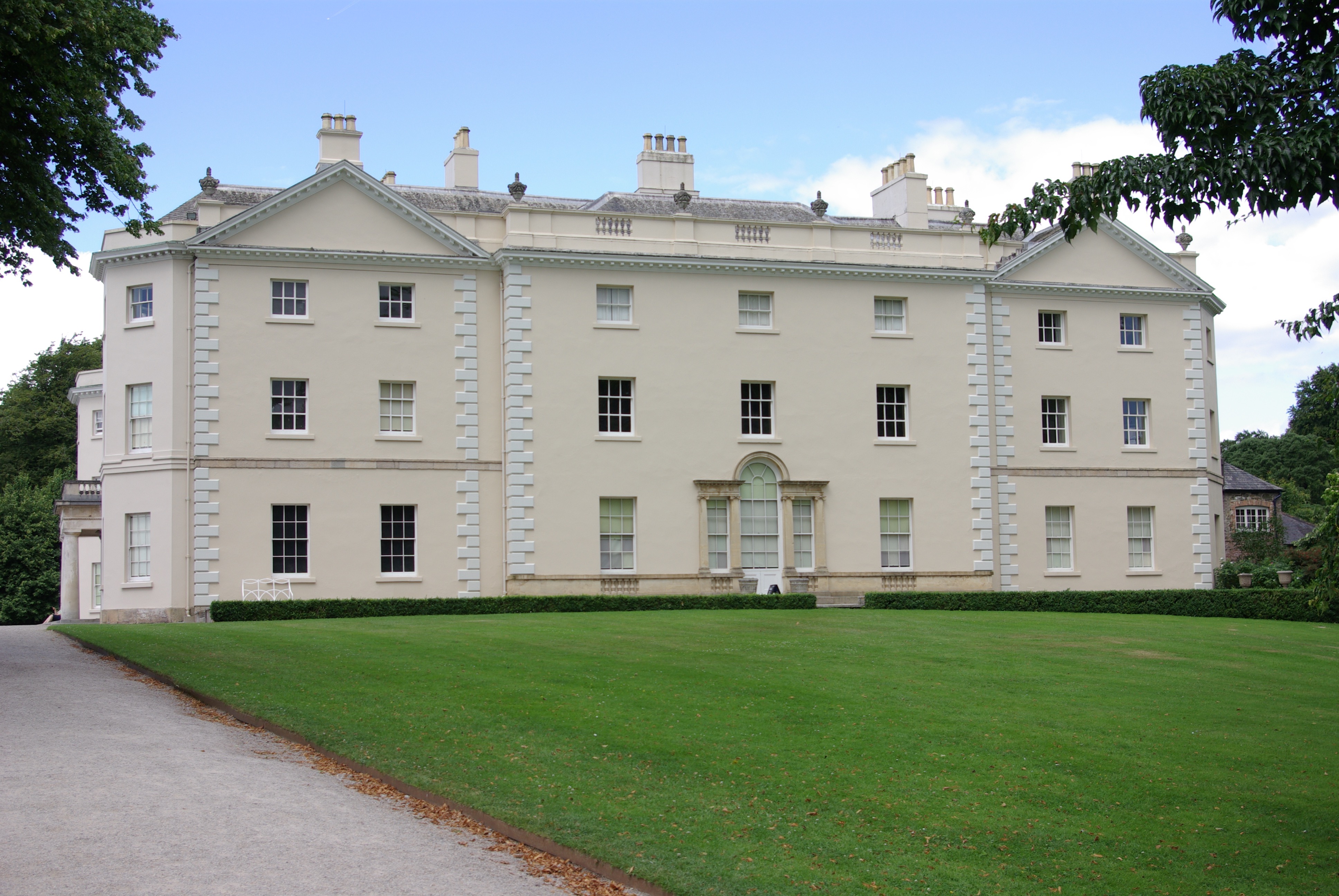
    If you’ve ever seen Emma Thompson’s version of Sense and Sensibility, you might recognise Saltram House. This beautiful home served as Norland Park, home of the Dashwood family. It also has a personal connection to Jane Austen in that the famous author was friends with Frances, who was the Countess of Morely. Not only is it reported that Jane Austen gave Frances one of the first editions of Emma, but also it has been speculated that her husband, the Earl of Morely, was the model for Mr. Darcy. Whether such speculation is true is, of course, information Jane took to her grave, but still fun trivia!

    Saltram House is thought to have been built during the reign of George II when the pre-existing Tudor home was integrated into a new Palladian style. The home changed hands several times until it was purchased by the Parker family in 1712.

    Now, if you’re an art lover, you must see Saltram. One could say that about quite a number of homes, but the Parker family were friends with Sir Joshua Reynolds, so at least one portrait by the famous painter can be found in almost every room. I was pleasantly surprised and thrilled to find a few histories by Angelica Kauffman along the famous stairwell that features into one of the best scenes in Sense and Sensibility (in my opinion anyway πŸ™‚  ). I’ve seen a few portraits by Kauffman, but loved seeing these history paintings since women so seldom painted them during that time period.

    The house is lovely on the inside and I thoroughly enjoyed the interior. Websites and rumours abound online that the home is haunted, though, much to the disappointment of my daughters, no ghosts were seen, and the staff claimed to know nothing of the reported ghosts.

    The grounds are beautiful and just like every National Trust property, there are trails you can wander for days. If you enjoy taking your dog, then you must stick to the outer trails as dogs are not allowed within the main portion of the park.

    The outer trails are definitely not boring. There is a nice long walk that wraps around the property and runs alongside an estuary as the house is not far from the coastline.

    Just make sure your camera works when you go through this pretty house. My settings were not right, and I had to walk back through and take new shots of what I missed–not that I minded one bit πŸ˜‰

    Whether you are a Jane Austen fan or not, I think anyone can find something to appreciate at Saltram.

    Sources:
    https://en.wikipedia.org/wiki/Saltram_House
    https://www.nationaltrust.org.uk/saltram#Overview
    http://www.bbc.co.uk/devon/outdoors/walks/saltram.shtml
    http://www.telegraph.co.uk/culture/books/11569673/Jane-Austens-real-Mr-Darcy-unmasked-by-historian.html

    Share this:

    • Share
    • Tweet
    Like Loading…
←Previous Page
1 … 15 16 17 18 19 … 31
Next Page→

Blog at WordPress.com.

Loading Comments...
  • Subscribe Subscribed
    L.L. Diamond
    Join 258 other subscribers

    Have a WordPress.com account? Log in now.

  • L.L. Diamond
    View site in Reader
    Manage subscriptionsSign upLog in
    Report this content
    Collapse this bar
%d