In my Regency novels, I have a lot of fun naming characters, but one of my favourites is naming the modistes for great female artists. I’ve used Lebrun, duParc, and in Particular Intentions and its sequel, Madame Guiard for the portraitist Adélaïde Labille-Guiard.
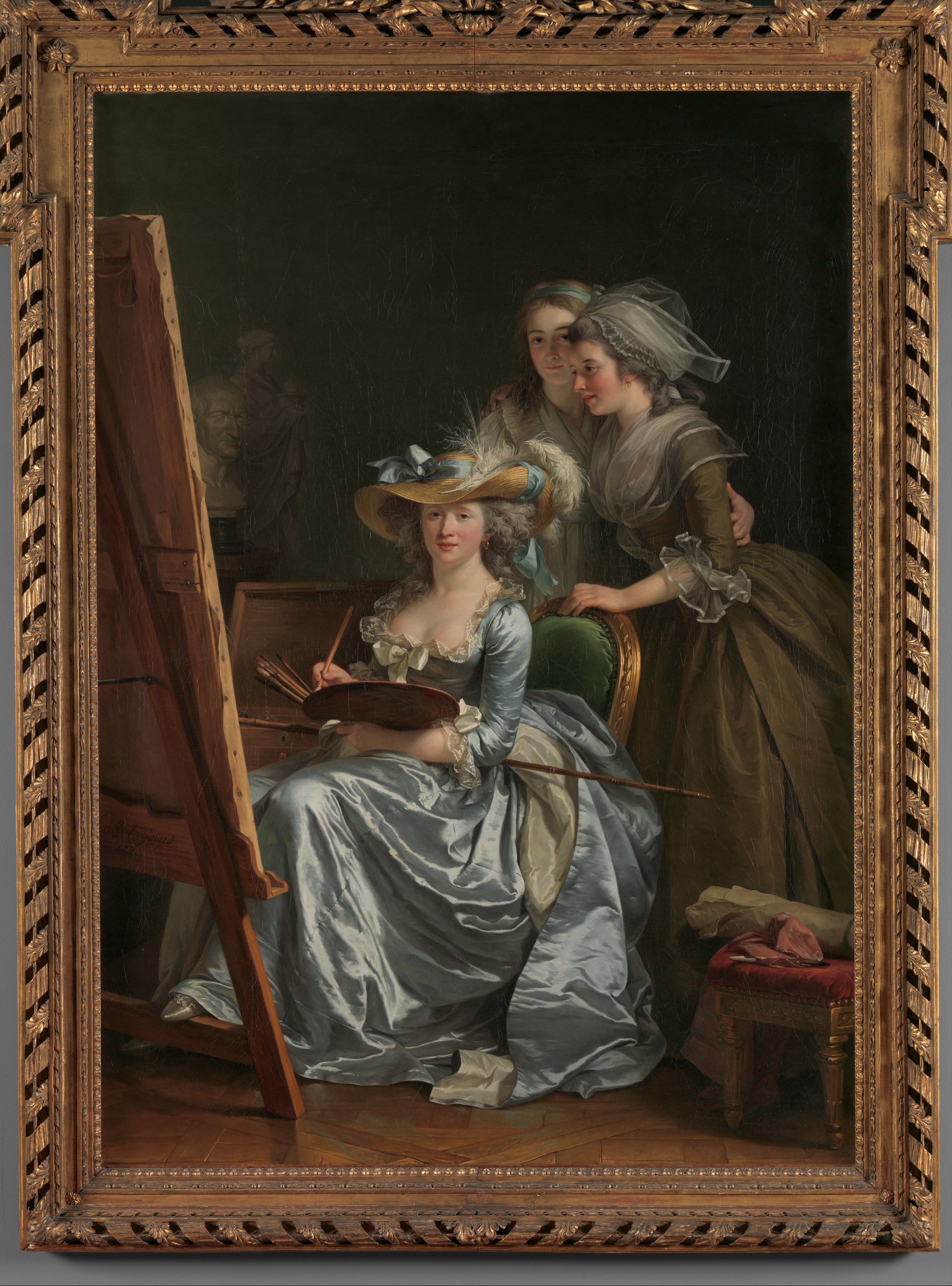
Self-Portrait with Two Pupils, Marie Gabrielle Capet (1761–1818) and Marie Marguerite Carreaux de Rosemond (died 1788), 1785
Oil on canvas; 83 x 59 1/2 in. (210.8 x 151.1 cm)
The Metropolitan Museum of Art, New York, Gift of Julia A. Berwind, 1953 (53.225.5)
http://www.metmuseum.org/Collections/search-the-collections/436840
Adélaïde Labille was born in 1749 and was the daughter of a Paris shopkeeper (Coincidentally, her father owned a fashion boutique 🙂 ). She first studied as a miniaturist before joining the Académie de Saint-Luc or the Paris Guild in 1774, and later studied history paintings and portraits. In 1783, she was admitted to the Académie Royale de Peinture et de Sculpture and was later awarded the title Peintre des Mesdames (painter to the king’s aunts), an apartment at the Louvre, and a government pension of 2,000 lives.
She continued to show at the Salon through the French Revolution, and unlike her contemporary, Elisabeth Vigee-Lebrun, she supported the French Revolution and remained in not only France, but kept to Paris for a long time. However, the new regime closed down the Académie Royale and banned women from joining the groups that succeeded it. She was also ordered to destroy some of her “royalist” works. She then waited out the remainder of the Terror in the countryside with her partner François-André Vincent and her student, Marie Gabrielle Capet.
Despite her exclusion from the French art world, Labille-Guiard continued to show, even though she received little notice after her exclusion from the Académie. Throughout her career Labille-Guiard used her experience and talent to train aspiring female artists and was no doubt a great influence with her talent and her ambition. She died in 1803.

